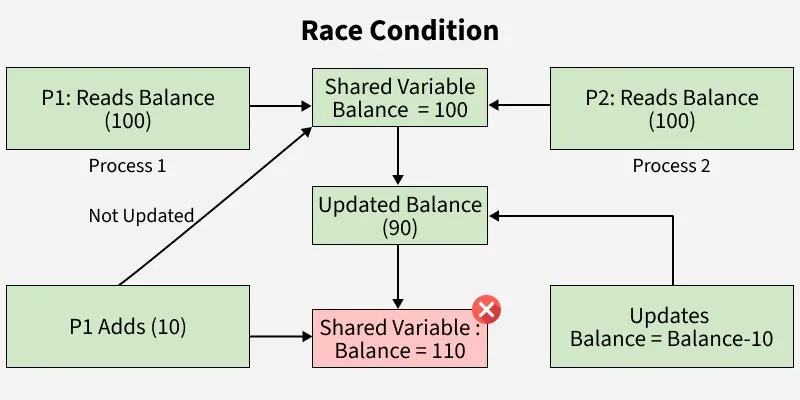
A race condition occurs when two or more processes or threads access and modify the same data at the same time, and the final result depends on the order in which they run. Without proper coordination, this can lead to incorrect or unpredictable results.
For example: If two people update the same bank account simultaneously without checking each other’s changes, the final balance may be wrong.
Shared Resource: A variable, file, memory location, or device accessed by multiple processes.
Concurrency: Multiple processes or threads executing simultaneously or overlapping in execution.
Non-Atomic Operations: Operations that can be interrupted, such as read-modify-write, which can cause inconsistent states when multiple processes access the same data concurrently.
Causes of Race Conditions
Simultaneous Access: When two or more processes try to read or write the same shared resource at the same time.
Non-Atomic Updates: Operations like increment or decrement are not indivisible.
Lack of Synchronization: No mechanisms like locks, semaphores, or monitors are used to control access.
Improper Scheduling: OS scheduler interrupts processes at critical moments.
Example: Two Processes Updating a Shared Variable
Let’s take a shared variable balance = 100 and two processes P1 and P2: