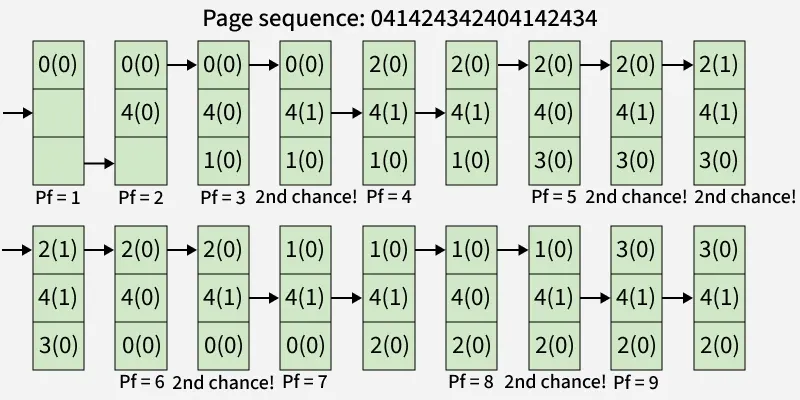
The Second Chance Page Replacement Algorithm is an improvement over FIFO that avoids removing frequently used pages by using a reference bit. When a page is accessed, its reference bit is set to 1, and during replacement, pages with bit 0 are replaced while pages with bit 1 are given a second chance, making memory management more efficient.
Uses a reference bit to track page usage
Replaces pages with reference bit 0
Gives a second chance to pages with bit 1 by resetting it
More efficient and scalable than FIFO, and sometimes better than LRU in modern systems
Algorithm
The algorithm works by associating a reference bit with each page in memory:
Reference Bit = 1, The page has been recently used.
Reference Bit = 0, The page has not been recently used.
Steps:
1. Pages are maintained in a queue (like FIFO). 2. When a page fault occurs, the algorithm checks the page at the front of the queue. 3. If the reference bit = 0, the page is replaced. 4. If the reference bit = 1:
The reference bit is reset to 0.
The page is moved to the back of the queue (given a second chance).
The search continues until a page with reference bit = 0 is found.
Thus, frequently accessed pages are less likely to be replaced.
Example
Let's say the reference string is 0 4 1 4 2 4 3 4 2 4 0 4 1 4 2 4 3 4 and we have 3 frames. Let's see how the algorithm proceeds by tracking the second chance bit and the pointer.
Initially, all frames are empty so after the first 3 passes they will be filled with {0, 4, 1} and the second chance array will be {0, 0, 0} as none has been referenced yet. Also, the pointer will cycle back to 0.
Pass-4: Frame={0, 4, 1}, second_chance = {0, 1, 0} [4 will get a second chance], pointer = 0 (No page needed to be updated so the candidate is still page in frame 0), pf = 3 (No increase in page fault number).
Pass-5: Frame={2, 4, 1}, second_chance= {0, 1, 0} [0 replaced; it's second chance bit was 0, so it didn't get a second chance], pointer=1 (updated), pf=4
Pass-7: Frame={2, 4, 3}, second_chance= {0, 0, 0} [4 survived but it's second chance bit became 0], pointer=0 (as element at index 2 was finally replaced), pf=5