The Abstract Factory Pattern is a creational design pattern that provides an interface for creating families of related or dependent objects without specifying their concrete classes. It acts as a "factory of factories," where a super-factory creates other factories that in turn produce specific objects.
Works around a super-factory that produces multiple factories.
Concrete factories created at runtime decide the actual product types.
Useful when the system needs to be independent of how products are created or represented.
Makes it easy to switch between different groups of related objects without code changes.
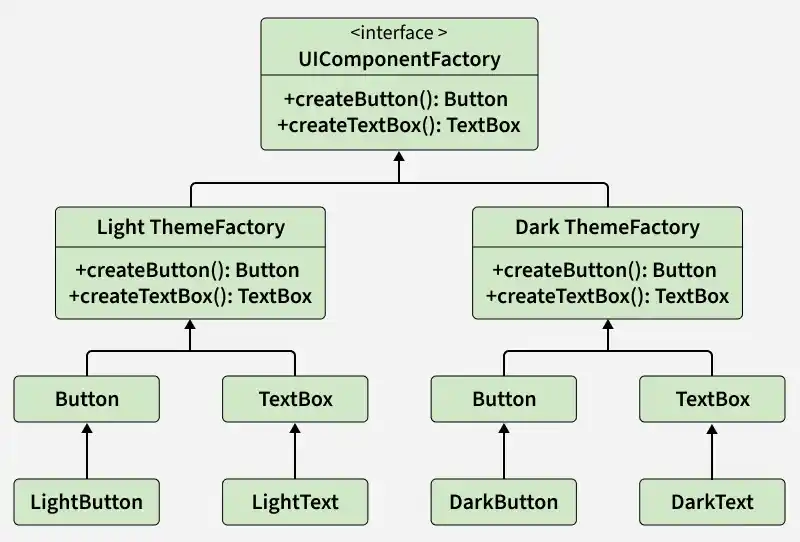
Example: A UI theme system supports Light and Dark themes, where each theme provides its own set of components like Button and TextBox. The application uses a factory to create these components, allowing it to switch between themes without changing the main code.
The diagram shows two factories, LightThemeFactory and DarkThemeFactory, that create UI components.
Each factory produces related components like Button and TextBox, ensuring consistency within a theme.
The client uses the abstract factory, allowing easy theme switching without changing core code.
Real Life Applications
The Abstract Factory Pattern is widely used to provide a consistent way to create related objects across different platforms or systems.
In applications that need to support multiple cloud platforms (e.g., AWS, Azure, Google Cloud), the Abstract Factory Pattern facilitates the creation of cloud-specific services. An abstract factory can define interfaces for services like storage, compute, and networking.
In applications that need to support multiple database systems (e.g., SQL, NoSQL), the Abstract Factory Pattern can be used to create database connections and queries. An abstract factory defines interfaces for creating database-related objects.
Components
To understand abstract factory pattern, we have to understand the components of it and relationships between them.
Abstract Factory: It provides a way such that concrete factories follow a common interface, providing consistent way to produce related set of objects.
Concrete Factories: Concrete Factories implement the rules specified by the abstract factory. It contain the logic for creating specific instances of objects within a family.
Abstract Products: It acts as an abstract or interface type that all concrete products within a family must follow to and provides a unified way for concrete products to be used interchangeably.
Concrete Products: They implement the methods declared in the abstract products, ensuring consistency within a family and belong to a specific category or family of related objects.
Client: Client utilizes the abstract factory to create families of objects without specifying their concrete types and interacts with objects through abstract interfaces provided by abstract products.
Features
The Abstract Factory Pattern provides a structured way to create related objects while keeping client code independent of their concrete implementations.
Creates families of related or dependent objects.
Provides an interface for creating multiple related products.
Promotes consistency among products of the same family.
Implementation Example
Understand Abstract Factory Design Pattern using an example:
Imagine you're managing a global car manufacturing company
You want to design a system to create cars with specific configurations for different regions, such as North America and Europe.
Each region may have unique requirements and regulations, and you want to ensure that cars produced for each region meet those standards.
Challenges while implementing this system
Different regions have different cars with different features, so designing this can be challenging.
The other main challenge is to ensure consistency in the production of cars and their specifications within each region.
There can be updation in having new cars in different regions so adapting the system to changes in regulations or introducing new features for a specific region becomes challenging.
So, Modifications would need to be made in multiple places, increasing the chances of introducing bugs and making the system more prone to errors.
Solution of above challenges by Abstract Factory Pattern
Below is how abstract factory pattern help to solve the above challenges. After using this pattern:
Different regions has their own factory to create cars for local needs.
This helps to keeps the design and features the same for vehicles in each region.
You can change one region without affecting others (e.g., updating North America doesn’t impact Europe).
To add a new region, just create a new factory, no need to change existing code.
The pattern keeps car creation separate from how they are used.
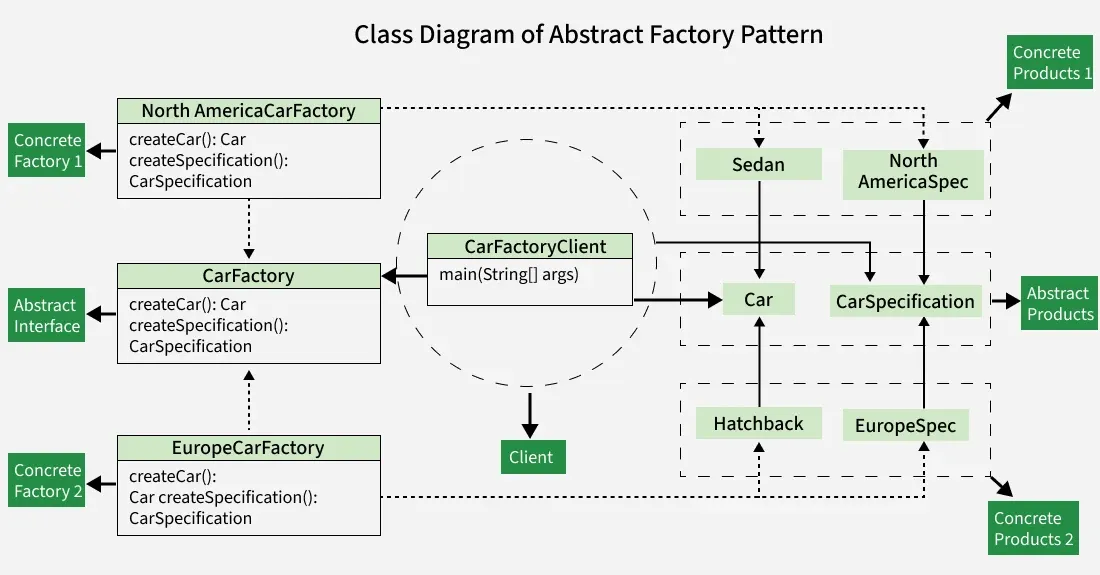
"CarFactory" is a Abstract Factory Interface that defines methods for creating cars and their specifications.
2. Concrete Factories (NorthAmericaCarFactory and EuropeCarFactory)
"NorthAmericaCarFactory" and "EuropeCarFactory" are concrete factories that implement the abstract factory interface "CarFactory" to create cars and specifications specific to North America, Europe.
3. Abstract Products (Car and CarSpecification interfaces)
Define interfaces for cars and specifications to ensure a common structure.
"Sedan", "Hatchback", "NorthAmericaSpecification", "EuropeSpecification" are concrete products that implement the interfaces to create specific instances of cars and specifications.
Complete code for the above example
Below is the complete code for the above example:
Output
Assembling Sedan car.
North America Car Specification: Safety features compliant with local regulations.
Assembling Hatchback car.
Europe Car Specification: Fuel efficiency and emissions compliant wit...
Advantages
The Abstract Factory Pattern improves modularity, flexibility, and scalability in large systems.
Promotes loose coupling between client and product classes.
Makes switching product families easy without modifying client code.
Supports Open/Closed Principle.
Disadvantages
Although powerful, Abstract Factory can introduce complexity and additional overhead.
Increases number of classes and interfaces.
Can make the system more complex than necessary for small projects.
Adding a new product type requires modifying the abstract factory interface.