VOOZH about

URL: https://www.geeksforgeeks.org/system-design/most-commonly-asked-system-design-interview-problems-questions/

⇱ Most Commonly Asked System Design Interview Questions - GeeksforGeeks


  • Courses
  • Tutorials
  • Interview Prep

Most Commonly Asked System Design Interview Questions

Last Updated : 16 Apr, 2026

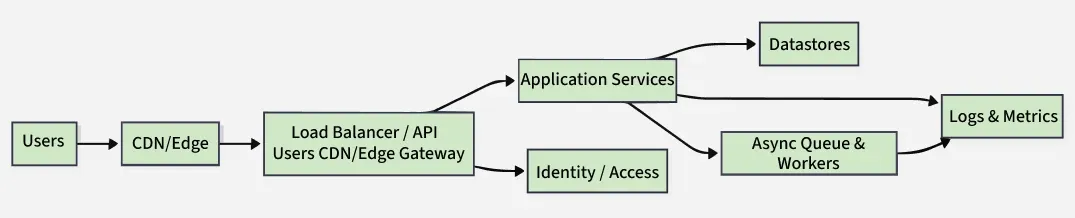
This System Design Interview Guide will provide the most commonly asked system design interview questions and equip you with the knowledge and techniques needed to design, build, and scale your robust applications, for professionals and newbies. The common request flow most applications follow from user to data and back

👁 flowchazt
  • Users - Edge & Gateway: Requests hit CDN/Edge first (for caching, TLS termination, basic DDoS/rate-limits), then the Load Balancer/API Gateway routes to the right service.
  • Gateway - Services: The application/service layer handles business logic (auth, features, rules) and coordinates downstream calls.
  • Services - Data: Reads/writes go to datastores (SQL/NoSQL/object storage/search). Hot reads may be cached; writes are validated and persisted.
  • Services - Async: Non-blocking work (emails, webhooks, reindexing, heavy compute) is pushed to a queue; workers consume and update state later.
  • Auth & Observability: Identity/Access checks happen at gateway/services; logs, metrics, and traces are emitted for monitoring, alerting, and audits.
  • Response - User: The service returns a response via the gateway/edge; caches may be updated to speed up future requests.

A list of the most commonly asked interview problems/case studies/questions in System Design interviews:

1. Content & Media Streaming

These systems handle large-scale media delivery and real-time streaming while ensuring low latency, high availability, and a smooth user experience.

2. Social Networks & Community Platforms

These platforms manage user-generated content, social feeds, notifications, and engagement features at scale.

3. Messaging & Real-Time Communication

These systems support low-latency chat, presence updates, delivery guarantees, and message synchronization across devices.

4. Search, Suggestions & Ranking

These systems process user queries and return ranked, relevant suggestions by indexing, caching, and ranking algorithms.

5. Maps, Location & Ride Services

These services use GPS, routing algorithms, geospatial indexing, and live updates to provide real-time location-based operations.

6. Commerce, Ticketing & Payments

These platforms handle inventory, transactions, concurrency, order states, and secure real-time payment workflows.

7. File Storage & Data Systems

These systems allow distributed file storage, replication, CDN caching, and consistent data availability across regions.

8. Distributed Infrastructure Components

Core backend building blocks used to support scalability, reliability, scheduling, and security in large systems.

9. Small Real-World System Designs

Common practical systems used to test core design thinking, object modeling, and workflow control.

Further Reads:

Comment

Explore