|
VOOZH | about |
|
VOOZH | about |
Designing Amazon’s database requires handling customers, products, orders, and recommendations in a scalable way. It integrates components like load balancers, caching, CDNs, and analytics to ensure performance.
Example: During a sale event, caching and CDNs help serve product pages quickly while load balancers distribute traffic across servers.
This section defines the overall functional and non-functional needs of the system.
This section describes the core capabilities related to data handling and processing in the system.
This section defines system qualities like performance, reliability, scalability, and security.
Accurately estimating capacity is a critical step in designing Amazon's database to ensure the system can handle current and future user demands. This process involves predicting the expected traffic, data volume, and resource requirements to create an architecture that is both scalable and performant.
More than 295 million visitors per month on Amazon
Amazon sells about 150,000 products per day in India
Total Product Sell in a month in India = 150,000 * 30 = 4,500,000
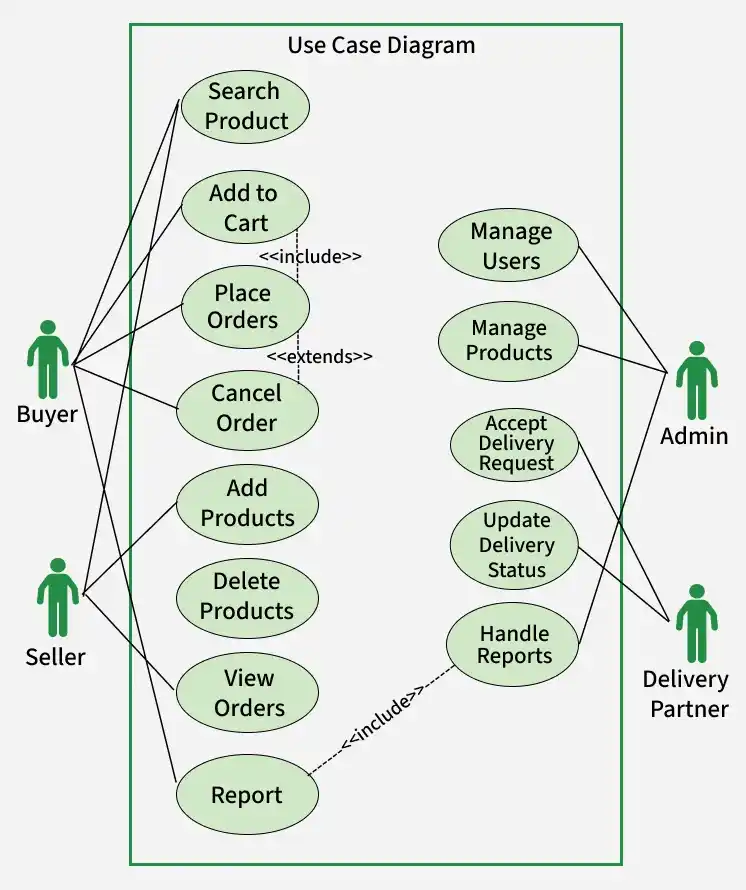
A Use Case Diagram for Amazon’s database would visualize the various interactions and functionalities as far as Amazon’s e-commerce platform is concerned. Use Case Diagrams usually focus on the interaction of end users.
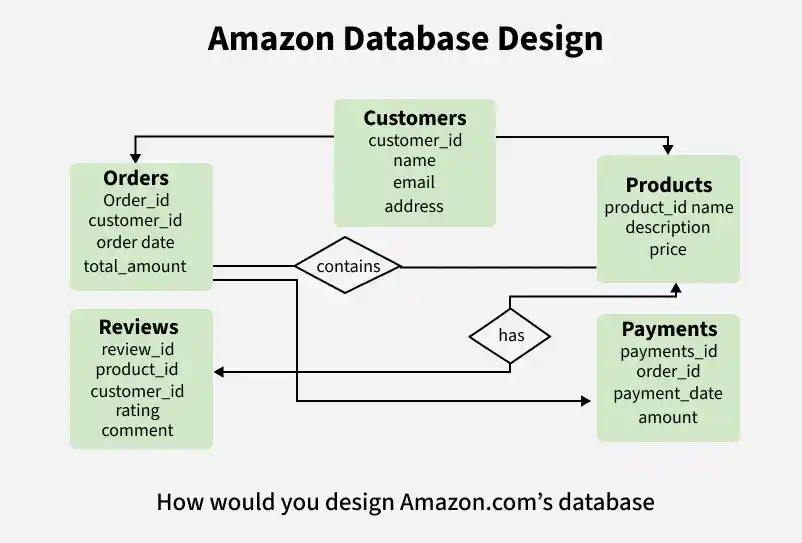
Design a relational database that includes tables for customers, orders, products, reviews, payments, etc. establish relationships between tables using primary and foreign keys. Here's a simplified example of tables:
Relational databases are preferred for designing Amazon's database because they offer strong data integrity, ACID compliance, complex query support, and consistent performance, ensuring the reliability and delicacy required for critical functions like fiscal deals and order processing, which are fundamental to Amazon's e- commerce platform.
1. Structured Data
Relational databases excel at handling structured data, which comprises a significant portion of Amazon's database, including product catalogs, customer information, and transaction records.
2. ACID Compliance
Relational databases provide strong ACID (Atomicity, Consistency, Isolation, Durability) guarantees, ensuring transactional integrity and data consistency, which is crucial for financial transactions and order processing on Amazon.
3. Data Integrity
Relational databases enforce referential integrity constraints, ensuring that data relationships are maintained correctly. This is essential for maintaining the accuracy of product catalogs, user profiles, and order histories
4. Complex Queries
Amazon's database must support complex queries, such as product searches, personalized recommendations, and sales analytics. Relational databases offer robust SQL query capabilities for these requirements.
5. Consistent Performance
Relational databases can provide consistent and predictable performance for a wide range of operations, which is essential for delivering a seamless shopping experience to millions of users.
6. Scalability Options
Relational databases like Amazon RDS offer options for horizontal and vertical scaling to accommodate growing data and user traffic. They can be combined with caching layers and load balancing for improved scalability.
7. Security
Relational databases offer robust security features, including access control, encryption, and authentication mechanisms, which are vital for protecting user data and sensitive information.
The key to maintaining high performance in the face of growing data and web traffic is to scale the database accordingly. With the growth of Amazon comes the need for scalable database management across multiple servers. On how to efficiently scale a database, here is a detailed guide.
This section explains how data is distributed across multiple data centers for reliability and performance.
This section describes how large datasets are divided for better scalability.
This section explains how read and write operations are separated for optimization.
This section describes scaling by upgrading a single server’s resources.
This section explains techniques to improve database query performance.
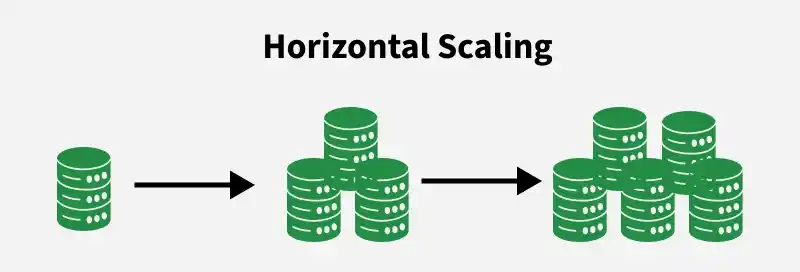
Amazon's need to handle massive amounts of user traffic and data, horizontal scaling is a robust solution. It allows Amazon to distribute the load, handle traffic spikes, and ensure high availability. As Amazon's customer base and data continue to grow, horizontal scaling enables the platform to seamlessly accommodate increasing demands while maintaining responsiveness and reliability.
Remember that while horizontal scaling is a powerful approach, the specific choice depends on your application's unique requirements and constraints. Careful planning, monitoring, and optimization are essential to ensuring the successful implementation of horizontal scaling.
Bottleneck conditions are the critical points in a system where performance suffers, causing overall efficiency to decline. For complex systems like Amazon.com, relating and addressing Bottleneck conditions is key to delivering a seamless user experience and upholding high functionality. Conditions can emerge due to factors like limitations, algorithm restraints, or altered demand and they call for strategic measures to ensure system reliability and receptiveness.
This section describes the key components involved in building an e-commerce system like Amazon.
Amazon can use an RDBMS like MySQL, PostgreSQL, or Amazon RDS to store structured data. Interacts with all other components to store, retrieve, and manage data across different tables (customers, orders, products, etc.).
Distribute incoming traffic across multiple application servers to prevent overloading and ensure even distribution. Balances the load among different application server instances to maintain responsiveness.
Handle user requests, process business logic, and interact with the database. Interact with the database to retrieve product information, process orders, and manage user accounts. Utilize load balancers to ensure uniform distribution of incoming requests.
Customers interact with the system through web interfaces, mobile apps, or other client applications. They send requests to application servers, which process the requests and retrieve data from the database tables as needed.
When a customer places an order, the application server collects the necessary order details, including the customer's ID and the product details, and inserts them into the Orders table. This represents a relationship between Customers and Orders, as one customer can have multiple orders.
To display products, the application server queries the Products table to fetch product information such as names, descriptions, and prices. This retrieval process establishes a relationship between Customers and Products, as customers browse and potentially purchase products.
Customers can submit product reviews and ratings. When this happens, the application server records these reviews in the Reviews table. This relates Customers, Products, and Reviews, as customers provide reviews for specific products.
After a customer confirms an order, the payment gateway interacts with the Payments table to record payment details, including the order ID and payment amount. This establishes a relationship between Orders and Payments, as each payment is associated with a specific order.