The Builder Design Pattern is a creational design pattern that provides a step-by-step approach to constructing complex objects. It separates the construction process from the object’s representation, enabling the same method to create different variations of an object.
Encapsulates object construction logic in a separate Builder class, enabling flexible and controlled creation.
Supports creating different variations of a product using the same construction process.
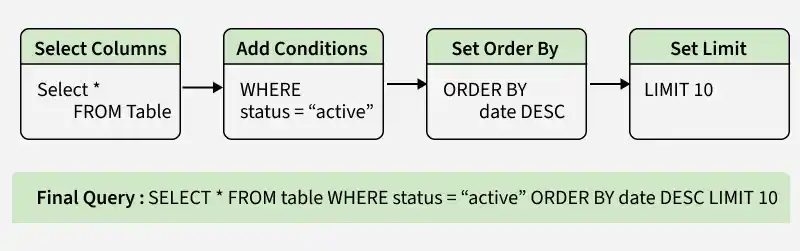
Example: Consider building an SQL query in a database application. A query can have different parts like select fields, conditions, sorting, and limits.
Instead of using a complex constructor with many parameters, the Builder pattern allows you to construct it step by step:
Select columns
Add conditions (WHERE clause)
Set order (optional)
Set limit (optional)
Using the same building process, you can create different queries like simple queries, filtered queries, or sorted queries without changing the main code.
Real-Life Applications
The Builder Pattern is widely used in real-life software applications to construct complex objects step by step.
SQL Query Builders: Used in ORMs (like Hibernate, SQLAlchemy, Laravel’s Eloquent) to dynamically construct SQL queries with methods like select(), where(), orderBy(), etc.
UI Component Builders: Useful in building dialog boxes, forms or widgets step by step by adding buttons, text fields or styles.
Document Builders: Used in tools like PDF/HTML generators, where content and styles are added step by step.
Components
The Builder Pattern consists of several key components that work together to construct complex objects step by step while keeping construction separate from representation.
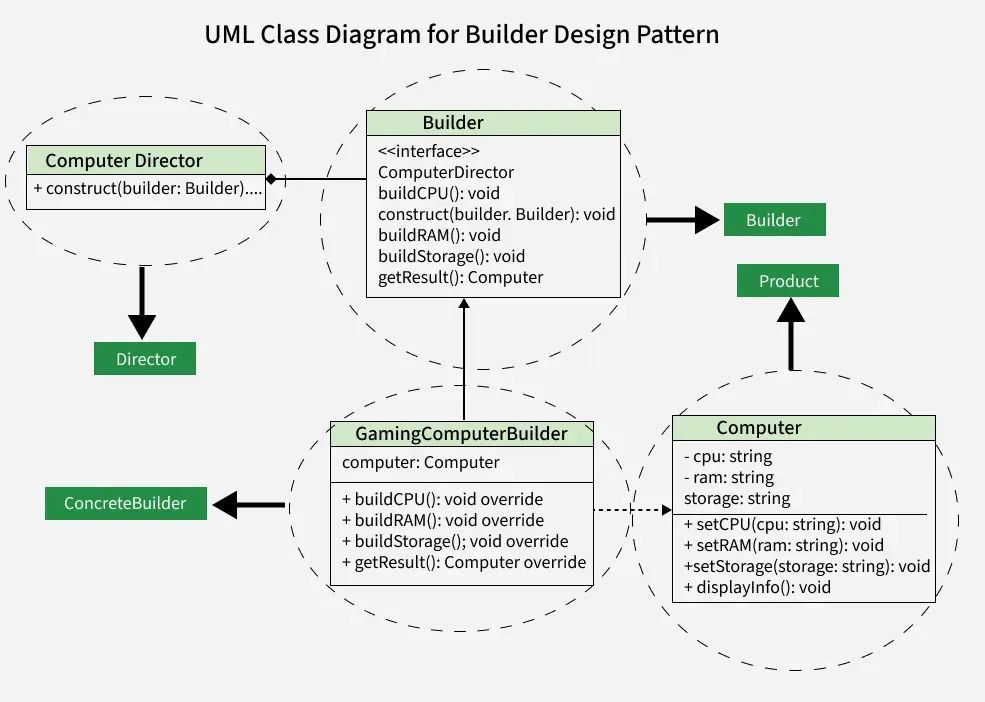
Product: The complex object being constructed, typically a class with attributes representing different parts built by the Builder.
Builder: An interface or abstract class that defines construction steps, including methods to build individual parts of the product.
Concrete Builder: Implements the Builder interface, providing specific logic to construct each part and create a particular variation of the product.
Director: Manages the construction process by working with a Builder, without knowing the internal details of how parts are created.
Client: Initiates the construction by creating a Builder and passing it to the Director to build the final product.
Uses
The Builder Pattern is helpful when creating complex objects with multiple optional steps or configurations.
Useful for complex objects with many optional steps.
Separates construction logic from object representation.
Avoids telescoping constructors with too many parameters.
Supports creating different representations using the same construction process.
Implementation
The steps to implement the Builder Design Pattern:
Create the Product Class: Define the object (product) that will be built. This class contains all the fields that make up the object.
Create the Builder Class: This class will have methods to set the different parts of the product. Each method returns the builder itself to allow method chaining.
Add a Build Method: In the builder class, add a method called build() (or similar) that assembles the product and returns the final object.
Use the Director (Optional): If needed, you can create a director class to control the building process and decide the order in which parts are constructed.
Client Uses the Builder: The client will use the builder to set the desired parts step by step and call the build() method to get the final product.
Understanding the Builder Design Pattern in a simple and beginner-friendly way.
Implementation Example
Problem Statement
You are tasked with implementing a system for building custom computers. Each computer can have different configurations based on user preferences. The goal is to provide flexibility in creating computers with varying CPUs, RAM, and storage options.
Implement the Builder design pattern to achieve this, allowing the construction of computers through a step-by-step process. Use the provided components - Product (Computer), Builder interface, ConcreteBuilder (GamingComputerBuilder), Director, and Client