|
VOOZH | about |
|
VOOZH | about |
Builder Pattern is defined as a creational design pattern that is used to construct a complex object step by step. It separates the construction of an object from its representation, allowing us to create different variations of an object with the same construction code. This pattern is particularly useful when dealing with a complex object with many optional parameters or configurations.
Important Topics for Builder Design Pattern in Java
Assume we have a 'Person' class with several optional attributes like 'firstName', 'lastName', 'age', 'address', and 'phone'. We can use the Builder pattern to create instances of 'Person' more intuitively and cleanly.
So here in this example the 'Person' class has a nested 'PersonBuilder' class, which allows us to set optional attributes using chained method calls. The 'build' method creates a 'Person' object with the specified attributes, and it enforces that required attributes like firstName and lastName are set.
Let's take a look at how the Builder pattern works in Java:
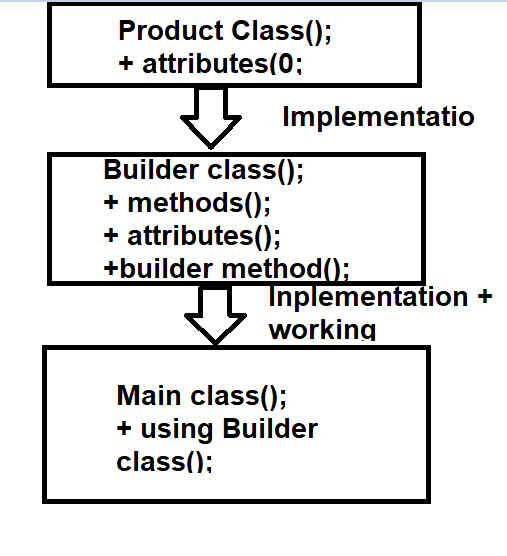
1. Create the Product Class:
First, we have to define the class for the product we want to build. This class should have attributes that need to be set during the construction process. These attributes can be optional or mandatory.
2. Create the Builder Class
Next, we have to create a separate builder class for the product. The builder class has methods to set the various attributes of the product. It also contains a build method to create the final product instance.
3. Using the Builder
To create a Product instance, we want to use the ProductBuilder class to set the desired attributes and then call the build method to obtain the final product.
Person [firstName=John, lastName=Doe, age=30, address=123 Main St, phone=555-1234]
So by using the Builder pattern, we can create a Product object step by step, setting only the attributes that are necessary, and leaving the others with default values or null if applicable. This approach makes the code more readable and allows for flexible construction of objects with various configurations. It also prevents the need for large constructors with multiple parameters and improves code maintainability.
A fluent builder is a design pattern in Java that allows us to create complex objects with a more readable and expressive syntax.
Uses of Fluent Builder:
It is often used to chain method calls together to configure and build an object. The key idea behind the fluent builder pattern is to return the builder itself from each method call, allowing us to chain method calls together in a fluent and intuitive way.
Example : we have a "pizza" class and there are various attributes of it. so there we will use the fluent builder pattern.
Pizza{size='Large', cheese=true, pepperoni=true, mushrooms=true}Explanation of example :
In this example, we have a Pizza class with a nested PizzaBuilder class. The Pizza class has private fields for pizza properties like size, cheese, pepperoni, and mushrooms. The PizzaBuilder class provides methods to set these properties and then returns the built Pizza object. This allows us to create a Pizza object using a fluent and readable syntax.
Note: In the main method, we demonstrate how to use the Fluent Builder Pattern to create a Pizza object with various properties.
The Faceted Builder is a design pattern that combines the Builder pattern with a fluent API to create a more expressive and readable way of constructing complex objects with multiple configuration options.
Uses of Faceted Builder:
Faceted Builder pattern is particularly useful when we have an object with a large number of configuration options, and we want to provide a clear and organized way to set those options. Instead of having a single builder class with many methods for configuring different attributes, we create multiple builder classes, each responsible for a specific set of attributes.
Further Read: Java Design Pattern Tutorial