|
VOOZH | about |
|
VOOZH | about |
The Chain of Responsibility design pattern in JavaScript allows a request to be passed through a chain of handlers until one processes it. This pattern helps manage complex workflows by decoupling the sender of a request from its receivers, making the system more flexible and easier to extend. In this article, we'll explore how to implement the Chain of Responsibility in JavaScript, with practical examples to demonstrate its use in creating more maintainable and scalable code.
Important Topics for Chain of Responsibility Method Design Pattern in Javascript
The Chain of Responsibility method design pattern is a behavioral pattern that allows multiple objects to handle a request, passing it along a chain until one of the objects handles it. Each object in the chain either processes the request or passes it to the next handler in the chain. This pattern is useful for decoupling the sender of a request from its receivers, providing a way to handle requests by different handlers without hard-wiring the request-processing code to specific classes. It promotes flexibility in assigning responsibilities to objects dynamically.
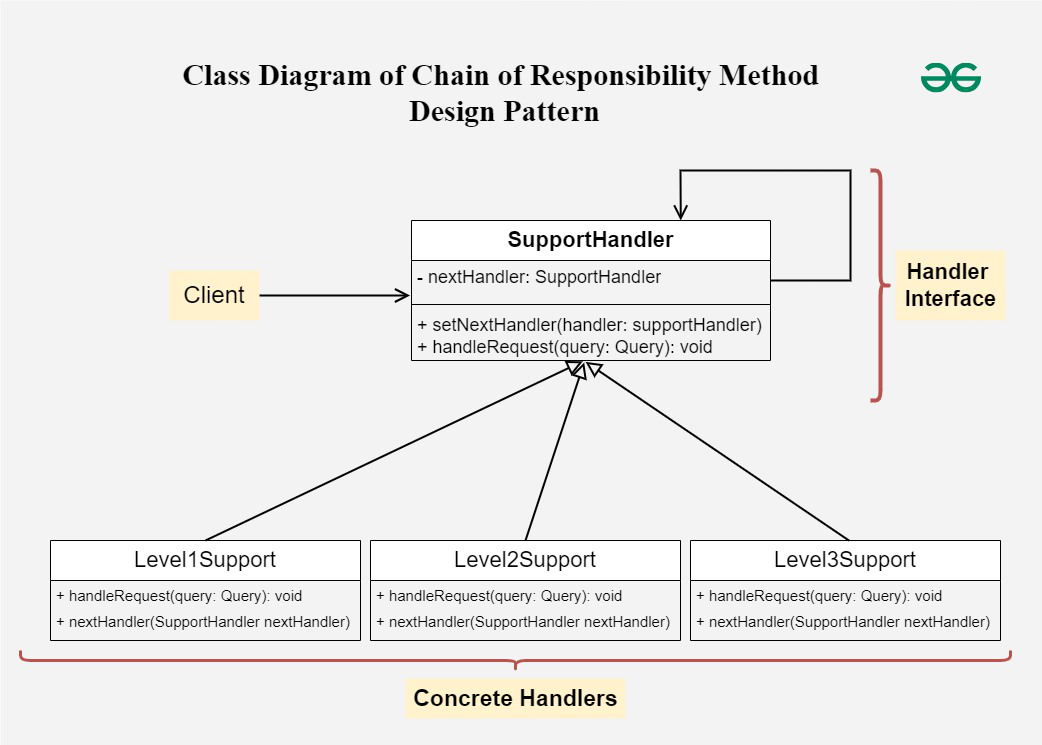
The Chain of Responsibility design pattern consists of several key components:
Problem Statement:
Imagine a tech support system where customer queries are handled by different levels of support agents. A basic query can be handled by a Level 1 support agent, but more complex issues need to be escalated to Level 2 or even Level 3 support. Without a clear process, queries might be mishandled, leading to delays or unresolved issues. The challenge is to efficiently route each customer query to the appropriate support level.
The Chain of Responsibility design pattern can be applied to solve this problem. Each support level will be a handler in the chain, processing the query or passing it on to the next level if it cannot handle it.
Below is the implementation of the above approach:
Below is the complete code provided:
Level 1 Support: Handling easy query.
Level 2 Support: Handling medium query.
Level 3 Support: Handling hard query.
Query cannot be handled at any level.
Below is the explanation of the above code:
This design pattern is effective in handling queries of varying complexity by delegating responsibility through a chain, ensuring each query reaches the appropriate handler.
By implementing the Chain of Responsibility pattern, you can create flexible and decoupled systems where requests are handled by different handlers based on their type or context. This pattern is especially useful in scenarios where you have a series of processing steps that can be organized into a pipeline of handlers.