|
VOOZH | about |
|
VOOZH | about |
In the modern restaurant industry, delivering exceptional dining experiences requires more than just good cuisine. Restaurant Management Systems have emerged as the secret ingredient for efficient operations and customer satisfaction.
They can seamlessly get menus, explore ratings, and conveniently place orders online, with the added flexibility of choosing between dine-in or delivery to any location within the specified range.
By following SDLC phases mentioned below, we make sure that every part of our restaurant management system—from planning what it needed to do to keeping it working well—was carefully thought out and done right.
To estimate the scale of the system and to get the idea about the storage requirements, we have to make some assumptions about the stored data and traffic.Following are some assumptions for the given design.
Let's assume on average:
Total storage needed:
Assuming we maintain orders for last 3 years:
72 GB per day x 365 days x 3 years = 77TB (approx.)
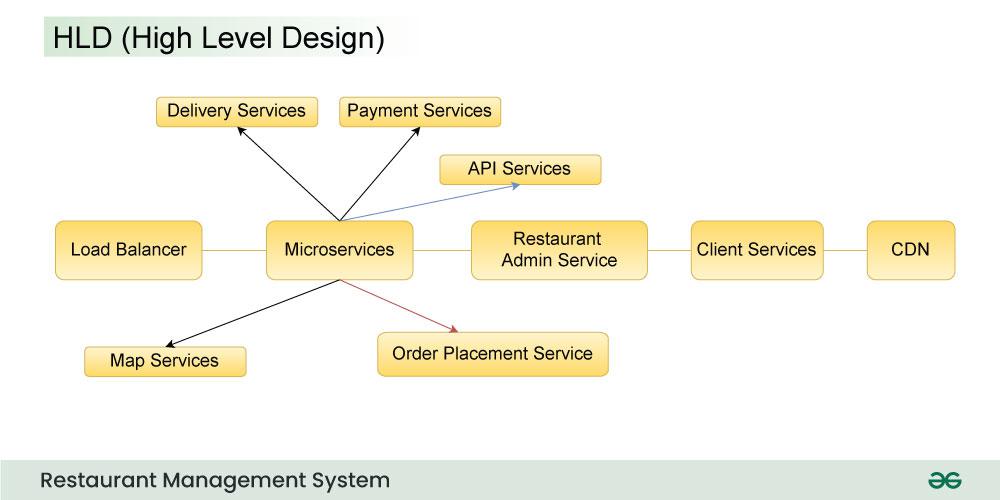
Within this framework, three fundamental services need management:
👁 High-level-design-of-restaurant-management-system
{
-customer_Id
-customer_name,
-address
,-phone
_no,
}
{
-restaurant_id,
-restaurant_name,
-payment_details_id,
-location,
-menu_Id
}
{
 -restaurant_id,
-restaurant_name,
-payment_details_id,
-location,
-menu_Id
}
{
-order_id,
-customer_id,
-restaurant_id,
-agent_id,
-time_stamp,
-is_delivery,
-delivery_location,
-items_id,
-delivery_price,
-items_price,
-transcation_id:
-order_status
}
{
-restaurnat_id,
-rating
}
{
-agent_id,
-rating,
}
In selecting the appropriate database architecture, a relational database management system (RDBMS) such as SQL is deemed essential for tables housing critical information, like customer, restaurant, and agent details. This choice is made because of the necessity for high consistency, ensuring swift and accurate reflection of any alterations, such as changes in payment details or menu prices.
SQL's adherence to ACID (Atomicity, Consistency, Isolation, Durability) properties makes it particularly well-suited for maintaining data integrity and ensuring reliability in such scenarios.
Conversely, for data that exhibits more relaxed consistency requirements, such as restaurant and agent ratings, a NoSQL database is a judicious choice.
NoSQL, characterized by BASE (Basically Available, Soft state, Eventually consistent) properties, aligns with the nature of these datasets. This allows for greater flexibility, accommodating the dynamic and non-critical nature of rating information, where immediate and stringent consistency is not a primary concern.
This hybrid approach harnesses the strengths of both SQL and NoSQL databases, tailoring the database architecture to the specific needs and characteristics of the data being managed.
Employing RESTful APIs for the Restaurant Management System proves advantageous due to their simplicity, uniform interface, and statelessness. REST's straightforward design, using standard HTTP methods, facilitates ease of use and development, promoting interoperability across various platforms and programming languages.
1. Endpoint:
POST /api/users/register
2. Request:
{
 "username": "salik",
 "password": "secure_password",
 "email": ""xyz@gmail.com",
 "address": "123 Main St, City",
 "phone": "+1234567890"
}
3. Response:
{
"message": "Login successful",
"userId": "12345",
 "token": "authentication_token"
}
GET /api/restaurants/search?location=City&cuisine=Italian&rating=42. Request:
{
"username": "salik",
 "password": "secure_password"
}
{
 "message": "Login successful",
"userId": "12345",
 "token": "authentication_token"
}
Endpoint:
GET /api/restaurants/search?location=City&cuisine=Italian&rating=4
Response:
[
{
 "restaurantId": "abc123",
 "name": "Italian Delight",
 "location": "456 Main St, City",
 "cuisine": "Italian",
 "rating": 4.5 },
 { "restaurantId": "def456",
 "name": "Pizza Palace",
 "location": "789 Main St, City",
 "cuisine": "Italian",
 "rating": 4.2 }
]
Endpoint:
POST /api/orders/place
Request:
{
 "userId": "12345",
]"restaurantId": "abc123",
"items": [
{ "itemId": "item1", "quantity": 2 },
 { "itemId": "item2", "quantity": 1 } ],
 "deliveryPreference": "delivery", "paymentMethod": "credit_card"
}
Response:
{
 "orderId": "order123",
 "message": "Order placed successfully",
"totalAmount": 25.99
}
Endpoint:
GET /api/restaurants/orders?restaurantId=abc123
Response:
[
 {
"orderId": "order123",
 "userId": "user456",
"items": [
 {
 "itemId": "item1", "quantity": 2 },
 { "itemId": "item2", "quantity": 1 }
 ],
 "totalAmount": 25.99,
 "status": "pending" },
 // Additional orders...
]
Endpoint:
GET /api/delivery/track?orderId=order123
Response:
{
 "orderId": "order123",
 "status": "in_transit",
"location": { "latitude": 37.7749,
 "longitude": -122.4194
}
}
Let’s drill deeper into each microservices:
Customers initiate requests to the load balancer for various services, such as user registration, restaurant searches, and order placement. Additionally, delivery agents and restaurant admins utilize the load balancer to send requests for registration or authentication.
This vital component monitors server health, rerouting traffic in the event of failures to ensure minimal downtime. Not only does it enhance security by mitigating DDoS attacks, but it also plays a crucial role in scaling applications. Available in hardware, software, and cloud-based forms, load balancers act as traffic managers, directing the flow in modern IT infrastructures.
Serving two key functions, API services handle user authentication, ensuring only authorized users access the system. Once authenticated, these services act as intermediaries for communication with various microservices such as order placement, payment, and search. For example, implementing Kafka for message queuing ensures reliable communication between microservices.
Offering robust user authentication and user registration functionalities, these services are pivotal for security and onboarding new users. The registration process assigns a unique user ID and securely stores essential user information, including names, addresses, and payment details, within the system's database.
Offering a variety of payment options, Payment Services ensure flexibility and convenience for settling bills. They validate payments, confirming transaction accuracy and the availability of funds. This process prevents errors, fraud, or unsuccessful payments, ensuring a smooth and trustworthy payment experience. For instance, integrating with a payment gateway like Stripe or PayPal enhances transaction security.
Specializing in storing static assets like dish images and menus, CDNs reduce the load on the main server, enhancing content accessibility. Positioned strategically, CDNs ensure swift data retrieval, minimizing latency, and speeding up content delivery. For example, using Akamai or Amazon CloudFront for CDN services optimizes the loading time of menu pages, improving the overall user experience.
Enabling users to search for restaurants based on criteria like ratings and cuisines, these services leverage ElasticSearch for rapid data retrieval in a distributed database. For example, users can easily find top-rated Italian restaurants in their vicinity by utilizing ElasticSearch's powerful search capabilities.
Managing the entire order life cycle, these services provide information to restaurants and update customers on order status. The Order Queue facilitates communication with Restaurant Services, while requests for delivery include interactions with Delivery Services. Implementing Apache Kafka as a message broker ensures efficient order processing and communication between services.
Facilitating order pickup, these services establish seamless communication between agents and customers, enabling real-time order tracking. They are instrumental in ensuring successful deliveries and collecting customer feedback. For instance, Delivery Services efficiently coordinate the delivery of food from restaurants to customers using real-time tracking tools like Google Maps.
Searching for nearby agents and tracking orders, Map Services provide real-time location updates to customers. Using technologies like Google Maps, it connects users to the service for order tracking through long polling, minimizing traffic while providing timely updates.
Services wishing to send notifications to users push messages to the Notification Queue, with Notification Services consuming these requests, subsequently sending notifications to users. For example, Kafka can be employed to implement a robust and scalable notification queue.
Storing ongoing requests for quick retrieval, the cache provides speedy access to customers and other microservices. Redis cache, for example, efficiently stores and retrieves frequently accessed data, improving overall system performance.
Storing user data, restaurant information, and menus, the database is shared and replicated across various servers. Horizontal sharding, exemplified by MySQL for high consistency in user and transaction data, is complemented by NoSQL for non-critical metadata such as restaurant ratings and delivery agent details. For instance, MongoDB can be used for its flexibility in handling unstructured data like ratings and agent information.
Below is the step by step process:
Below is the step by step process for delivery:
To further enhance the efficiency of the Restaurant Management System, several optimizations can be considered: