|
VOOZH | about |
|
VOOZH | about |
Dynamic load balancing makes real-time decisions to distribute incoming traffic or workloads across multiple servers based on current system conditions. It continuously adapts to changes such as server load, network traffic, and resource availability.
Note: The choice between dynamic and static load balancing depends on system characteristics and workload behavior. Dynamic load balancing suits high-traffic, changing environments, while static load balancing works well for predictable scenarios.
Types of Dynamic Load Balancing Algorithms are:
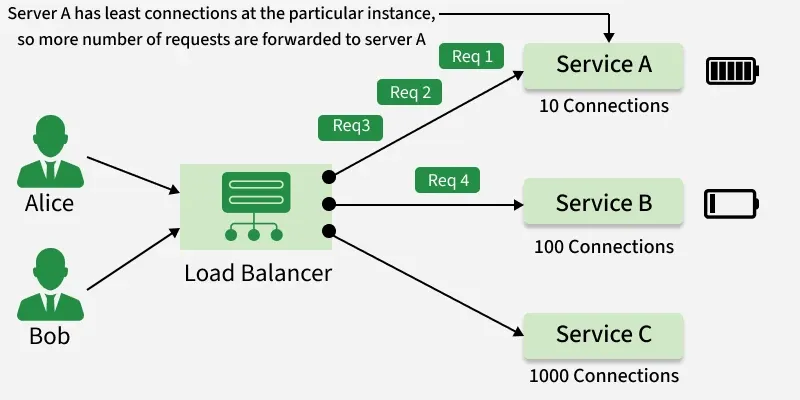
The Least Connections algorithm is a dynamic load balancing technique that routes new requests to the server with the fewest active connections. It focuses on balancing workload by considering the current load on each server.
For Example: Lets say you're at a playground, and some kids are playing on different swings. You want to join the swing with the fewest kids so that it's not too crowded. Least Connection is like choosing the swing with the least number of kids already on it.
A load balancing algorithm distributes incoming requests across multiple servers by routing new requests to the server with the fewest active connections. This helps balance workload and prevents overload on individual servers.
Request 1: Routed to Server1
Request 2: Routed to Server2
Request 3: Routed to Server3
Request 4: Routed to Server1
Request 5: Routed to Server2
Request 6: Routed to Server3
Request 7: Routed to Serve...
The Least Connection Algorithm is best suited for environments where request durations and connection lifetimes vary significantly.
The Least Connection Algorithm dynamically distributes traffic based on current server connections, offering efficient load balancing with certain limitations.
Benefits: The Least Connection Algorithm helps distribute traffic efficiently by considering current server load.
Drawbacks: Despite its efficiency, this algorithm has some limitations.
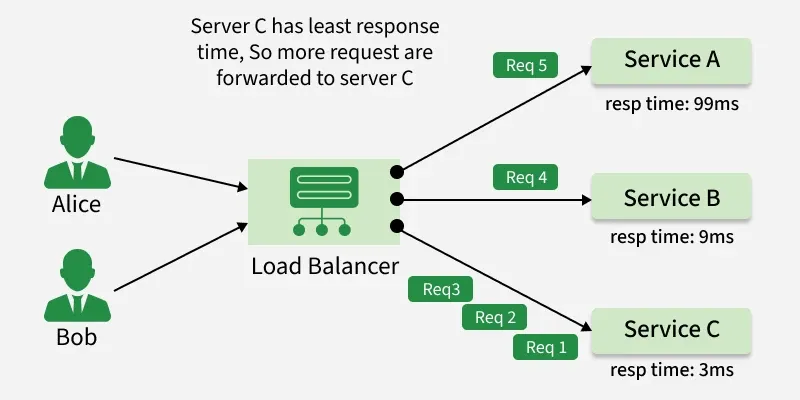
The Least Response method is a dynamic load balancing approach that aims to minimize response times by directing new requests to the server with the quickest response time.
For Example: Picture yourself at a snack bar where you can order food from different servers. You notice that some servers are faster than others. You choose the server that seems to serve food the quickest each time you go. Least Response Time is like picking the server with the shortest line.
A load balancing algorithm distributes incoming requests across multiple servers by directing new requests to the server with the least accumulated response time. This approach balances workload and optimizes overall system performance.
Request 1: Routed to Server1
Request 2: Routed to Server2
Request 3: Routed to Server3
Request 4: Routed to Server1
Request 5: Routed to Server2
Request 6: Routed to Server3
Request 7: Routed to Serve...
The Least Response Time Algorithm is well suited for performance-critical systems where fast responses are essential.
The Least Response Time Algorithm improves request routing by considering server responsiveness, but it also introduces added complexity.
Benefits: The Least Response Time Algorithm enhances performance by making routing decisions based on server responsiveness.
Drawbacks: Despite its advantages, the algorithm introduces additional complexity.
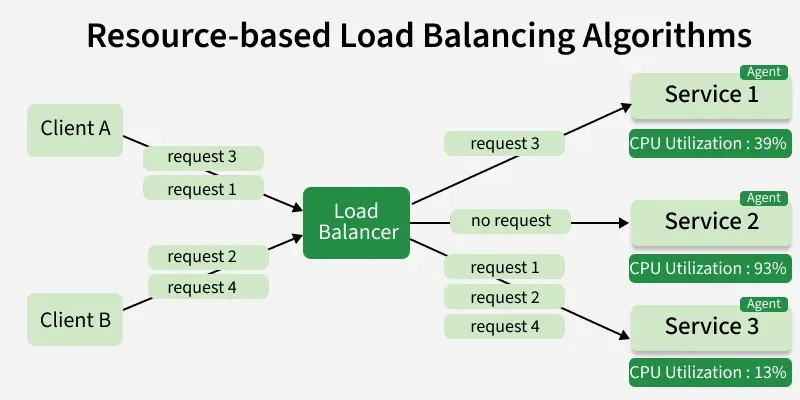
The Resource-Based Load Balancing algorithm distributes incoming requests based on the current resource availability of each server, such as CPU usage, memory, or network bandwidth. Rather than just routing traffic equally or based on past performance, this algorithm evaluates the current "resource health" of each server to decide where new requests should go.
For Example: Imagine it like assigning tasks in an office based on each employee’s workload at the moment—some are busy, while others are free. Resource-Based Load Balancing directs requests to the server with the most available resources.
Resource-based load balancing routes incoming requests by evaluating each server’s real-time resource usage to select the most suitable server.
Routing request to server: Server3 with current CPU load: 20.0%
Resource-based load balancing is ideal for environments where server capacity varies and efficient resource utilization is critical.
This algorithm makes load distribution decisions based on real-time server resource usage, offering efficiency with added complexity.
Benefits: Resource-based load balancing improves efficiency by making decisions based on actual server resource usage.
Drawbacks: Despite its effectiveness, this approach introduces additional complexity.