VOOZH about

URL: https://www.geeksforgeeks.org/system-design/failover-mechanisms-in-system-design/

⇱ Failover Mechanisms in System Design - GeeksforGeeks


  • Courses
  • Tutorials
  • Interview Prep

Failover Mechanisms in System Design

Last Updated : 18 Jun, 2026

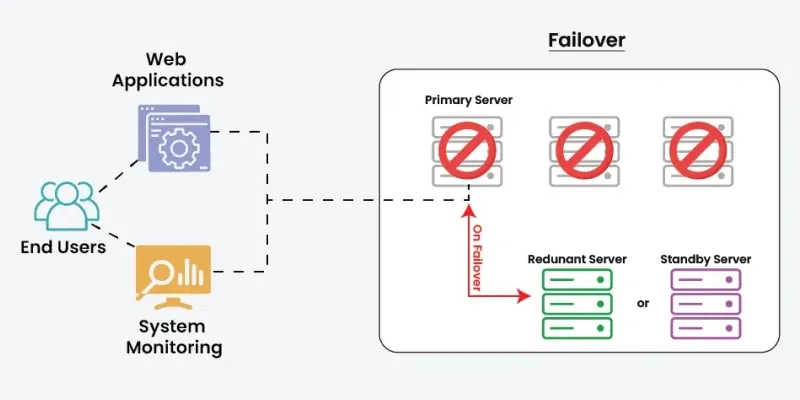
Failover Mechanism is a technique used in system design to maintain service availability when a component fails. It automatically transfers operations to a backup or standby component, ensuring minimal disruption and continuous system operation.

  • Automatically switches to redundant servers, databases, or network devices when the primary component becomes unavailable.
  • Reduces downtime and helps maintain stable service during hardware, software, or network failures.

Example: A web application may automatically redirect traffic to a backup server if the primary server crashes. Similarly, a database cluster can switch to a standby database when the main database becomes unavailable.

👁 load_balancer
Failover mechanism

Triggers Failover

This section highlights the common conditions that can trigger a failover in a system.

👁 failover

The following events can trigger a failover mechanism to maintain system availability and reliability.

  • Hardware Failure: Failure of servers, storage devices, or network equipment can trigger failover to backup hardware.
  • Software Failure: Application crashes, bugs, or service failures may cause traffic to switch to redundant software instances.
  • Network Outages: Connectivity issues or network failures can activate alternate network paths or backup communication channels.
  • Performance Degradation: High latency, low throughput, or resource exhaustion may trigger failover to maintain service quality.
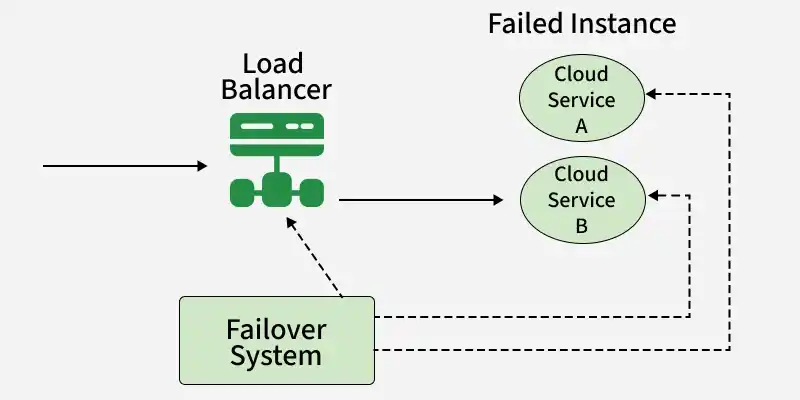
  • Load Balancer Health Checks: If a server fails health checks, the load balancer redirects traffic to healthy instances.
  • Manual Intervention: Administrators may manually initiate failover during maintenance, upgrades, or emergency situations.
  • Configuration Changes: Changes to system settings, routing rules, or failover policies can activate failover mechanisms.

Types

Various types of failover exist, depending on the degree of redundancy offered and the manner in which it is implemented. Here are a few typical failover types:

1. Failover to Cold Standby

A standby system or component is available but not actively operating in this kind of failover. Compared to other forms of failover, standby systems usually need more downtime because they must be initiated and brought online in the event of a failure.

2. Cozy Standby Failure Mode

In the event of a failure, a warm standby system is prepared to take over, operating partially. Even though the standby system might not be handling live traffic, it is typically partially configured and has a short downtime when brought online.

3. Warm Standby Failure-Over

Keeping a fully functional, synchronized backup system up to date so it can take over right away in the event that the primary system fails is known as hot standby failover. The quickest recovery time with the least amount of service disruption is offered by this kind of failover.

4. Active-Passive Switching

Just one system or component is active at a time in an active-passive failover configuration, with the others operating in standby mode. The passive system kicks in when the active system malfunctions. High availability clustering and database mirroring frequently use this configuration.

5. Dynamic-Active Switchover

Both the primary and standby systems are concurrently processing traffic and fulfilling requests in an active-active failover arrangement. The burden is automatically reassigned to the surviving operational systems in the event that one system fails. This configuration is frequently used to increase load balancing and scalability.

Importance of Failover Mechanisms

Failover mechanisms are essential for maintaining system reliability, availability, and business continuity when failures occur.

  • High Availability: Ensures services remain accessible even when a system component fails, minimizing service interruptions.
  • Redundancy: Provides backup resources that can take over during failures, reducing the risk of a single point of failure.
  • Fault Tolerance: Automatically detects failures and redirects workloads to healthy components, improving system resilience.
  • Disaster Recovery: Helps restore services quickly after hardware failures, network outages, or other unexpected incidents.
  • Business Continuity: Minimizes downtime and ensures critical operations continue running without major disruptions.
  • Customer Satisfaction: Maintains reliable and uninterrupted services, improving user experience and trust.

Failover Architecture

Failover architecture is a system design approach that ensures continuous service availability by automatically switching to backup resources when failures occur. It combines redundancy, monitoring, and automated recovery mechanisms to minimize downtime and maintain reliability.

  • Uses backup servers, storage, and network components to take over when primary resources fail.
  • Continuously detects failures and automatically redirects traffic or workloads to healthy components.
  • Keeps critical data synchronized across multiple systems to prevent data loss.

Example: A cloud application may run on multiple servers in different data centers. If one server or data center fails, traffic is automatically routed to another available location, ensuring uninterrupted service.

Examples Failover Mechanisms

A wide range of sectors and technologies have real-world instances of failover systems. Here are a few instances:

1. Google Cloud Platform (GCP) Regional Failover

Google Cloud Platform enables users to distribute resources over various geographical areas by providing regional failover for its services. GCP automatically reroutes traffic to reliable resources in other regions in the case of a regional failure or outage, guaranteeing high availability.

2. Netflix Chaos Monkey

One tool that Netflix uses in their Chaos Engineering process is called Chaos Monkey. In production scenarios, Chaos Monkey randomly ends virtual machine instances to mimic failures and assess how resilient their systems are. In order to maintain continuous service for its streaming platform, this aids Netflix in identifying flaws and strengthening its failover methods.

3. Elastic Load Balancer (ELB) on Amazon Web Services (AWS)

Incoming traffic is automatically split up among several Availability Zones or EC2 instances by Amazon Elastic Load Balancer. Apps hosted on AWS are guaranteed to be continuously available and reliable even in the event of an instance or zone failure, thanks to ELB's ability to reroute traffic to healthy instances or zones.

4. Global Load Balancer (GSLB) on Facebook

Global Load Balancers (GSLBs) are used by Facebook to disperse user traffic among its global data centers. To guarantee the best possible user experience and uptime, the GSLB constantly checks the health and performance of data centers and reroutes traffic away from underperforming or unavailable data centers.

Failover Mechanisms in Different Systems

Failover mechanisms are used across different systems to ensure continuous operation and minimize service disruptions during failures.

  • Network Infrastructure: Routing protocols and redundant network devices automatically reroute traffic when links or routers fail, maintaining network connectivity.
  • Database Systems: Database clusters and replication techniques provide backup nodes that can take over if the primary database becomes unavailable.
  • Cloud Computing Platforms: Cloud platforms use virtual machine failover, load balancers, and DNS failover to keep services available during server or data center failures.
  • Web Applications: CDNs, load balancers, and redundant application servers ensure uninterrupted access and maintain application responsiveness.
  • Telecommunication Systems: Redundant switches, routers, and signaling gateways automatically reroute traffic to maintain communication services during equipment failures.

Challenges in Implementing Failover Mechanisms

  • Complexity: Because failover systems can be complex, coordination between multiple teams and technologies is necessary.
  • Cost: Adding failover and redundancy methods frequently results in higher infrastructure, software, and hardware costs.
  • Compatibility: It can be difficult to integrate failover solutions with current applications and infrastructure.
  • Testing and Validation: It can be difficult and resource-intensive to carry out thorough testing and validation of failover systems.
  • Staff Training: It might be difficult to make sure employees are properly prepared to handle failover processes, particularly in companies with little funding.
  • Security: Data protection and secure communication are two new security issues brought about by failover methods that need to be taken into account.
Comment
Article Tags:
Article Tags:

Explore