|
VOOZH | about |
|
VOOZH | about |
The Interpreter design pattern in Python is a behavioral design pattern that facilitates the interpretation and evaluation of expressions or language grammars.
Important Topics to Understand Interpreter Method Design Pattern in Python
The Interpreter Design Pattern helps in evaluating sentences in a language while also giving some guidelines for interpreting sentences using a series of symbols. It is most efficient during the definition of language's grammar as well as during constructing interpreters and parsers for those languages. It lets you build an interpreter for a language using symbols (or expressions) you need to define a class corresponding to each symbol (or expression) and implement an interpret method that evaluates these symbols in a nutshell.
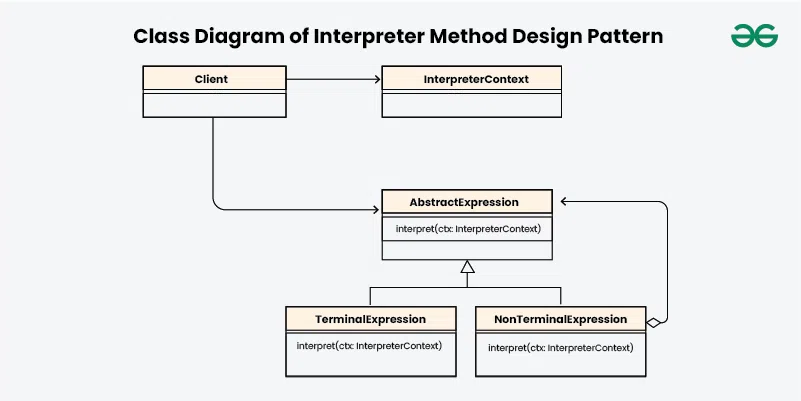
This is an abstract class or interface that declares an abstract interpret() method. It represents the common interface for all concrete expressions in the language.
These are the concrete classes that implement the AbstractExpression interface. Terminal expressions represent the terminal symbols or leaves in the grammar. These are the basic building blocks that the interpreter uses to interpret the language.
These are also concrete classes that implement the AbstractExpression interface. Non-terminal expression classes are responsible for handling composite expressions, which consist of multiple sub-expressions. These classes are tasked to provide the interpretation logic for such composite expressions.
This class contains information that is global to the interpreter and is maintained and modified during the interpretation process. The context may include variables, data structures, or other state information that the interpreter needs to access or modify while interpreting expressions.
The client is responsible for creating the abstract syntax tree (AST) and invoking the interpret() method on the root of the tree. The AST is typically created by parsing the input language and constructing a hierarchical representation of the expressions.
Below is the problem statement to understand interpreter design pattern:
We are going to make an interpreter that can take the form of a simple language for addition and subtraction of numbers.
Defines the interpret method that all concrete expressions must implement.
Represents the terminal symbols (e.g., numbers) in the expression.
Represents the non-terminal symbols (e.g., addition and subtraction) in the expression.
Stores global information needed for interpretation. In this simple example, it's an empty class.
Builds the syntax tree and interprets the expression.
Here’s the complete code bringing all the components together:
The client in our example evaluates the expression (5 + 3) - (2 + 1) by building a syntax tree from Number, Add and Subtract nodes and interpreting it yielding the result 5.
For scenarios in which evaluating expressions or parsing simple languages is necessary, the interpreter pattern is utilized:
The Interpreter Design Pattern offers an orderly method to understand sentences in a language by dissecting the grammar into terminal as well as non terminal expressions; this technique fits well with simple languages and expression evaluators but may not be so good for complex or performance critical applications.
By following this pattern, you can create flexible and maintainable code for evaluating expressions, defining languages and implementing command processors.