The Strategy Design Pattern is a behavioral pattern that defines a group of related algorithms, encapsulates each one in a separate class, and makes them interchangeable. It allows the algorithm to vary independently from the client that uses it, enabling behavior changes at runtime without altering existing code.
Encapsulates different algorithms into separate strategy classes, allowing dynamic selection or switching at runtime.
Promotes flexibility by reducing complex conditional logic and making code easier to maintain.
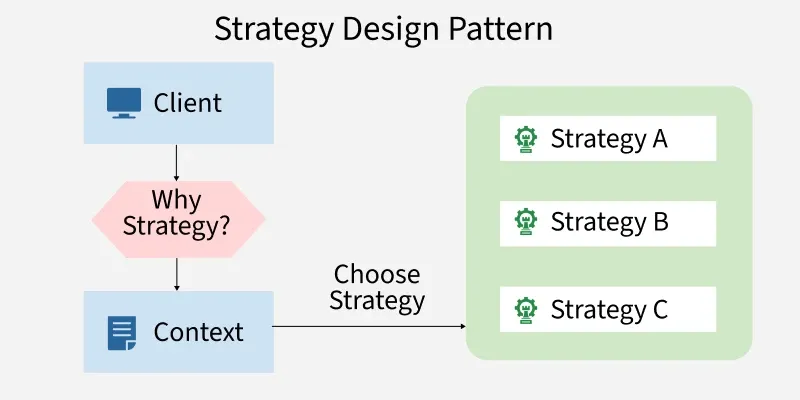
Example: A payment system where a user (client) selects a payment method, and the system (context) applies a strategy like Credit Card, UPI, or PayPal to process the payment.
The Client interacts with the Context and decides which strategy to use.
The Context does not implement the algorithm itself but delegates the task to a selected Strategy (A, B, or C).
Different strategies can be switched easily without changing the client or context, ensuring flexibility.
Real-Life Software Applications
Some real-world examples where the Strategy Pattern is commonly used are:
Multiple Payment Methods: E-commerce platforms use different payment strategies (Credit Card, PayPal, UPI, etc.), each with its own processing logic. The system selects the appropriate strategy at runtime based on user choice.
File Compression Tools: Applications provide multiple compression options (ZIP, GZIP, TAR), allowing users to choose the desired compression strategy dynamically.
Components
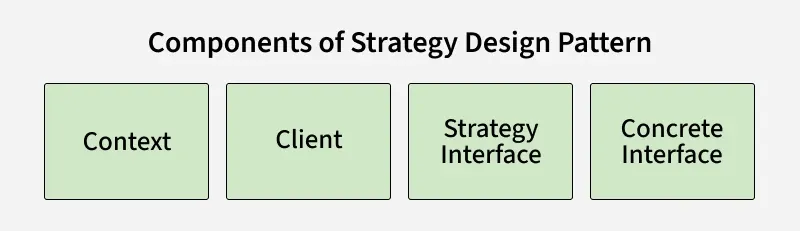
The Strategy Design Pattern consists of key components that work together to define and use interchangeable algorithms.
Acts as an intermediary between the client and the strategy, delegating tasks to the selected strategy.
Holds a reference to a strategy object and uses it to perform operations.
Allows switching strategies without changing its own code.
2. Strategy Interface
Defines a common interface that all concrete strategies must implement.
Ensures consistency so all strategies are interchangeable.
Promotes flexibility by decoupling context from implementations.
3. Concrete Strategies
Provide specific implementations of the strategy interface with different algorithms or behaviors.
Encapsulate the actual logic of each algorithm.
Can be selected and replaced based on requirements.
4. Client
Responsible for selecting and configuring the appropriate strategy for the context.
Decides which strategy to use based on the problem.
Passes the chosen strategy to the context for execution.
Working
The Strategy pattern works by delegating a specific task to interchangeable algorithm classes.
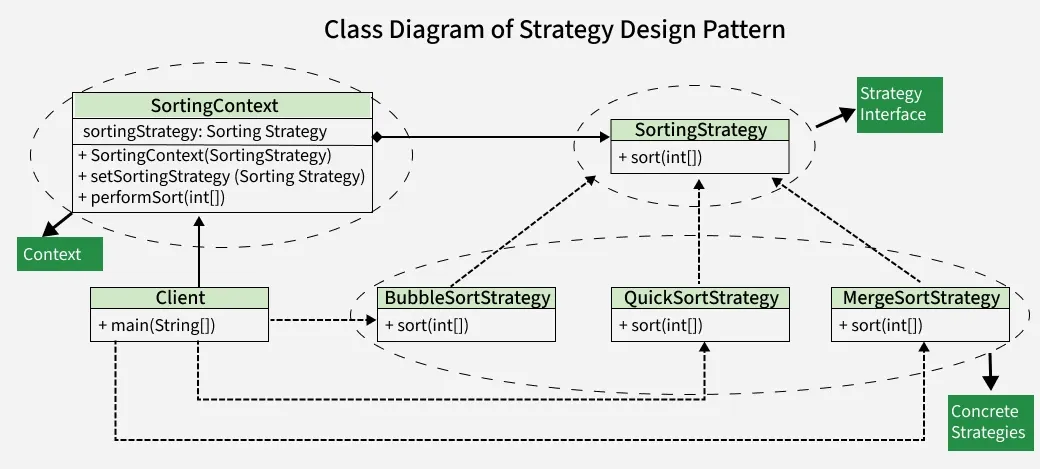
A Strategy interface defines a common method for all algorithms.
Concrete strategy classes implement this interface with different behaviors.
The context class holds a reference to a strategy object.
At runtime, the client selects or changes the strategy, and the context uses it to perform the task.
Uses
The Strategy pattern is used when an application needs to choose different behaviors or algorithms dynamically based on context.
Selecting different algorithms at runtime (e.g., payment methods, sorting strategies)
Eliminating large conditional statements (if-else or switch cases)
Making behavior easily extendable without modifying existing code
Implementation Example
Problem Statement
Consider a sorting application where we need to sort a list of integers. However, the sorting algorithm to be used may vary depending on factors such as the size of the list and the desired performance characteristics.
Challenges Without Using Strategy Pattern:
Limited Flexibility: Implementing sorting algorithms directly within the main sorting class can make the code inflexible. Adding new sorting algorithms or changing existing ones would require modifying the main class, which violates the Open/Closed Principle.
Code Duplication: Without a clear structure, you may end up duplicating sorting logic to handle different algorithms.
Hard-Coded Logic: Implementing sorting logic directly within the main sorting class can make the code rigid and difficult to extend or modify.
Benefits of Using the Strategy Pattern to solve above challenges
Here's how the Strategy Pattern helps:
Code Reusability: By encapsulating sorting algorithms into separate strategy classes, you can reuse these strategies across different parts of the system. This reduces code duplication and promotes maintainability.
Flexibility and Extensibility: The Strategy Pattern makes it simple to adapt or add new sorting algorithms without changing the existing code. Since each strategy is independent, it is possible to change or expand it without impacting other system components.
Separation of Concerns: The Strategy Pattern separates sorting logic into distinct strategy classes, which encourages a clear division of responsibilities. As a result, the code is easier to test, and maintain.