|
VOOZH | about |
|
VOOZH | about |
Multiprogrammed, batched systems provide an environment where various system resources were used effectively, but it did not provide for user interaction with computer systems. Time-sharing is a logical extension of multiprogramming. The CPU performs many tasks by switches that are so frequent that the user can interact with each program while it is running. A time-shared operating system allows multiple users to share computers simultaneously. With each action or order at a time the shared system becomes smaller, so only a little CPU time is required for each user. As the system rapidly switches from one user to another, each user is given the impression that the entire computer system is dedicated to its use, although it is being shared among multiple users.
A time-shared operating system uses CPU scheduling and multi-programming to provide each user with a small portion of a shared computer at once. Each user has at least one separate program in memory. A program is loaded into memory and executes, it performs a short period of time either before completion or to complete I/O. This short period of time during which the user gets the attention of the CPU is known as time slice, time slot, or quantum. It is typically of the order of 10 to 100 milliseconds. Time-shared operating systems are more complex than multiprogrammed operating systems. In both, multiple jobs must be kept in memory simultaneously, so the system must have memory management and security. To achieve a good response time, jobs may have to swap in and out of disk from the main memory which now serves as a backing store for the main memory. A common method to achieve this goal is virtual memory, a technique that allows the execution of a job that may not be completely in memory.
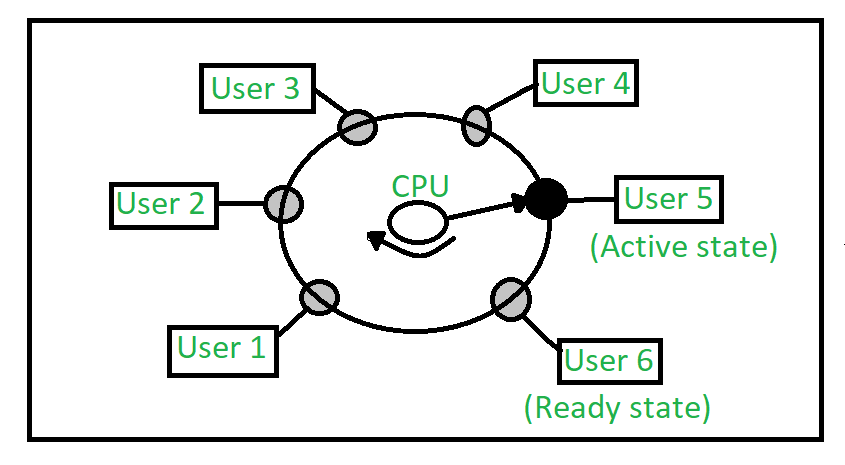
In the above figure the user 5 is active state but user 1, user 2, user 3, and user 4 are in a waiting state whereas user 6 is in a ready state.
Requirements of Time Sharing Operating System: An alarm clock mechanism to send an interrupt signal to the CPU after every time slice. Memory Protection mechanism to prevent one job's instructions and data from interfering with other jobs.
A Time-Sharing Operating System's key characteristics include the capacity to support multiple concurrent users and the capacity to reduce response times for all users. Additionally, because they permit multiple users to use the system without needing to purchase individual licenses, time-sharing operating systems may be more cost-effective for businesses.
The ability for multiple users to use the system at various terminals simultaneously is one advantage of using a time-sharing operating system. All users' response times can be cut down, and the system's resources can be used more effectively.
Additionally, because they permit multiple users to use the system without needing to purchase individual licenses, time-sharing operating systems may be more cost-effective for businesses.
A time-sharing operating system enables concurrent use of the computer by multiple users. By distributing the computer's resources among the users, this is accomplished. In this manner, the response time is reduced and each user receives an equitable share of the resources. The limited number of terminals that can be linked to the system at once and the added complexity of multiple instances of the operating system running on each terminal are some drawbacks. Conflicts between users who attempt to use the system at the same time could also arise.