|
VOOZH | about |
|
VOOZH | about |
Are you preparing for the TOEFL iBT 2024? Whether you're aiming to study abroad or need certification for job requirements, the TOEFL iBT (Test of English as a Foreign Language Internet-based Test) is your gateway to global opportunities. This comprehensive guide offers essential insights into the TOEFL exam, helping you understand the format, registration process, and effective study tips. Discover strategies to boost your reading, writing, listening, and speaking skills, and learn how to maximize your test scores.
If you're looking for the best study materials or wondering how to book your test date for the TOEFL iBT 2024, you'll find all your answers here. Start your journey to success and unlock your potential with confidence!
Table of Content
The Test of English as a Foreign Language (TOEFL) iBT is an internationally recognized standardized test designed to assess the English language proficiency of non-native speakers. Developed and administered by the Educational Testing Service (ETS), TOEFL iBT measures a test taker's ability to understand and use English in academic settings, such as universities, colleges, and workplaces.
Unlike its predecessor, the paper-based TOEFL test, the TOEFL iBT is administered entirely via the Internet, making it accessible to test takers worldwide. It evaluates four essential language skills: Reading, Listening, Speaking, and Writing.
TOEFL iBT scores are widely accepted by universities, colleges, and institutions around the world as part of their admissions process for non-native English speakers. Additionally, many governments and agencies also recognize TOEFL scores for visa applications and professional certification purposes.
Solve Free TOEFL Practice Papers:
| TOEFL iBT full form | TOEFL internet-based test |
|---|---|
| Conducting authority | ETS |
| Meant for | International students willing to study abroad |
| Sections tested | 4 - reading, listening, speaking, and writing |
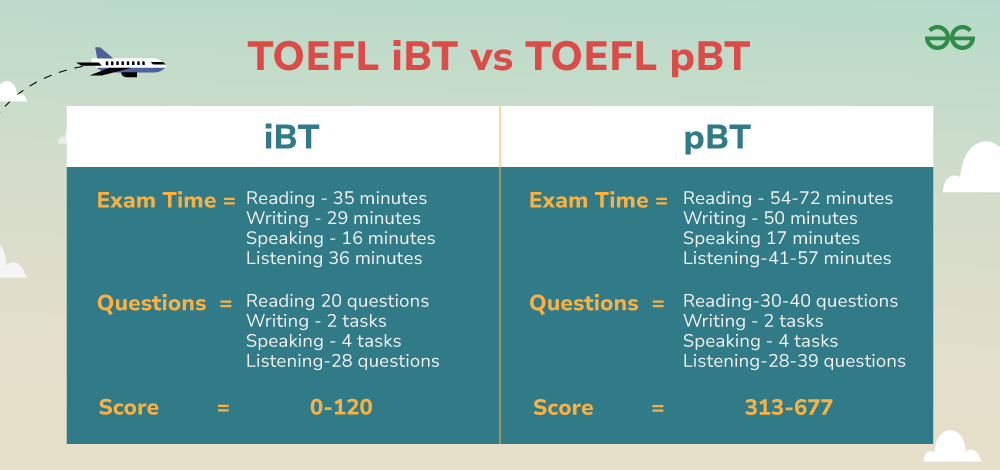
| Exam Pattern | Reading: 35 minutes to answer 20 questions. Listening: 36 minutes to answer 28 questions. Speaking:16 minutes to answer 4 tasks. Writing: 29 minutes to answer 2 tasks. |
| Duration | 2 hours |
| Score range | 0-120 |
| Average score obtained in India | 91 |
| Average score accepted | 65-115 |
The TOEFL iBT (Test of English as a Foreign Language Internet-Based Test) is designed to evaluate a test taker's proficiency in the English language across four key skills: Reading, Listening, Speaking, and Writing. Here's a breakdown of the format:
Throughout the test, there may be unscored experimental questions used for research purposes, but test takers won't be able to distinguish them from the scored questions.
The TOEFL iBT (Test of English as a Foreign Language Internet-Based Test) is structured to assess a test taker's proficiency in the English language across four main sections: Reading, Listening, Speaking, and Writing. Here's an overview of the exam pattern and the breakdown of question types within each section:
Here's a brief comparison between TOEFL iBT and IELTS:
The below table lists the IELTS to TOEFL iBT Score Conversion:
TOEFL iBT score | IELTS Score |
|---|---|
118-120 | 9 |
115-117 | 8.5 |
110-114 | 8 |
102-109 | 7.5 |
94-101 | 7 |
79-93 | 6.5 |
60-78 | 6 |
46-59 | 5.5 |
35-45 | 5 |
32-34 | 4.5 |
0-31 | 0-4 |
The following table lists the essentials of TOEFL and TOEFL iBT:
Parameters | TOEFL iBT | TOEFL Essentials Test |
|---|---|---|
What it Measures | Language skills in an academic setting | Fundamental language skills in academic and non-academic contexts |
Language Proficiency | 100% academic English setting | 50% general and 50% academic English |
Sections | Listening, Speaking, Reading, Writing | Reading, Writing, Listening, Speaking + 5-minute personal video statement |
Who’s likely to take it | Students applying for UG/PG/PhD courses abroad | International students applying to universities (limited acceptance) and high schools |
Exam Duration | 2 hours | 1.5 hrs |
Main Test Design Principle | Designed to be the most effective assessment of applied English communication in academic contexts, with a range corresponding to CEFR B1 to C2. | Designed to be a highly efficient, multistage adaptive test that measures the full spectrum of English proficiency (CEFR A1 to C2) accurately with fewer test items and in just 1-1/2 hours |
Delivery | At a test centre or at-home | At-home (same procedure as TOEFL iBT) |
Cost | INR 16,900 | $120(INR 9974.40) |
Score Reports and Additional Cost | First 4 reports: free Additional: INR 1,950 per university | Free, unlimited score reports |
Scale Score | 0 – 120 | 1-12 |
The following table lists the differences between TOEFL iBT and TOEFL PBT:
Aspect | TOEFL iBT | TOEFL PBT |
|---|---|---|
Format | Internet based | Paper based |
Sections | Reading, Listening, Speaking, Writing | Listening, Structure and Written Expression, Reading, Writing |
Availability | Offered Worldwide | Limited availability in select locations |
Duration | Approximately 3 hours and 30 minutes | Approximately 2 hours and 30 minutes |
Speaking Section | Includes speaking tasks via computer | Not included in the test |
Writing Section | Typing essays on a computer | Handwriting essays on paper |
Score Reporting | Scores available online within 6 days | Scores delivered via mail |
Test Dates | Offered frequently throughout the year | Fewer test dates compared to iBT |
Acceptance by Schools | Widely accepted by universities worldwide | Accepted by some institutions, but iBT preferred |
Test Flexibility | More flexible test dates and locations | Limited flexibility in scheduling |
The conversion of raw score to scaled score is the key to the TOEFL iBT score. The TOEFL iBT test range is 0-120, with a score range of 0–30 for each component. The raw score range for each section and the method used to calculate TOEFL scores are shown in the following table:
Section | Raw Score range | TOEFL Score Calculation |
|---|---|---|
TOEFL Reading | 0-45 | Based on the number of correct answers |
TOEFL Listening | 0-34 | Based on the number of correct answers |
TOEFL Speaking | 0-24 (each speaking task carry equal points) | Based on the quality of the answer, fluency, and range of vocabulary |
TOEFL Writing | 0-10 (each writing task carry equal points) | Based on the structure of essays, usage of relevant examples, words, and connecting words |
Preparing for the TOEFL iBT requires a strategic approach to master the four key skills: Reading, Listening, Speaking, and Writing. Here are some effective preparation tips to help you succeed:
In conclusion, to succeed in the TOEFL iBT (Test of English as a Foreign Language Internet-Based Test), one must have a thorough grasp of its structure, testing methodology, scoring methodology, and efficient study techniques. Knowing the structure and testing methodology of the TOEFL iBT is essential for achieving peak performance. Examinees must prepare and practice carefully to tackle the specific challenges presented by each area of the test, which include the Speaking and Writing assignments, Reading and Listening sections, and Writing sections. A strong foundation for success in the TOEFL iBT is preparation. Test-takers can reach their full potential and give their best on exam day by using official preparation materials, practicing key skills, and putting targeted study tactics into practice.
Read More