 |
VOOZH | about |
|
VOOZH | about |
Advanced vector editing techniques in Figma allow designers to create detailed and professional-quality designs. Vector editing in Figma involves manipulating shapes, paths, and lines to create intricate and precise graphics. Figma provides a range of powerful tools and features that make vector editing both accessible and highly effective. In this article, we will delve into advanced techniques that will help you refine your vector designs and achieve more complex results. Whether you are looking to enhance your skills or learn new tips and tricks, these techniques will elevate your design work in Figma.
Table of Content
Vectors are different layers of shapes made up of multiple anchor points or nodes. These points can be manipulated to alter the shape, direction, and curvature of lines and paths. Vectors are essential for creating precise and scalable graphics, as they allow designers to adjust elements without losing quality.
Here are a few key aspects to understand before diving into advanced vector editing techniques:
Understanding these basic elements is essential for mastering advanced vector editing techniques, which will help you create more intricate and refined designs.
Vectors, as the name suggests specifies different directions, Vector helps unlock different points on a shape, reframing through which we can achieve an altogether different shape. For eg. A star can be changed into a hexagon and vice versa by simply handling the dots on those vectors.
Any single shape/text is a vector and can be converted into custom shapes/texts.
Here's how you can create a custom shape/vector:
Double click on the shape and you'll receive the following options in the toolbar at the top.
You can accordingly change the colors. Also look for the dots in the shape and traverse through them to create any custom shape.
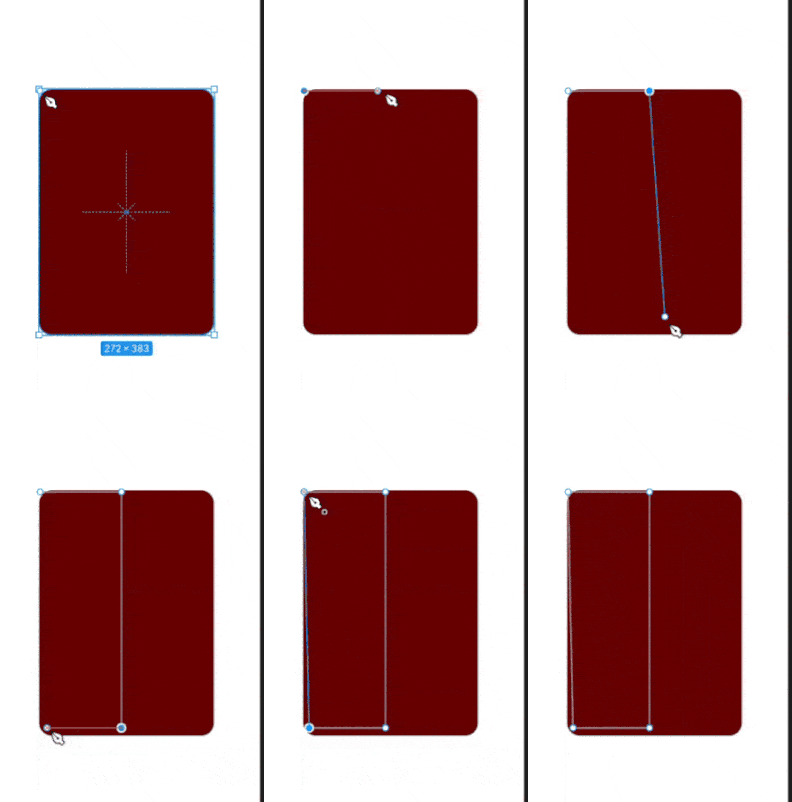
A vector network is a net of different vectors that enable us to create and access paths of different vectors to create an overall new image. It allows usage of multiple paths in the same set of vectors.
Double click on both the sections individually to change the vectors, thus, in turn creating a vector network. Follow the given set of screenshots to achieve the same.
1. Change the background rectangle to any shape of your choice.
2. Change the rectangle in front too.
3. Edit both the shapes according to your choice.
4. Make the final touchups.
Texts can also be transformed into beautiful custom sizes. It is helpful at those places where we want to change the font shape and style of a particular letter.
The pen tool lies in the top toolbar & looks like this: (Just beside the cursor)
It is helpful in creating vectors manually like this:
The Bend tool lies in the top toolbar & looks like this: (Just beside the pen tool, or next to next of cursor)
It is helpful in creating logos of websites since it involves rotation and curves.
The Vector Edit Mode is basically the top toolbar that provides all possible options to edit a vector. It consists of the pen tool, the bend tool, the color fill tool & the cursor to place vectors too. Each one of them has their separate use. Above are the usages of pen tool & bend tool & the color fill allows us to differentiate the colors of vectors(more than one in a vector network).
Mastering vector editing in Figma lets you create detailed and precise designs. By learning how to use anchor points, paths, handles, strokes, and fills, you can make your graphics look professional and scalable. Advanced vector editing techniques help you be more creative and make your designs more versatile. As you practice these skills, Figma will become an even more powerful tool for your projects.

.png)
.png)
.png)
.png)
.png)
.png)
.png)
.png)
.png)
.png)
-9.png)
.png)
.png)
.png)
.png)
.gif)