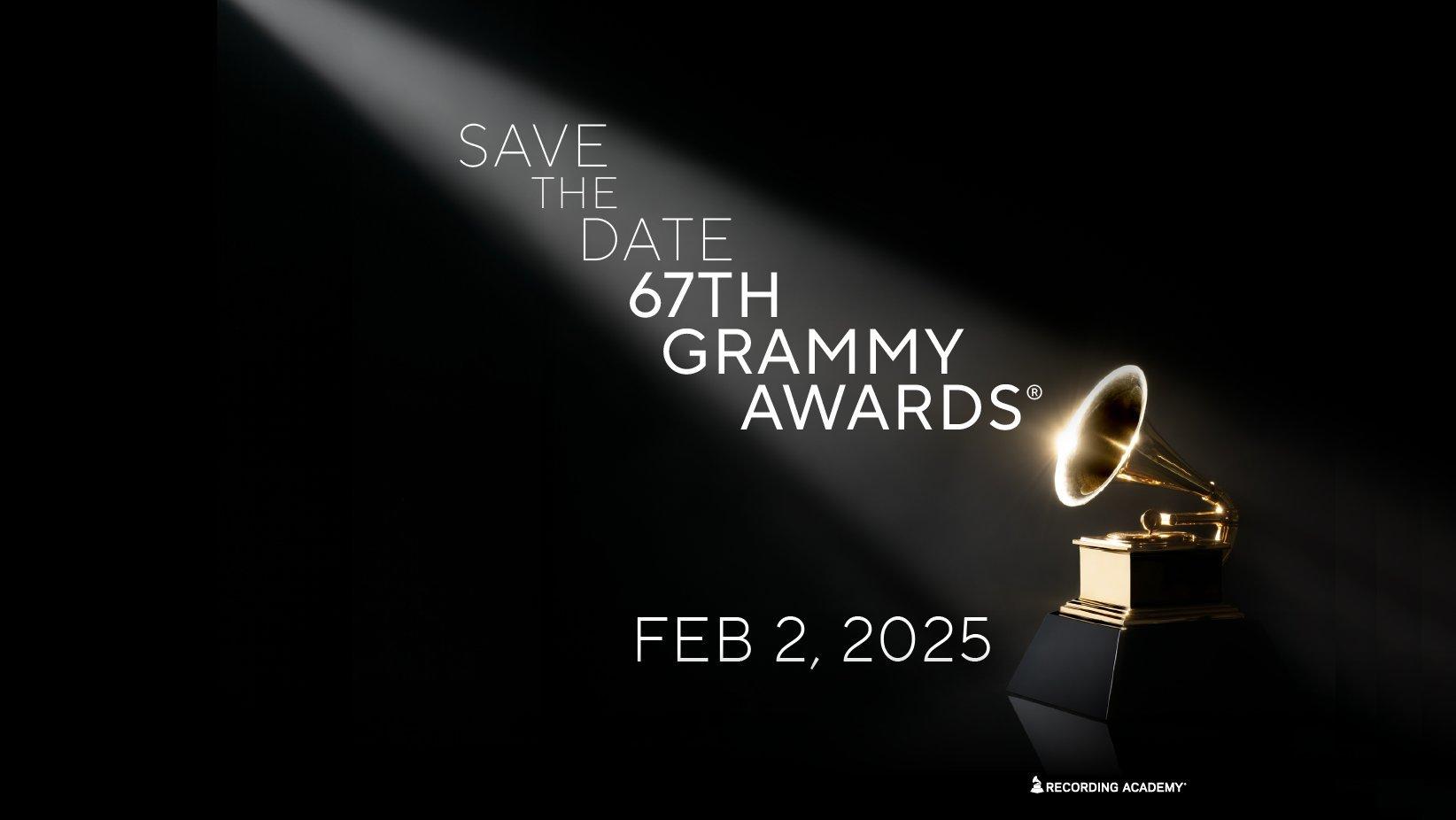
Graphic Courtesy of the Recording Academy
2025 GRAMMYs To Take Place Sunday, Feb. 2, Live In Los Angeles; GRAMMY Awards Nominations To Be Announced Friday, Nov. 8, 2024
The 2025 GRAMMYs return to Los Angeles on Sunday, Feb. 2. Nominations for the 2025 GRAMMYs will be announced Friday, Nov. 8. Learn more about the key dates and deadlines ahead of Music's Biggest Night.
The 2025 GRAMMYs, officially known as the 67th GRAMMY Awards, will air live on CBS and Paramount+ on Sunday, Feb. 2. Watch highlights from the 2025 GRAMMYs on live.GRAMMY.com.
The 2025 GRAMMYs telecast will be reimagined to raise funds to support wildfire relief efforts and aid music professionals impacted by the wildfires in Los Angeles. Donate to the Recording Academy's and MusiCares' Los Angeles Fire Relief Effort To Support Music Professionals.
Music's Biggest Night is back! The 2025 GRAMMYs will take place Sunday, Feb. 2, live at Crypto.com Arena in Los Angeles, the Recording Academy announced today. The 2025 GRAMMYs will broadcast live on the CBS Television Network and stream live and on demand on Paramount+. As well, nominations for the 2025 GRAMMYs will be announced Friday, Nov. 8, 2024. See the full list of key dates and deadlines for the 2025 GRAMMYs, officially known as the 67th Annual GRAMMY Awards, below.
Key dates for the 2025 GRAMMY Awards season are as follows:
Sept. 16, 2023 – Aug. 30, 2024
Product Eligibility Period
The period by which recordings are submitted for GRAMMY consideration. All releases must be available for sale, via general distribution, to the public by this date and through at least the date of the current year’s voting deadline (final ballot) to be eligible for the 2025 GRAMMY Awards.
July 8, 2024 – Aug. 23, 2024
Media Company Registration Period
Media companies must apply for registration with the Recording Academy to submit recordings.
July 17, 2024 – Aug. 30, 2024
Online Entry Period
All eligible recordings must be entered prior to the close of the Online Entry Period, regardless of the public release date.
Oct. 4, 2024 – Oct. 15, 2024
First Round Voting
First Round Voting determines all the GRAMMY nominees for each GRAMMY Awards year.
Nov. 8, 2024
Nominees Announced for the 2025 GRAMMY Awards
Announcing the official nominees list for the 2025 GRAMMYs.
Dec. 12, 2024 – Jan. 3, 2025
Final Round Voting
Determines the GRAMMY winners across all categories revealed on GRAMMY night.
Feb. 2, 2025
2025 GRAMMY Awards
Music's Biggest Night, recognizing excellence in the recording arts and sciences.
This February, the 2024 GRAMMYs proved to be an epic, history-making night. Women dominated the 2024 GRAMMYs: For the second time in four years, women won in the majority of the General Field Categories, winning Album Of The Year (Taylor Swift), Song Of The Year (Billie Eilish), Record Of The Year (Miley Cyrus), and Best New Artist (Victoria Monét). Elsewhere, Taylor Swift broke the all-time record for most GRAMMY wins in the Album Of The Year Category after winning for Midnights. Tyla won the first-ever GRAMMY Award for Best African Music Performance, one of three new GRAMMY Categories that debuted this year.
The 2024 GRAMMYs also celebrated the return of music legends, including Tracy Chapman, Joni Mitchell and Celine Dion, and ushered in new music icons-in-the-making like Victoria Monét, Samara Joy and Tyla. Relive some of the must-see moments and memorable, heartwarming acceptance speeches from the 2024 GRAMMYs. And rewatch all of the performances and key highlights from the 2024 GRAMMYs all year long on Live.GRAMMY.com.
Learn more about the upcoming 2025 GRAMMY Awards season and the annual GRAMMY Awards process.
2025 GRAMMYs: Performances, Acceptance Speeches & Highlights

Graphic Courtesy of the Recording Academy
2026 GRAMMYs: Voting Tips For First-Time Voters
Recording Academy Voting Members have the opportunity to shape the GRAMMY nominations at the 2026 GRAMMYs. This guide breaks down essential GRAMMY voting tips and resources to help make every vote count.
The 2026 GRAMMYs will air live on CBS and Paramount+ on Sunday, Feb. 1, live at Crypto.com Arena in Los Angeles. Nominations for the 2026 GRAMMYs will be announced Friday, Nov. 7, 2025.
Voting in the GRAMMY Awards is a unique opportunity to recognize excellence across all facets of the music industry. As the 2026 GRAMMYs draw closer, First Round Voting is open Friday, Oct. 3 through Wednesday, Oct. 15, at 6 p.m. PT/9p.m. ET. To help Voting Members navigate the process, we've outlined some helpful GRAMMY voting tips and resources.
The 2026 GRAMMYs will recognize the best in music, and First Round Voting is where the annual GRAMMY Awards voting process begins. During First Round Voting, Recording Academy Voting Members will cast their ballots through their member dashboard to determine the GRAMMY nominees across all 95 Categories for the upcoming 2026 GRAMMYs. Final Round Voting for the 2026 GRAMMYs, which opens Dec. 12, 2025, and closes Jan. 5, 2026, will determine the final GRAMMY winners across all Categories to be revealed on GRAMMY night. Each year, GRAMMY winners and GRAMMY nominees are determined as voted by the Recording Academy's Voting membership, which is composed of music creators, including artists, producers, songwriters, and engineers.
Nominations for the 2026 GRAMMYs will be announced Friday, Nov. 7, 2025. The 2026 GRAMMY Awards, when all final GRAMMY Award winners will be announced, take place Sunday, Feb. 1, live at Crypto.com Arena in Los Angeles and broadcasts live on the CBS Television Network and streams live and on demand on Paramount+.
"During this time, I reflect on the power of our collective voice as Voting Members of the Recording Academy, and the unique light our awards shine on music's ability to shape the world and connect people across the globe," Recording Academy CEO Harvey Mason jr. said about the importance of GRAMMY Voting in a message sent to Recording Academy Voting Members. "Every vote can shape the future of music, empower creators, and ignite innovation. It’s a 67-year legacy that lasts well beyond Music’s Biggest Night."
As a member of the Academy, you may be asked questions about GRAMMY Voting. Equip yourself with the knowledge to explain the complete GRAMMY Awards process by reviewing the tips below and visiting our interactive online resource. Whether you’re a new voter or returning for another GRAMMY season, following these tips can ensure your vote reflects the best in music.
Essential Tips For First-Time GRAMMY Voters
Take Your Time
GRAMMY voting isn’t a race. While the ballot is extensive, it’s crucial to consider each entry thoughtfully. Give every submission the same level of attention to ensure a fair and well-rounded outcome.
Break Voting Into Manageable Chunks
To avoid feeling overwhelmed, tackle the GRAMMY voting ballot in sections. For example, set goals to finish certain Categories each day. Taking short breaks between sections can help maintain focus and avoid fatigue.
Utilize The Save & Return Feature
When you start feeling tired, the Save button can be a lifesaver. Don't rush it. Save your progress and return to the GRAMMY voting ballot when you’re refreshed to ensure you’re voting with a clear mind and fair judgment.
Consider Reviewing From Z To A
The GRAMMY voting ballot is presented alphabetically, which can sometimes lead to fatigue near the end. Try reviewing the entries in reverse order or splitting the alphabet into smaller groups. This approach can help maintain objectivity across all entries.
Review The Voter Code Of Conduct
Before voting, familiarize yourself with the Voter Code of Conduct to maintain the integrity of the GRAMMY Awards. Voting within your areas of expertise helps honor each submission fairly.
Download The GRAMMY One App
The GRAMMY One app allows Voting Members to vote from their phones, making it easy to complete GRAMMY Voting ballots from anywhere. The app is available on both iOS and Android.
Make Use Of Resources
The Recording Academy offers an interactive guide explaining the GRAMMY Awards process in full to help members fully understand the GRAMMY journey from entry to award. This resource is invaluable for first-time GRAMMY voters and provides context for the entire awards cycle.
Encourage Your Peers
Our Voting membership class is the most diverse it’s ever been. As a fellow member and respected industry professional, your encouragement to your Voting Member peers during the voting process can make an impact on voter participation and turnout.
When your peers sit down to cast their GRAMMY vote, their voices will reflect the diversity and excellence of the greater music community. If you manage or represent an Academy Voter, please remind them that their First Round Voting ballot is available via their member dashboard.
Explore The "GRAMMY Effect"
Winning or even just being nominated for a GRAMMY can dramatically boost an artist's career by increasing resources, visibility and industry standing. GRAMMY nominees often receive greater production support, see higher Billboard chart rankings, and gain recognition that opens doors to further opportunities. This is know as the “GRAMMY Effect,” an industry phenomenon in which a GRAMMY accolade directly influences the music biz and the wider popular culture. Your GRAMMY vote highlights deserving talent and also contributes to elevating careers across the music landscape.
Ask For Help If Needed
If you encounter technical issues or have questions, voter support is available through phone and email. Don’t hesitate to reach out to ensure your GRAMMY voting ballot is completed successfully.
VOTER TECHNICAL SUPPORT
PHONE: 866-992-9902 x403
EMAIL: grammys@yangaroo.com
HOURS: M-F, 6 a.m. — 5 p.m. PT / 9 a.m. — 8 p.m. ET
First Round Voting: Oct. 3 — Oct. 15
Final Round Voting: Dec. 12, 2025 — Jan. 5, 2026
AWARDS, FYC (FOR YOUR CONSIDERATION) & NON-TECHNICAL SUPPORT:
PHONE: 833-789-8683
EMAIL: votersupport@grammy.com
HOURS: 9 a.m. – 5 p.m. PT / noon – 8 p.m. ET
MEMBERSHIP QUESTIONS:
PHONE: 866-794-3391
EMAIL: membership@grammy.com
HOURS 9 a.m. – 5 p.m. PT / noon – 8 p.m. ET
2026 Grammys: Performances, Winners & Highlights

Photos: Jason LaVeris/FilmMagic; Kevin Mazur/Getty Images for TW; Amy Sussman/Getty Images
Songbook: Inside The Weeknd’s Sonic Universe & Cinematic Vision
With 'Hurry Up Tomorrow' album and film available to stream and tour dates on the horizon, explore the breadth of Abel Tesfaye's artistry.
The term pop star gets tossed around easily, but few truly earn it. From his humble, anonymous beginnings to a four-time GRAMMY winner with seven No. 1 hits and a Super Bowl halftime show under his belt, The Weeknd has certainly earned the accolade.
The Canadian artist born Abel Tesfaye floats seamlessly between music, television, and film — from his starring role in "The Idol" to his big-screen debut in Hurry Up Tomorrow, which hit theaters on May 16. His six studio albums and three mixtapes blend pop, R&B, and hip-hop, proof that The Weeknd carries the presence and range of a classic rock star; the kind who reshapes genres while building a world entirely his own.
The Weeknd first captivated listeners in 2011 when he uploaded several tracks to YouTube under the username "xoxxxoooxo." The mysterious R&B songs — self-produced and later compiled into his breakthrough mixtape House of Balloons — created an immediate buzz around his identity. That same year, he founded his XO Records and contributed to four songs on Drake's second studio album, Take Care, as a songwriter, producer; he was a featured artist on the album's seventh single, "Crew Love."
Following his 2013 debut Kiss Land, The Weeknd's evolution continued with 2015's Beauty Behind the Madness and his 2016 follow-up, Starboy, both of which topped the Billboard 200 chart. Beyond music, he brought a menacing charm to acclaimed films like Uncut Gems, showcasing his artistry across mediums.
Tesfaye reached new heights in 2025 with his unconventional pop album Hurry Up Tomorrow. Over 22 tracks, The Weekend seamlessly blended R&B, synth-pop, and trap foundations while venturing into Brazilian funk and experimental hip-hop. What makes this effort particularly significant is that it allegedly represents his final work under The Weeknd moniker — a deliberate conclusion to the persona that revolutionized modern music.
Following the album's release, Tesfaye made a symbolic return to the 2025 GRAMMYs stage, ending his three-year boycott of the Ceremony following public criticism of its nomination processes. His surprise performance of "Cry For Me" and "Timeless" signaled both a reconciliation with the Academy. Whether the release of Hurry Up Tomorrow (both album and film) truly concludes The Weeknd chapter or heralds further development remains to be seen. Regardless, Abel Tesfaye's transformation from anonymous moody uploads to a cultural phenomenon is one for the history books.
Watch: 2025 GRAMMYs: The Weeknd Makes Triumphant Return To GRAMMY Stage
Below, follow The Weeknd's musical evolution from atmospheric early mixtapes to stadium-filling anthems, and silver screen charisma. Explore his innovations, cultural impact and artistic vision that have established him as the architect of modern pop’s darker, more cinematic turn.
No Rules, Just Hit Records
"Wicked Games" (2011)
The Weeknd’s first entry on the Billboard Hot 100, the haunting "Wicked Games," has lived many lives. First released as a loosie on YouTube in 2011, it later reappeared as the lead single from his debut mixtape House of Balloons, and then again as the lead single from his 2012 compilation album Trilogy (2012). The song opens with waves crashing and The Weeknd’s signature falsetto layered on top. The painful but alluring lyrics — plucked straight out of the Tumblr generation where he thrived — earned the track a deserved 3x platinum status.
Trilogy (2012)
Trilogy is The Weeknd’s major label arrival — a three-part special combining his 2011 mixtapes that first attracted fans online and forever influenced the moodiness of the Toronto sound. Released through XO and Republic Records, the compilation marked a turning point as his cult following began to scale. Alongside the charting single "Wicked Games," it features deep cuts like "What You Need," which samples Aaliyah’s "Rock the Boat," and "The Party & The After Party," built around Beach House’s "Master of None." With its brooding seduction and chaotic comedown, the latter’s two-act arc reads like a fever dream — an early glimpse into the emotional peaks and valleys that would define his later work. The Weeknd’s ability to pull from such sonically different artists showcased his skill as a producer and predicted the genre-bending, filmic ambition that would shape his career.
"Can’t Feel My Face" (2015)
Not too many artists are drawing comparisons to Michael Jackson at the dawn of their careers, but then there's The Weeknd's GRAMMY-nominated "Can't Feel My Face." Like MJ, The Weeknd has a gift for crafting infectious hooks that transcend meaning, captivating listeners of all ages. The darker themes fans had come to expect from him are still there, but this time they’re masked in a joyful rush of modern disco-funk. This single from his GRAMMY-winning sophomore studio album, Beauty Behind the Madness, launched The Weeknd into full-blown pop stardom. First leaked in May 2015 and officially released weeks later, it went on to top the Billboard Hot 100 and charts in Canada, Mexico, New Zealand, Denmark, Ireland, and South Africa.
"The Hills" (2015)
"The Hills" stands in stark contrast to the glossiness of "Can’t Feel My Face," showcasing The Weeknd’s range and reaffirming the darker edge that made his early work so magnetic. Released in 2015 and later certified diamond by the RIAA, it became his first diamond record and solidified his status as dark-pop king. Over distorted bass and crashing synths, he brags about his conflicting feelings about being an outlaw and dysfunctional relationships that still manages to enchant the mainstream. It’s an eerie and vivid track, with songwriting and production that sparks daydreams or nightmares. Fittingly, the track takes its title from Wes Craven’s 1977 cult horror The Hills Have Eyes, a nod to The Weeknd’s obsession with cinema.
Starboy (2016)
Starboy (2016) lived up to its name in spectacular fashion, cementing Tesfaye's musical supernova. The sleek, neon-drenched album married R&B and electronic pop, debuting at No. 1 on the Billboard 200; its Daft Punk-assisted title track topped the Hot 100 the following January. Tesfaye and the French electronic duo met again on "I Feel It Coming," which further is where cemented his ability to capture the zeitgeist while maintaining his signature mystique and moodiness. This period didn't just produce chart successes; it defined the sound of an era. For its inventiveness, Starboy took home a golden gramophone for Best Urban Contemporary Album at the 2018 GRAMMYs.
"Blinding Lights" & "Heartless" (2019)
These twin '80s-inspired synthwave tracks proved equally fit for both nightclub dance floors and high-intensity cycling classes. "Heartless" claimed the top spot on the Hot 100 while "Blinding Lights" became one of the most successful singles of all time, breaking multiple Billboard records, including the longest-charting Hot 100 hit ever. With their immaculate production and arena-sized sonics, these singles solidified "The Weeknd" as a distinct archetype in pop culture — a modern tragic hero whose fate we recognize from the first notes, perpetually entangled in destructive relationships yet impossible to look away from.
Despite the familiar narrative of toxic entanglements, both respected institutions and his fans remained captivated, rewarding him with multiple awards, and billions of streams worldwide. Those successes continued to prove that Tesfaye's dark, persistent vision resonated regardless of how many times we witness his character's downfall.
"Save Your Tears" ft. Ariana Grande (2021)
What did pop music sound like in 2021? "Save Your Tears," featuring Ariana Grande, is the answer. Their defining collaboration — and second partnership after 2014's "Love Me Harder" and preceding "Off the Table" later that same year — remade an already successful track into a No. 1 hit that spent multiple weeks on the Billboard Hot 100 and accumulated over 2 billion global streams.
Grande's signature breath control and clarity are perfectly matched by the chameleonic The Weeknd, who adapts his voice against the '80s-inspired synths. The track's massive commercial success, including a diamond certification, demonstrated how two unique sonic identities could merge into something greater than the sum of its parts.
From XO To OVO: Everybody’s Favorite Feature
"Crew Love" with Drake (2011)
This early collaboration from Drake's seminal Take Care introduced a whole new audience to The Weeknd's haunting falsetto and atmospheric production style, establishing the blueprint for their creative partnership. "That OVO and that XO," as Drake calls it.
The track's nocturnal ambiance and confessional, singalong lyrics about fame's dark side showcase Tesfaye's signature blend of hedonism and vulnerability. "Crew Love" also reflects the embryonic stage of what would become The Weeknd's trademark sound, characterized by collaborations with artists from Drake to Anitta to Ariana Grande — a melancholic, drug-hazed R&B that would eventually reshape pop music.
"Love Me Harder" with Ariana Grande (2014)
No one expected The Weeknd to show up on Ariana Grande’s sweetly innocent My Everything album — but in hindsight, it makes perfect sense. They both carry a magnetic falsetto, and their collaboration earned The Weeknd his first entry into the Hot 100’s Top 10. The title "Love Me Harder" fits — the romance of Grande meets the grit of Tesfaye — and it foreshadows the pop-leaning, ‘80s-inspired tracks he’d later release into the world.
"Woo" by Rihanna (2016)
It was only right that The Weeknd co-wrote one of the grittiest, standout tracks on Rihanna’s ANTI, a move that highlights his behind-the-scenes influence on R&B. The breakup track simmers with his nonchalant nature and a moth-to-a-flame knack for dysfunctional relationships. The Weeknd is also a writer on the song, bringing the emotional intensity that defines his work while still sounding entirely like a Rihanna song made for both a lap dance and the runway.
"Coming Out Strong" with Future (2017)
Don’t we love it when two toxic kings link up? "Comin' Out Strong," the hypnotic 2017 collaboration from Future’s HNDRXX project, is peak melodic trap — almost a meditation on fame’s isolation. It’s floaty, spacey, drugged-out, yet confessional and honest, touching on the media scrutiny both artists have faced over the arcs of their careers.
"You Right" with Doja Cat (2021)
In 2021, The Weeknd lands on Planet Her, adding another chart success to his growing list of collaborations. There’s a sensual tension between Doja’s raspy rhymes and The Weeknd’s ability to shape-shift his vocals to complement a woman’s artistic voice. He’s high-pitched, crooning, and how the two interact feels almost like a call and response. The chemistry is undeniable.
A Worldbuilder In Every Medium: Stage, Screen & Stadium
"Earned It" (Fifty Shades of Grey, 2015)
If there’s one artist destined to land on a soundtrack about BDSM, it’s The Weeknd. "Earned It," from Fifty Shades of Grey, marked his first foray into film soundtracks and earned him an Academy Award nomination for Best Original Song. With this track, Hollywood was introduced to his seductive sound, which felt just as fitting on the industry’s biggest stage as in a dimly lit bedroom.
"Earned It" was a massive commercial success, earning a quadruple platinum certification, three GRAMMY nominations and a win for Best R&B Performance. It was also featured on Beauty Behind the Madness, where it seamlessly fits both the soundtrack and his project — a double whammy of musical mastery.
The Hunger Games: Catching Fire Soundtrack (2013)
Of course, the popstar would leave his mark on the dystopian blockbuster franchise with "Devil May Cry" and "Elastic Heart" (with Sia and Diplo) expanding his cinematic presence before he became a household name. The atmospheric production and haunting vocals on these tracks demonstrated The Weeknd's natural affinity for scoring dystopian worlds, foreshadowing his later soundtrack work.
"Pray For Me" with Kendrick Lamar (Black Panther, 2018)
When one pop star and one rap star link up, they're bound to make magic. "Pray For Me," a collaboration merging Tesfaye’s soaring melodic hooks with Lamar’s incisive verses, was a solid addition to Marvel’s pan-African Black Panther soundtrack. Rooted in themes of identity and power, The Weeknd brought his self-lacerating persona to the mix. If you listen closely, themes of sacrifice and duality perfectly complement the film’s exploration of heroism and responsibility. A platinum certification and a Top 10 chart position solidified The Weeknd’s place as a go-to artist for high-profile, culturally resonant soundtracks.
Uncut Gems (2019)
Tesfaye played himself in the Safdie Brothers' 2019 anxiety-inducing thriller — a meta cameo that blurred the lines between his musical persona and acting potential. His appearance is brief but memorable, complete with a nightclub performance and a confrontation with Adam Sandler's character, capturing the raw, chaotic energy of his early career persona while hinting at his cinematic ambitions. This cult classic appearance was exactly what he needed to solidify his pop stardom further, proving his versatility and expanding his reach beyond music.
Super Bowl Halftime Show (2021)
In 2021, he brought the Toronto sound to the Super Bowl as the first Canadian solo artist to headline the most-watched musical event in America; Tesfaye delivered a dazzling, self-funded spectacle that earned three Emmy nominations while celebrating his entire discography. The Weeknd presents as a showman on football's biggest night with intricate choreography, visual effects that showcase a knack for immense production value, and a nostalgic but fresh medley of hits.
Fun fact: he financed the $7 million production, maintaining complete creative control, which gave audiences a halftime show that felt like entering The Weeknd's universe rather than a compromised mass-market performance.
"The Idol" (2023)
"The Idol" caused a lot of conversation but showcased The Weeknd’s willingness and ability to explore the darker side of fame across mediums. Tesfaye's HBO debut was ambitious and polarizing, with "The Idol" describedas gauche, raunchy, and even pornographic.
His performance as enigmatic cult leader Tedros, alongside co-stars Lily-Rose Depp, Jennie Kim, and Troye Sivan, demonstrated surprising acting range and a love for deeply unsympathetic characters, suggesting a fearlessness reaching far beyond his music.The show’s unflinching examination of the music industry's exploitation and excess revealed Tesfaye's interest in deconstructing the star-making machinery that elevated his career.
Hurry Up Tomorrow (2025)
His official feature film debut represents the culmination of a decade-long expansion beyond music, proving there's no medium Tesfaye won't explore — or alter with his daringly illicit, yet one-of-a-kind vision. Directed and edited by Trey Edward Shults, the musical psychological thriller is a companion to Abel "The Weeknd" Tesfaye’s sixth studio album of the same name.
Early critical reception suggests his performance captures the same emotional intensity that defines his musical output, translating his gift for storytelling to the visual medium. Starring alongside newcomer but proven talent Jenna Ortega, Tesfaye’s portrayal and production prowess is an alleged final act as The Weeknd, a tastemaker.
Latest News & Exclusive Videos



Photo: Todd Owyoung/NBC via Getty Images
Every Year Is The Year Of Shakira: 11 Songs That Prove She's Always Been A Superstar
As the four-time GRAMMY winner kicks off the U.S. leg of her Las Mujeres Ya No Lloran tour, cruise through Shakira's discography for a reminder of her innovative and boundless aesthetic universe.
Editor's note: This story was originally published in 2023 and has been updated to reflect the artist's recent releases.
After taking home a golden gramophone in the inaugural Best Latin Electronic Music Performance at the 2024 Latin GRAMMYs, Shakira kicked off 2025 in style at Music's Biggest Night. There, on the 2025 GRAMMYs stage, the icon performed a medley of her winning "Bzrp Sessions" and "Ojos Asi," and took home the award for Best Latin Pop Album.
Recently, Shakira appeared together with Wyclef Jean at "The Tonight Show Starring Jimmy Fallon" to perform "Hips Don’t Lie," celebrating the 20th anniversary of the global hit. There was a tenderness to her rendition — a sweet exuberance in the dancing and the seductive smiles. Clearly, this brief celebration of her superstar status found the Colombian legend in a joyful mood.
At 48, Shakira is, more than ever, on top of the world. Seemingly, she has left behind the emotional travails that inspired the GRAMMY-winning epic Las Mujeres Ya No Lloran — one of the most defiant and ambitious albums of her extraordinary career. On Feb. 11, she kicked off her latest tour in Rio de Janeiro to rave reviews. She also broke a number of attendance records as she zigzagged from her native Barranquilla to Buenos Aires and Mexico City.
As she prepares to launch the much anticipated U.S. leg of the tour on May 13, enjoy 11 anthemic mega-hits and lesser-known gems from Shakira’s expansive catalog.
"Antología" (1995)
Culled from her breakthrough third album Pies Descalzos, the lilting "Antología" remains one of her biggest hits.
Even though she would go on to experiment with every genre under the sun — from merengue and bhangra to reggaetón — Shakira always emphasized solid songwriting as the main ingredient of her craft. A bouncy ballad with an unassuming chord progression, it leaves plenty of space for her passionate vocalizing to shine through.
"Ojos Así" (1998)
The apocalyptic closing track of Dónde Están Los Ladrones? —basically, a rock album — "Ojos Así'' revealed a reality that wasn’t obvious back in the late ‘90s: Shakira was no ordinary pop star.
A tribute to her Lebanese roots with subtle echoes of Led Zeppelin’s "Kashmir," the song fused Arabic folk and rock. She beamed and belly danced on stage while performing the song, captivating a generation of concertgoers.
"La Tortura" (2005)
The Oral Fixation/Fijación Oral album diptych signaled Shakira’s creative growth and global star status. No other song summed up this moment of artistic exuberance like "La Tortura" — a pop smash that transcends the limitations of the genre.
A duet with the gruff voice of Spanish balladeer Alejandro Sanz, "La Tortura" combines quotable lyrics with a reggaetón backbeat, EDM textures and accordion riffs — the perfect marriage of digital slickness and analog warmth.
"Gypsy" (2009)
Look beyond the hits and you will find a treasure trove of deep cuts in Shakira’s discography. Culled from She Wolf — her eighth LP — "Gypsy" finds its inspiration in Indian bhangra music, with spidery lines of sitar and hypnotic tabla rhythms. Of note: whenever she explores regional genres outside her own culture, Shakira’s respectful approach results in tracks that preserve the style’s roots.
"Loca" (2010)
What did Shakira do when she decided to tackle a merengue? Well, naturally, she flew to the Dominican Republic and spent some time working with authentic merenguero El Cata at his unassuming recording studio.
Included in the life-affirming Sale El Sol LP — one of her best — "Loca" brims with staccato piano lines, fun electro accents and the diva’s sassy delivery.
"Islands" (2010)
Shakira’s ethereal cover of British band the xx’s "Islands" was a pivotal moment for her reputation as a tastemaker. In interviews, she often expressed a deep affinity for mainstream rock'n'roll, naming Led Zeppelin and Queen as some of her favorite artists. But until this moment, no one could have suspected that she also kept up with the best of British indie rock.
Her decision to cover a song by critical darlings the xx demonstrates what a sophisticated listener she is. This dazzling version also showcases her impeccable taste in terms of the track’s arrangement and the specificity of its mood.
"Empire" (2014)
The singer had always shown a proclivity for lush sonics. This epic tour de force — from her self-titled 2014 album — took her sumptuous tendencies to a different level.
A cinematic ballad tailor-made for the exquisite vulnerability and command of her voice, "Empire" implies that Shakira’s reputation as a "pop star" is only a fragment of her artistic identity. She can also sound downright operatic when the mood strikes.
"Me Enamoré" (2017)
The beauty of autobiographical love songs is that the purity of those initial feelings remains frozen in time — regardless of the relationship’s outcome.
A chronicle about meeting her then-partner and the father of her children, soccer star Gerard Piqué, "Me Enamoré" struck a chord for the way it captured the butterflies-in-the-stomach giddiness of falling head over heels in love. A window into her emotional world, it also shows how witty and funny she can be in the lyrics department.
"Chantaje" (2017)
If "La Tortura" introduced Shakira as one of the first mainstream artists to flirt with reggaetón, this duet with Colombia’s Maluma operates in full progressive urbano mode.
Quick to absorb the influences that evolve around her, she sounds right at home in the jagged bounce of the rhythm track, trading seduction barbs like a seasoned reggaetonera. Shakira seems to love infectious dance music, and the urbano cosmovision is a perfect match for her pop sensibility.
"Bzarp Music Sessions, Vol. 53" (2023)
This infamous viral session by the Argentine producer signified a step forward for both artists. It provided Bizarrap with a larger-than-life arena where he could show off the addictive beats that he had been cooking up for years in his home studio. It also confirmed Shakira as the kind of timeless artist who fits seamlessly in the aesthetic universe of a 24 year-old wunderkind.
The lyrics, quoted gleefully by the entire planet throughout 2023, illustrated the genius of Shakira — and how she managed to turn heartbreak into both material riches and emotional payback.
"TQG"
This collaboration between the two greatest divas ever to emerge from Colombia was so momentous, that it was included in both Las Mujeres Ya No Lloran and Karol G’s groundbreaking fourth album Mañana Será Bonito. Shakira has felt comfortable stomping on reggaetón ground since the very birth of the genre, and this sinuous diss ode to disappointing exes is packed with slick urbano flavor, courtesy of producer Ovy on the Drums, Karol’s recurring partner in crime. Bonus points for La Bichota ending one of her verses with the iconic shoutout Shakira, Shakira.
Latest In Latin Music, News & Videos


Graphic courtesy of the Recording Academy
GRAMMY Viewers Contributed $10 Million To L.A. Fire Relief: Here's How It Will Help
MusiCares and the Recording Academy raised $26 million during GRAMMY weekend this year to support their ongoing mission and dedicated fire relief efforts. Take a look at how the funds have directly supported music professionals and local communities.
The 2025 GRAMMYs paid tribute to the city of Los Angeles, raising funds for those affected by the devastating wildfires earlier this year. During the GRAMMY telecast, which took place in Los Angeles in February, viewers generously contributed nearly $10 million for Los Angeles Fire Relief efforts — and that money is now helping both music professionals and the broader local population in the L.A. area affected by the devastating wildfires.
MusiCares has distributed $6,125,000 to more than 3,100 music professionals across Los Angeles. MusiCares directed another $3,969,005 to three community-based organizations — California Community Foundation, Direct Relief and Pasadena Community Foundation — to address the broader community impact beyond the music industry
Donations made during the 2025 GRAMMYs telecast came from everyday supporters around the world, with the median contribution of $53.50. This overwhelming show of solidarity demonstrated how people across the globe opened their hearts, and their wallets, in support of Angelenos in need. The GRAMMY telecast also included several performances and segments dedicated to raising awareness of the crisis created by the wildfires.
In addition to the $10 million contributed by GRAMMY telecast viewers, MusiCares and the Recording Academy raised another $16 million during GRAMMY weekend thanks to the MusiCares Fire Relief campaign and the annual Persons Of The Year gala. MusiCares has allocated $6 million to long-term fire relief efforts, while the other $10 million from Persons of the Year gala will be used for MusiCares' year-round mission delivery.
"The music community does amazing things when it comes together," Recording Academy and MusiCares CEO Harvey Mason jr. said in a statement. "This outpouring of love and support was humbling, whether it was performing or participating on the show, making contributions or donating their time and items for fundraisers. We are grateful for this amazing community and the GRAMMY viewers who felt inspired to give."
In a statement, MusiCares Executive Director Laura Segura added, "What moved us most in the days following the GRAMMY telecast wasn't just the scale of support, it was the spirit behind it. Thousands of people gave what they could, and together, their generosity became a lifeline for those in crisis, which reached far beyond our industry. That's why we partnered with trusted community organizations who are helping Angelenos across the region access the care, resources and support they need to rebuild."
When disaster strikes, emergency support is only the first step. Recovery is a phased process that stretches well beyond the news cycle. While MusiCares responded within days of the fire's outbreak to provide immediate assistance, the long-term needs of music professionals are now coming into sharper focus. From loss of work and instruments to the emotional toll of displacement and trauma, the aftermath continues to affect lives.
Few cities embody the soul of music like Los Angeles. Thousands of people here make a living in music, often relying on specialized tools and gig-based income to survive. With equipment destroyed, events canceled and homes damaged or lost, the music community has faced a multifaceted crisis. MusiCares continues to provide aid through customized case management, mental health support and financial assistance to those with lasting need.
MusiCares’ and the Recording Academy's partnership with California Community Foundation, Direct Relief and Pasadena Community Foundation — three trusted organizations already embedded in the neighborhoods hit hardest by the fires — helps address the impact on the broader community beyond the music industry. Below, see how these funds are helping rebuild Los Angeles as a whole.
California Community Foundation (CCF)
CCF is supporting groups working on rebuilding the infrastructure that binds communities. Along with funding organizations that provided cash assistance and emergency supplies immediately after the fires, we are supporting our partners in reviving the places where people in neighborhoods come together as a community.
"Recovery isn't just about rebuilding homes," said CCF President and CEO Miguel Santana. "People who lost their homes also lost schools, churches, stores -- the places that connected them to their neighbors to form the community they treasured. As we bring activity back to places like a park, a church, or a school, people can re-connect as a community. Those chances to be together can give people strength and hope as they continue the difficult process of rebuilding their individual lives."
Direct Relief
In the aftermath of the devastating wildfires, Direct Relief mobilized its resources to address both the immediate and long-term healthcare needs of affected communities. As the fires displaced thousands and overwhelmed local healthcare systems, many residents—particularly those uninsured or underinsured—faced significant health risks, compounded by housing instability, food insecurity, and the loss of essential services. Direct Relief responded by delivering critical medical supplies to health centers, collaborating with local healthcare providers to ensure access to emergency care, and supporting mental health services to help survivors cope with the trauma. Beyond healthcare, the organization worked to stabilize the broader community by providing grants to local organizations focused on restoring housing, food security and essential services, ensuring a comprehensive recovery approach for those hardest hit by the disaster.
"Recovery from wildfires involves more than rebuilding physical infrastructure—it requires addressing complex social challenges such as housing instability, food insecurity, and healthcare disparities," said Dr. Byron Scott, CEO of Direct Relief. "Community health centers and free and charitable clinics serve as vital anchors, providing not just medical care but comprehensive support including mental health counseling, housing assistance, and nutritional services. MusiCares' generous funding will empower safety-net providers to continue delivering the holistic care that Los Angeles communities urgently need."
Pasadena Community Foundation (PCF)
Pasadena Community Foundation has played a vital role in distributing critical resources to Altadena and surrounding communities, where many families were displaced, and community systems were overwhelmed. Through its Eaton Fire Relief & Recovery Fund, PCF adopted a three-phase funding approach focused on immediate relief, stabilization and support, and long-term housing recovery.
Phase 1: Emergency Relief
Phase 2: Interim Housing, Children's Mental Health, Case Management, and Family and Childcare Support
Phase 3: Rebuilding Housing in Altadena through Altadena Builds Back Foundation
In collaboration with Pasadena Unified School District and several other child health-centered nonprofits, including the Boys & Girls Club of Pasadena and Pasadena Sierra Madre YMCA, PCF is now channeling funds into supporting mental health initiatives for children and subsidizing summer programming. These efforts aim to foster a sense of stability and healing for youth, particularly as the six-month post-trauma milestone—a common time when PTSD symptoms emerge—approaches this summer.
"Nonprofits in Pasadena, Altadena, and Sierra Madre have been our partners on the ground for more than 70 years. Throughout the last three months, PCF has seen these organizations meet the moment in countless ways—disbursing cash assistance and emergency supplies, securing stable housing, addressing the unique challenges of older adults, rescuing and tending to lost and injured pets, and so much more. We are so grateful for the support of organizations like MusiCares, which allowed PCF to get resources to these organizations very quickly and begin our community's recovery," said Jeannine Bogaard, VP of Community Impact at Pasadena Community Foundation.
As Los Angeles continues to recover, MusiCares remains committed to seeing its music community through every phase of this journey. MusiCares has a long history of crisis response dating back to Hurricane Katrina and beyond, and will continue to walk alongside those who have lost so much until they are fully back on their feet.
For more information on the MusiCares Los Angeles Fire Relief Effort or to donate, visit the MusiCares website.
Read our GRAMMY Impact Report to learn more about how the Recording Academy supports and serves the music industry on a year-round basis, including through direct assistance and multifaceted services.