 |
VOOZH | about |
|
VOOZH | about |
17 min
read
Discover real Glide use cases across industries. See what you can build, from internal tools and CRMs to client portals, AI apps, and inventory systems.
By
Jesus Vargas
Updated on
May 29, 2026
.
Reviewed by
Thinh Dinh
Senior Developer
Real-World Experience with No-Code Tools: With over 320 apps built, we know firsthand what works—and what doesn't—when using no-code platforms like Glide, Bubble, FlutterFlow and Webflow.
Expert Team with 40+ Years of Combined Experience: Our team has deep technical knowledge, with experts who use no-code tools to solve real-world problems for clients every day, ensuring our advice is actionable and reliable.
Detailed Guides Based on Actual Projects: We don’t just talk about no-code; we use it daily to solve real business problems for our clients, from MVPs to complex automations.
Take a deeper look at our editorial guidelines
Glide is a no-code platform used to build internal tools and business apps on top of structured data. Instead of writing code, teams configure logic, data relationships, and permissions to turn spreadsheets or databases into applications their teams actually use day to day.
Glide is commonly used to replace manual workflows and scattered tools with a single, structured system. It works best for operational use cases where data accuracy, visibility, and consistency matter more than advanced front-end customization.
Because Glide apps are data-driven and role-based, they fit naturally into admin systems, internal CRMs, dashboards, and portals. For a deeper view into this approach, see how Glide apps work in real business contexts.
Glide App Development
Turn Sheets Into Apps
As the largest Glide agency, we help businesses transform spreadsheets into powerful internal tools, CRMs, and mobile apps
Glide is most commonly used to support day-to-day business operations. Teams choose it when they need clarity, structure, and shared visibility across processes that are currently managed in spreadsheets, emails, or disconnected tools. These use cases focus on internal efficiency first, with apps designed around how teams actually work.
Glide is especially effective for operational workflows where teams need real-time visibility, structured processes, and reliable data in the field. These use cases are less about presentation and more about keeping day-to-day work organized, traceable, and easy to update as conditions change.
Glide adapts well to industry-specific workflows when teams need systems that match how they already operate. Instead of forcing generic software, Glide lets teams model real processes, roles, and data needs, then refine them over time as operations evolve.
Glide is often used in early-stage environments where speed and learning matter more than polish or scale. Teams rely on it to validate ideas, test workflows, and understand real usage before committing to more complex architectures or long-term investments.
Glide is increasingly used as a foundation for AI-powered workflows, especially when teams want to add intelligence on top of existing data and operations. Instead of building standalone AI tools, teams embed AI directly into Glide apps to automate tasks, enrich data, and support better decision-making inside everyday workflows.
Glide works well as long as the app’s scope, data model, and usage patterns stay aligned with its strengths. Many teams start with Glide for speed and clarity, then evaluate long-term fit as data volume, users, and operational complexity grow.
Glide delivers apps primarily as Progressive Web Apps (PWAs), which makes distribution fast and lowers friction for internal and external users. This model works well for teams that want app-like behavior without the overhead of native app store deployment.
Glide offers clear advantages for certain types of products, but it also comes with trade-offs that teams should understand before committing long term. An honest assessment helps founders and operators choose Glide for the right reasons, not just for speed.
Glide is already powering production-grade systems used daily by real estate teams, enterprises, nonprofits, and operations-heavy businesses. At LowCode Agency, we’ve built Glide apps that replace fragmented tools and manual workflows with structured systems teams actually rely on.
A private listings and deal management app built for Sotheby’s International Realty to handle off-market luxury properties. The platform centralized listings, automated approvals, and improved data accuracy across teams.
Within weeks, it reduced listing management time and supported more than 200 agents with role-based access and real-time visibility.
A Glide-based project management system designed to centralize documents, dashboards, and financial tracking for construction teams. The app replaced scattered files and manual coordination, making project data easier to access and manage.
As a result, teams reduced document retrieval time and increased overall project capacity.
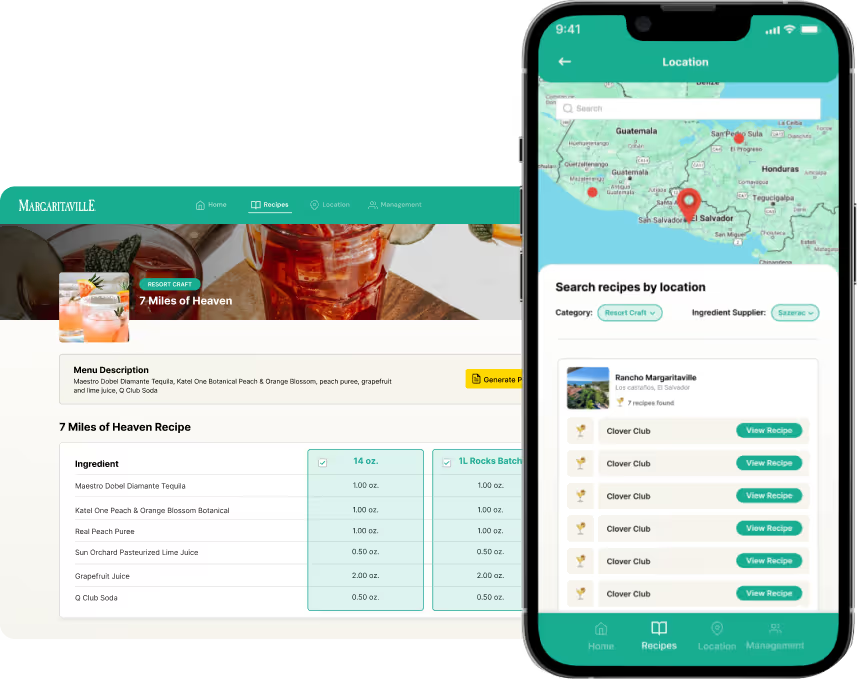
An internal recipe and cost management app used across more than 100 locations. The system centralized cocktail recipes, automated portion calculations, and adjusted costs dynamically based on glass size and inputs.
This allowed faster updates, better cost control, and more consistent operations across venues.
A valuation management platform built for Coca-Cola FEMSA’s retail division. The app centralized over 15,000 property valuations across brands and external partners, replacing fragmented manual processes.
With real-time dashboards and automated workflows, teams reduced processing time and operational friction at enterprise scale.
A Glide MVP created to automate rent payment verification and internal admin workflows for property managers. The app provided real-time tracking, clear controls, and fast validation of a new financial model.
It reduced processing time significantly and supported early traction during launch.
A donation and inventory management platform connecting donors, staff, and recipients in one system. The app streamlined submission, approval, and fulfillment workflows while keeping inventory visible in real time.
This reduced administrative workload and improved the organization’s ability to deliver aid efficiently.
LowCode Agency is a strategic product team that designs, builds, and evolves custom business software for teams that rely on their systems every day. We don’t approach Glide as a quick app builder. We use it as part of a broader product strategy to create reliable, scalable tools that support real operations, not demos or experiments.
Who we are and what we do
We build internal tools, business apps, CRMs, dashboards, portals, automation systems, and AI-powered workflows for growing SMBs, startups, and enterprise teams. Every Glide project is shaped around how the business actually works, with a focus on clarity, adoption, and long-term evolution.
Our process
We start with alignment and refinement to understand workflows, constraints, and goals. From there, we design clear product structures and UX, then build using low-code and AI as accelerators, not shortcuts. After launch, we continue iterating as operations grow and change.
If you’re considering Glide for a real business system and want clarity before committing, let’s talk.
Glide App Development
Turn Sheets Into Apps
As the largest Glide agency, we help businesses transform spreadsheets into powerful internal tools, CRMs, and mobile apps
Glide works best when it is used to support real operations, not abstract product ideas. Its strongest use cases include internal tools, workflow-driven apps, dashboards, CRMs, and portals where structured data, clarity, and adoption matter more than visual complexity.
For teams replacing spreadsheets, coordinating operations, or validating early systems, Glide can be the right choice. The key is understanding both its strengths and its limits, and using the platform intentionally within those boundaries.
The most successful Glide apps are built with decision clarity, not hype. When teams choose the platform for the right reasons and design around real workflows, Glide becomes a reliable foundation for systems that evolve as the business grows.
Last updated on
May 29, 2026
.
Jesus Vargas
-
Founder
Jesus is a visionary entrepreneur and tech expert. After nearly a decade working in web development, he founded LowCode Agency to help businesses optimize their operations through custom software solutions.
Custom Automation Solutions
Save Hours Every Week
We automate your daily operations, save you 100+ hours a month, and position your business to scale effortlessly.
Our AI — trained on 300+ shipped products — tells you what to build, what to skip, and what it'll actually cost. No fluff.
Assess My Idea"Working with LowCode Agency was the best decision I made in 2025"
Franklin Frith
CEO at HRM
Glide is most commonly used for internal tools such as admin apps, CRMs, dashboards, and operational workflows. Businesses rely on it to replace spreadsheets, centralize data, and create structured systems that support daily operations with clearer processes and shared visibility across teams.
Glide is best suited for internal tools and controlled-access apps rather than large-scale consumer products. It excels when used for operations, portals, and workflow-driven systems where data structure and clarity matter more than advanced UI customization or public app store distribution.
Yes, Glide is often used specifically to replace spreadsheets and manual workflows. It turns raw data into structured apps with permissions, logic, and validations, reducing errors and duplication while giving teams a single source of truth they can actually use day to day.
Glide is not ideal for complex consumer apps that require advanced animations, highly customized interfaces, or heavy real-time interactions. Products that depend on deep native features, high concurrency, or continuous live updates typically require more flexible platforms or native development approaches.
Glide is well suited for startups building MVPs when the goal is to validate workflows, internal systems, or early product concepts quickly. It allows teams to test assumptions, gather real usage feedback, and refine processes before investing in more complex or scalable architectures.
Glide apps scale well for small to mid-sized teams when data models and workflows are designed carefully. As usage, data volume, or complexity increases, teams may eventually reach platform limits and use Glide as a validated foundation before transitioning to a more flexible solution.
Glide
AI
Glide OpenAI Integration: Complete Practical Guide
Learn how to integrate OpenAI with Glide step-by-step, including setup, API connection, AI workflows, use cases, costs, and real limitations.
Glide
What Is Glide? No-code App Builder Review
What is Glide? Learn how Glide works, its features, pricing, limits, and how to build powerful no-code apps from beginner to pro level.
Glide
Glide App Pros and Cons (2026 Guide for Founders)
Glide is excellent for data-heavy internal tools but limited for complex logic and custom branding. We cover real strengths, deal-breaker limitations, and who it's actually built for.
Comparison
Glide
Glide vs Adalo | 10 Factors Compared (2026)
Adalo vs Glide: Choosing the right platform for your no-code app. Why Glide might surprise you!
Glide
Glide Review: Our Honest Opinion After Building 330+ Apps
With Glide, you can build easy-to-use web and mobile apps quickly and efficiently. But does it live up to the hype? Read our full review to find out!
Glide
Comparison
Glide vs Retool | 10 Factors to Decide the Best One
Compare Glide vs Retool across 10 key factors to choose the right no-code tool for your internal apps, MVPs, or custom dashboards








.avif)


