|
VOOZH | about |
|
VOOZH | about |
11 min
read
Glide is excellent for data-heavy internal tools but limited for complex logic and custom branding. We cover real strengths, deal-breaker limitations, and who it's actually built for.
By
Jesus Vargas
Updated on
May 29, 2026
.
Reviewed by
Thinh Dinh
Senior Developer
Real-World Experience with No-Code Tools: With over 320 apps built, we know firsthand what works—and what doesn't—when using no-code platforms like Glide, Bubble, FlutterFlow and Webflow.
Expert Team with 40+ Years of Combined Experience: Our team has deep technical knowledge, with experts who use no-code tools to solve real-world problems for clients every day, ensuring our advice is actionable and reliable.
Detailed Guides Based on Actual Projects: We don’t just talk about no-code; we use it daily to solve real business problems for our clients, from MVPs to complex automations.
Take a deeper look at our editorial guidelines
Glide is one of the most popular no-code tools for building apps from spreadsheets, but it is not the right choice for every project. Before you commit to a platform, you need to understand exactly where Glide excels and where it falls short.
In short: Glide is exceptional for internal tools, dashboards, and lightweight client portals. It struggles with native mobile app publishing, complex automation, and high-traffic consumer apps. This guide breaks down every major advantage and limitation so you can make a confident decision.
At LowCode Agency, we have built 350+ apps across Glide, Bubble, FlutterFlow, and custom code stacks. Here is our honest, experience-backed assessment.
Glide App Development
Turn Sheets Into Apps
As the largest Glide agency, we help businesses transform spreadsheets into powerful internal tools, CRMs, and mobile apps
The biggest mistake people make when evaluating Glide is asking 'Is it good?' without first asking 'Good for what?' Glide is purpose-built for specific use cases. Evaluating it outside of those use cases sets you up for frustration.
Here is a breakdown of common Glide project types and how Glide maps to each one:
Quick Answer: If you need an admin panel, CRM, workflow tracker, or operations tool for your team, Glide is an excellent fit. It shines for internal use cases where the user base is small and controlled.
Internal tools include:
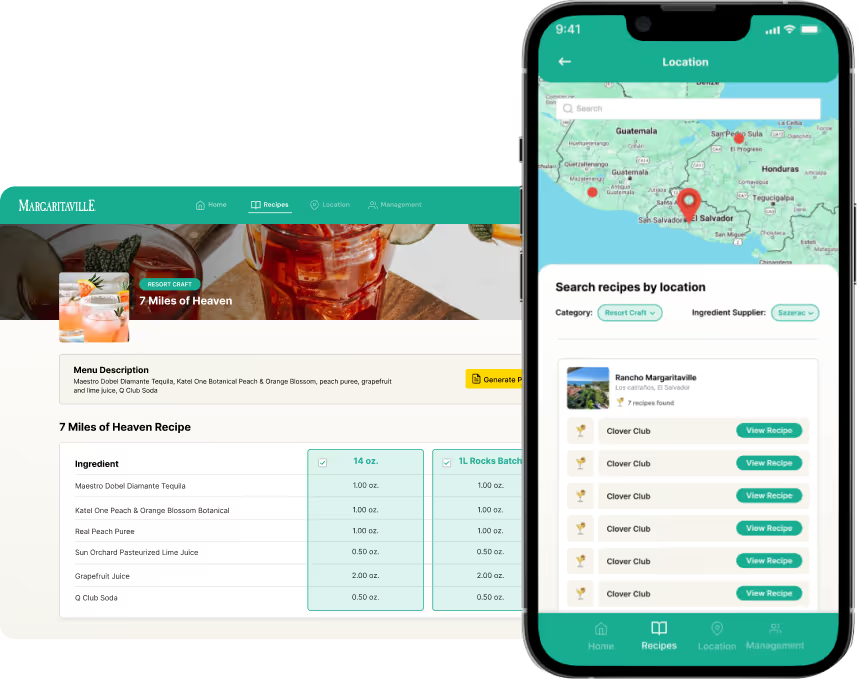
A common starting point is a structured Glide inventory app for operational tracking.
Quick Answer: Glide works well for client portals that require user logins, controlled data views, and basic access management, especially when the data already lives in Google Sheets or Airtable.
For enterprise setups, here’s how teams handle structured integrations like connecting Salesforce to Glide.
Quick Answer: This is where Glide shows its limits. Glide does not natively publish to the iOS App Store or Google Play. If your project requires push notifications, offline mode, or App Store distribution, you will need a different tool.
Glide deploys apps as browser-based experiences, which we explain fully in our breakdown of the Glide PWA model.
Quick Answer: Glide is not designed for SaaS products with complex workflows, payment processing, or large user bases. For these projects, tools like Bubble or custom development are better suited.
When Glide is the right tool for the job, it is genuinely impressive. These are the areas where it outperforms most alternatives.
Quick Answer: Yes. Glide has one of the lowest learning curves in the no-code market. With a drag-and-drop interface and zero coding requirements, most users can build a functional app in hours, not weeks.
Quick Answer: Glide is one of the fastest tools for MVP development. A working prototype can be built in a few hours using existing spreadsheet data, making it ideal for validating ideas before investing in full development.
Quick Answer: Glide's spreadsheet integration is its standout feature. It supports Google Sheets and Airtable natively, with real-time syncing, so teams that already manage data in spreadsheets can turn that data into an app instantly.
Quick Answer: Glide includes authentication, forms, conditional visibility, and a wide range of templates out of the box, features that would take weeks to build manually and are ready to configure in minutes.
You can explore curated Glide app templates that accelerate deployment.
Quick Answer: Yes. Glide apps are deployed as Progressive Web Apps (PWAs), meaning they work on both mobile and desktop browsers without requiring App Store approval or device-specific builds.
Here’s a detailed explanation of how a Glide mobile app actually works across devices.
Quick Answer: Glide supports shared editing, structured billing per team, and role-based access controls, making it straightforward to collaborate on app development and manage who can see what data.
Understanding Glide's limitations is critical before you commit. These are not deal-breakers for every project, but they will be for some.
Quick Answer: No. Glide cannot directly publish native apps to the iOS App Store or Google Play Store. Apps are deployed as PWAs, which are browser-based and cannot be listed in major app stores without third-party wrappers.
Quick Answer: Glide's design flexibility is limited compared to tools like Bubble or custom development. You can customize colors, fonts, and layouts within predefined constraints, but full pixel-level design control is not available.
Quick Answer: Glide offers partial offline capability, but it is not reliable enough for field apps or use cases where consistent internet connectivity cannot be guaranteed. Data syncing issues can occur when switching between online and offline modes.
Quick Answer: Glide's logic and automation capabilities are suitable for simple workflows but fall short for complex business logic. Multi-step automation, conditional branching, and API-heavy integrations are better handled in Bubble or with custom code.
For automation-heavy use cases, review real Glide AI features in action.
Quick Answer: Glide is not designed for high-traffic consumer applications. Performance can degrade with very large datasets in Google Sheets, and the platform is optimized for teams and small groups, not thousands of concurrent end users.
We’ve analyzed long-term performance ceilings in our guide to Glide scalability.
Quick Answer: Glide uses a per-user pricing model, which can become expensive as your team or user base grows. Key features like custom domains, advanced integrations, and more data rows are locked behind higher-tier plans.
Quick Answer: No. Glide does not offer code export. If you decide to migrate off the platform, you will need to rebuild your app from scratch in another tool or with custom code. This is a significant vendor lock-in consideration.
The decision between Glide and its alternatives usually comes down to one fundamental trade-off: speed and simplicity versus flexibility and control.
When clients come to us at LowCode Agency asking which tool to use, we always start with the use case before recommending a platform. The right answer depends entirely on what you are building and who will use it.
For operational teams, the measurable benefits of Glide AI-powered apps often justify staying within Glide’s ecosystem.
Quick Answer: Glide is the right choice when you need a fast, low-cost internal tool or client portal built on spreadsheet data, especially for teams without technical development resources.
If you'd rather work with specialists who’ve shipped production apps at scale, review our list of top Glide experts.
Quick Answer: Glide is not recommended when you need native mobile app publishing, complex automation, a large-scale consumer product, or enterprise-grade compliance and security.
Glide's pricing looks attractive at entry level, and for the right use case, the ROI is clear. The risk comes when you scale beyond what lower tiers support.
| Plan | Price | Best For | Key Limitation |
|---|---|---|---|
| Free | $0/month | Personal projects | Limited rows and users |
| Maker | $49/month | Solo builders, small teams | Limited users, integrations |
| Team | $99/month | Growing teams | Per-user costs increase |
| Business | Custom | Larger organizations | Sales call required |
Quick Answer: Migrating away from Glide is possible but requires significant effort. Your data (in Google Sheets or Airtable) is portable, but your app's UI, logic, and workflows must be rebuilt from scratch in any new platform.
If you think you will outgrow Glide within 12 to 18 months, it is worth factoring rebuild costs into your platform decision today. In our experience at LowCode Agency, clients who start in Glide and need to migrate often spend 2 to 3 times the initial development cost on the rebuild.
| Tool | Best For | App Store | Offline | Starting Price | Complexity |
|---|---|---|---|---|---|
| Glide | Internal tools, portals | No (PWA) | Partial | $49/mo | Low |
| Bubble | SaaS, marketplaces | No (PWA) | No | $29/mo | Medium–High |
| FlutterFlow | Native mobile apps | Yes | Yes | $30/mo | Medium |
| Adalo | Consumer mobile apps | Yes | Limited | $45/mo | Low–Medium |
| Custom Code | Complex, scalable apps | Yes | Yes | Project-based | High |
Glide App Development
Turn Sheets Into Apps
As the largest Glide agency, we help businesses transform spreadsheets into powerful internal tools, CRMs, and mobile apps
Quick Answer: Use Glide if you need a fast, affordable internal tool or client portal built on spreadsheet data. Choose an alternative if you need native mobile publishing, complex workflows, or a platform that scales to a large consumer audience.
Not sure which platform fits your project? When clients ask us at LowCode Agency to evaluate options, we run a quick discovery process to match the right tool to the right job. You can reach our team to discuss your specific use case.
If you’re still exploring broader options, review our structured breakdown of leading Glide alternatives before committing.
Last updated on
May 29, 2026
.
Jesus Vargas
-
Founder
Jesus is a visionary entrepreneur and tech expert. After nearly a decade working in web development, he founded LowCode Agency to help businesses optimize their operations through custom software solutions.
Custom Automation Solutions
Save Hours Every Week
We automate your daily operations, save you 100+ hours a month, and position your business to scale effortlessly.
Our AI — trained on 300+ shipped products — tells you what to build, what to skip, and what it'll actually cost. No fluff.
Assess My Idea"Working with LowCode Agency was the best decision I made in 2025"
Franklin Frith
CEO at HRM
Glide is not well-suited for most SaaS products. It lacks the complex workflow capabilities, payment infrastructure, and scalability required to build a competitive SaaS platform. Tools like Bubble or custom development are better options for SaaS.
Glide is designed for small-to-medium team sizes, typically under 100 active users. With large datasets in Google Sheets, performance degrades noticeably. For thousands of concurrent users, a dedicated backend and custom app is a more reliable approach.
No, Glide does not support direct publishing to the iOS App Store or Google Play Store. Glide apps are deployed as Progressive Web Apps (PWAs), which users access via a browser or add to their home screen. For native app store publishing, consider FlutterFlow or Adalo.
Glide offers solid security for most business use cases, including user authentication, role-based data visibility, and data encryption in transit. However, it is not currently certified for strict compliance frameworks like HIPAA or SOC 2. Businesses with regulatory requirements should verify Glide's compliance documentation before committing.
For complex apps, Bubble is the leading no-code alternative, offering full relational databases, complex workflows, and API integrations. For native mobile apps, FlutterFlow is a strong choice. For maximum flexibility and scalability, custom development using Next.js, React, and Supabase gives you complete control.
Glide's Maker plan starts at $49/month, but costs increase significantly as your user count and data needs grow. For teams with 50+ users and advanced feature requirements, monthly costs can range from $200 to $500 or more, at which point comparing against custom development becomes worthwhile.
Glide
Glide App Examples: 16 Real Business Apps (2026)
Explore 16 real Glide app examples used by businesses in 2026. See how teams build internal tools, CRMs, automation, and data-driven apps.
Glide
How to Translate a Glide App to Any Language (Complete Guide)
Learn how to translate a Glide app into any language using tables, computed columns, AI, and best practices for multi-language app setup and scaling.
Comparison
Glide
Bubble
Bubble vs Glide | 10 Factors to Decide the Best One
Compare Bubble vs Glide across 10 key factors, including use cases, backend needs, scalability, pricing, limitations, and which platform fits your app goals.
Glide
AI
Glide OpenAI Integration: Complete Practical Guide
Learn how to integrate OpenAI with Glide step-by-step, including setup, API connection, AI workflows, use cases, costs, and real limitations.
Glide
Glide Use Cases (Real Examples Across Industries)
Discover real Glide use cases across industries. See what you can build, from internal tools and CRMs to client portals, AI apps, and inventory systems.
Glide
Can Glide Build iPhone Apps? (Glide iOS App Guide)
Can Glide build iPhone apps? Learn how Glide works on iOS, App Store limits, key features, and when Glide is the right tool for mobile app development.