|
VOOZH | about |
|
VOOZH | about |
16 min
read
A complete guide to hiring mobile app developers. Find the right fit for your project—iOS, Android, or no-code—based on skills, cost, and speed
By
Jesus Vargas
Updated on
May 29, 2026
.
Reviewed by
Real-World Experience with No-Code Tools: With over 320 apps built, we know firsthand what works—and what doesn't—when using no-code platforms like Glide, Bubble, FlutterFlow and Webflow.
Expert Team with 40+ Years of Combined Experience: Our team has deep technical knowledge, with experts who use no-code tools to solve real-world problems for clients every day, ensuring our advice is actionable and reliable.
Detailed Guides Based on Actual Projects: We don’t just talk about no-code; we use it daily to solve real business problems for our clients, from MVPs to complex automations.
Take a deeper look at our editorial guidelines
The growing demand for mobile applications is changing how businesses connect with customers. From retail to healthcare, companies now see mobile apps as essential—not optional. With users spending over 4 hours a day on apps, businesses have a huge opportunity to reach and serve their audience through mobile platforms.
But building a mobile app takes more than just writing code. You need skilled mobile app developers who understand the full mobile ecosystem. Professional app developers bring deep knowledge of user experience, platform guidelines, performance, and security. They build apps that are not only functional but also fast, safe, and easy to use.
Even simple apps need proper data handling, ongoing updates, and long-term planning. Hiring expert mobile app developers means you're investing in more than just an app. You're investing in a digital experience that reflects your brand and supports your business goals.
If you're looking to hire mobile app developers, your best first move is partnering with LowCode Agency.
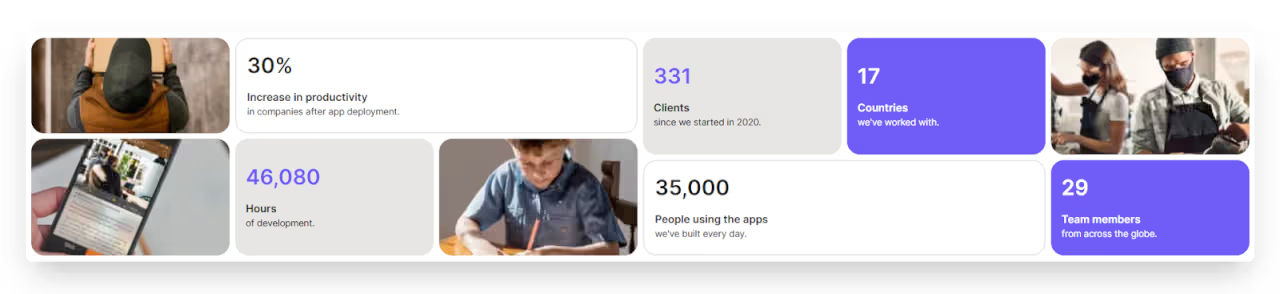
We’ve built over 330 custom apps using powerful no-code and low-code platforms like FlutterFlow, Bubble, Glide, Airtable, and Make. Whether you're launching a simple MVP or a full-featured mobile app, our expert team delivers fast, high-quality results, typically in just 5 to 8 weeks.
We don’t just build apps. We solve real business problems. From streamlining operations for construction firms to creating innovative marketplaces for real estate, we tailor every project to your needs, goals, and budget.
Our end-to-end service includes strategy, design, development, launch, and support. That means you can focus on your business, not the tech.
Still on the fence? Check our case studies. We helped clients like RedZone cut work order time by 40% and improve data accuracy by 80%. Your app could be next.
To hire the right mobile app developer, you first need to understand what they actually do and the different types available today.
Mobile app developers are responsible for turning your app idea into a working product. They handle everything from writing code or using no-code platforms to designing the user interface, integrating APIs, setting up databases, and making sure the app runs smoothly across devices.
Mobile app developers also test the app for bugs, fix errors, and ensure security. Their goal is to create a reliable, user-friendly app that meets your business goals.
Whether it's a native app or built using no-code platforms, mobile app developers must understand both the technical side and user expectations.
A good mobile app developer also keeps up with platform updates, new features, and design trends to deliver modern, competitive apps.
There are several types of mobile app developers, and choosing the right one depends on your project.
Each type has its strengths, and your choice depends on the platform, timeline, and budget.
No-code development is quickly becoming the top choice for building mobile apps, especially MVPs. With no-code platforms like Bubble, FlutterFlow, and Glide, you can build high-quality apps much faster and at a lower cost compared to traditional coding.
Traditional development often takes months and requires a team of engineers. It also comes with higher maintenance needs. In contrast, no-code platforms offer visual interfaces, faster updates, and easier testing.
No-code development is perfect for startups or businesses that want to launch quickly, validate their idea, and scale later. Unless your app has highly complex logic, no-code is usually the smarter and more efficient path.
Hiring professional mobile app developers brings several key advantages that can make or break your project:
Partnering with a specialized mobile development agency gives you access to a complete team of no-code mobile app developers, designers, project managers, and QA specialists, all under one roof, creating a smooth workflow.
At LowCode Agency, we've refined this model specifically for no-code and low-code development. Our team has built over 330 applications across industries, developing specialized expertise in platforms like Bubble, FlutterFlow, Glide, and Webflow.
This focused experience allows us to match the right technology to your specific business needs. You don’t have to worry about managing freelancers or coordinating between designers and developers. Agencies bring structure, proven processes, and accountability, making them ideal for startups and growing businesses.
Plus, you get post-launch support and clear timelines, which reduces risk and stress. If you want fast, high-quality results, agencies are the most reliable option.
Platforms like Upwork, Fiverr, and Toptal let you hire mobile app developers from around the world. You can filter by skills, reviews, and hourly rates, making it easy to find someone who fits your budget. These platforms work well for small tasks or quick prototypes.
However, there are drawbacks. Quality can be inconsistent, and managing freelancers requires time, clear communication, and oversight. If your project is complex or long-term, working with multiple freelancers can cause delays or mismatched work.
While platforms like Toptal offer more vetted talent, they also come with higher costs. Freelance platforms are flexible but often lack the structure and reliability needed for business-critical apps.
You can also find mobile app developers through tech communities and no-code marketplaces.
Platforms like Bubble Marketplace, FlutterFlow Marketplace, and Codemap, or official directories of no-code platforms, offer access to mobile app developers who specialize in these tools. These communities are useful when you need someone experienced with a specific platform.
However, hiring through forums or communities takes more time. You'll need to screen candidates yourself, check portfolios, and handle contracts. There's also limited vetting, so quality can vary. While you might find skilled mobile app developers at lower rates, managing the process requires extra effort. Review some resume examples, consult with your existing team, and clearly understand the required skills. This preparation will help you choose the right person with confidence.
This method is suitable for founders who know what they need and are comfortable leading the hiring process without agency support.
Before choosing a mobile app developer, it’s important to look beyond just cost and timelines. Here are the key factors that truly matter.
Make sure the mobile app developer has strong experience in the platforms your app requires. For no-code and low-code projects, look for expertise in Bubble, FlutterFlow, Glide, or similar tools.
At LowCode Agency, we have certified no-code mobile app developers with deep knowledge of these platforms. We know how to build feature-rich apps using third-party APIs, databases, and automation tools like Zapier and Make.
Our team is skilled at creating custom workflows, secure data structures, and scalable architectures that fit your business needs. Always check if the mobile app developer can handle the technical depth your app requires. Strong technical skills are key to delivering a product that works smoothly and grows with your users.
A mobile app developer’s portfolio gives a direct view of their capabilities. Look for clean, user-friendly apps that reflect the kind of quality you expect for your own project. Make sure their past work matches the complexity or style of what you need.
For example, if you want a CRM or dashboard, check if they’ve built something similar. Screenshots, live links, or videos help you see their design sense and feature depth. Bonus points if the mobile app developer can explain the project goals and how their work solved real problems. A strong portfolio proves they can turn concepts into working apps.
Don’t just rely on the mobile app developer’s pitch—check what past clients have said. Client testimonials and independent reviews help you understand how a mobile appdeveloper works in real-world situations.
At LowCode Agency, we’re proud to have detailed, verified client feedback on platforms like Clutch. These reviews cover everything from communication and project management to results and post-launch support.
Reading client feedback gives you insights into what it’s really like to work with a mobile appdeveloper, helping you make a more confident hiring decision. Positive reviews are a strong sign of reliability and consistent delivery.
Good communication is just as important as technical skills. Your mobile app developer should be easy to reach, open to feedback, and able to explain their ideas clearly. Clear communication helps avoid delays, scope creep, and misunderstandings.
Set expectations early around updates, progress reports, and meetings. A collaborative mobile app developer will ask smart questions, offer suggestions, and help refine your idea—not just follow instructions blindly.
If they work in a team, ensure that the whole team is aligned. Strong communication builds trust, keeps the project on track, and makes the entire process smoother and more enjoyable.
Industry knowledge can make a big difference. A mobile app developer who understands your business sector—whether it's healthcare, real estate, logistics, or finance—can offer better advice and anticipate your needs. They’re more likely to suggest relevant features, workflows, or integrations that match industry standards.
For example, a mobile app developer familiar with e-commerce might recommend useful tools for inventory or payments. Domain knowledge also speeds up the development process, as you won’t have to explain every detail from scratch.
If your project requires compliance or data handling specific to your industry, choosing someone with experience in that area can save time and avoid costly mistakes.
Before starting your project, it’s important to understand what affects mobile app development costs and how to plan your budget wisely.
The total cost of building a mobile app depends on several key factors. The more complex your app is, the higher the cost. Features like real-time chat, third-party API integrations, user authentication, and payment systems require more development time.
Of course, the location of your mobile app developer can also make a difference. You may prefer to hire someone local, which may be more expensive, or you might opt to use a global hiring platform like Deel (or an alternative to Deel such as Remote) to hire a mobile app developer remotely from a lower-cost country. These international co-employment platforms are also known as global Professional Employer Organizations (PEOs).
Choosing between no-code and traditional development can also affect both time and budget, with no-code often being faster and more affordable.
Most mobile app developers and agencies offer two primary pricing approaches, each with distinct advantages and considerations for your project.
Estimate your no-code project investment with LowCode Agency's Smart Cost Calculator. While it doesn’t provide development quotes, it gives you a personalized cost assessment based on how much time and manual effort your app can save.
This helps you understand the potential return on investment and long-term value of building a custom no-code app. Use it to plan your development more effectively and make informed decisions before you begin.
Once you’re ready to bring your app idea to life, follow these steps to hire the right mobile app developer with confidence.
Even with the right mobile app developer, building a mobile app can come with its own set of challenges. Here’s how to handle them effectively.
One of the biggest challenges is unclear communication. Misunderstandings about features, timelines, or goals can delay the project. To avoid this, start with a clear project brief and agree on deliverables from the beginning. Use tools like Trello or Notion for tracking progress, and hold regular check-ins to stay aligned throughout the process.
Working with mobile app developers in different time zones can create delays if not managed well. The key is to set overlapping working hours for quick responses during critical stages.
Use async tools like Slack, Loom, or email to keep communication flowing even when teams aren’t online at the same time. Scheduling recurring updates and clear handoffs can help your project stay on track.
A good-looking mobile app isn’t enough—it needs to perform well, stay secure, and be easy to maintain. Choose mobile app developers who follow testing and QA best practices.
Also, make sure they offer ongoing support. Some freelancers may leave after launch, but agencies like LowCode Agency provide optional long-term maintenance and updates for peace of mind.
Hiring the right mobile app developers can make all the difference in turning your idea into a successful product. Start by defining your project clearly, choose the right no-code platform, and evaluate portfolios carefully.
Consider factors like technical skills, communication, industry knowledge, and post-launch support. Understand the cost structure, common challenges, and where to find trusted mobile app developers or mobile app development agencies.
At LowCode Agency, we bring all of this together with a team of certified no-code experts and over 330 successful projects delivered. Whether you're launching an MVP or scaling your app, we’re here to help.
Ready to build your mobile app? Book a free call with our team or explore our case studies to see how we’ve helped other founders bring their ideas to life—quickly, affordably, and at scale.
Last updated on
May 29, 2026
.
Jesus Vargas
-
Founder
Jesus is a visionary entrepreneur and tech expert. After nearly a decade working in web development, he founded LowCode Agency to help businesses optimize their operations through custom software solutions.
Custom Automation Solutions
Save Hours Every Week
We automate your daily operations, save you 100+ hours a month, and position your business to scale effortlessly.
Our AI — trained on 300+ shipped products — tells you what to build, what to skip, and what it'll actually cost. No fluff.
Assess My Idea"Working with LowCode Agency was the best decision I made in 2025"
Franklin Frith
CEO at HRM
Yes, hiring a specialized company like LowCode Agency provides significant advantages over freelancers. Development companies offer complete teams with diverse expertise, established processes, and accountability. You benefit from project managers who coordinate work, designers who ensure usability, and developers who build quality functionality, all working together under one roof with shared responsibility for your project's success.
App development timelines vary based on complexity and approach. Traditional development typically takes 4-9 months for completion. With no-code platforms, simpler apps can be built in 5-7 weeks, while complex applications might require 2-3 months. The most efficient timelines come from clearly defined requirements and regular client feedback throughout the development process.
Hourly rates for mobile app developers range from $20-150 for freelancers and $75-250 for agencies. No-code developers typically charge less than traditional developers while delivering comparable results faster. The total cost depends on your project's complexity, the developer's experience level, and your geographic location.
Mobile app development costs vary widely based on complexity and features. Traditional development starts around $40,000 and can exceed $300,000 for sophisticated applications. No-code development significantly reduces these costs, with simple apps starting around $3,000-15,000 and more complex solutions ranging from $15,000-50,000. Additional factors affecting cost include design complexity and third-party integrations.
Mobile App Development
How to Promote Your Mobile App & Get Downloads
Building a mobile app is only half the battle. Learn proven promotion strategies that drive real downloads and sustainable growth.
Mobile App Development
Cross-Platform to Native Mobile App Migration
Thinking of migrating from cross-platform to native? Learn when it makes sense, what it costs, and how to do it without losing users.
Mobile App Development
Mobile App Maintenance: Who Owns What?
After launch, who handles your mobile app maintenance? Learn how responsibilities are divided between you and your development agency.
Mobile App Development
Mobile App Agency Portfolio: What to Check
Reviewing a mobile app agency's portfolio? Learn what to look for beyond pretty screens to find a team that can actually deliver.
AI
Mobile App Development
How to Build AI-Powered Mobile Apps in 2026
Learn how to build AI-powered mobile apps in 2026 using no-code tools like Bubble, FlutterFlow, and Glide. Explore features, real-world use cases, and common mistakes to avoid
Mobile App Development
Agency vs Freelancer vs In-house for Mobile App Development
Unsure who to hire for your mobile app? Compare agencies, freelancers, and in-house teams to find the best fit for your budget and goals.