|
VOOZH | about |
|
VOOZH | about |
15 min
read
Explore real no-code use cases you can build in 2026. See practical examples, tools, and ideas to launch apps, automate workflows, and solve business problems fast.
By
Jesus Vargas
Updated on
May 29, 2026
.
Reviewed by
Real-World Experience with No-Code Tools: With over 320 apps built, we know firsthand what works—and what doesn't—when using no-code platforms like Glide, Bubble, FlutterFlow and Webflow.
Expert Team with 40+ Years of Combined Experience: Our team has deep technical knowledge, with experts who use no-code tools to solve real-world problems for clients every day, ensuring our advice is actionable and reliable.
Detailed Guides Based on Actual Projects: We don’t just talk about no-code; we use it daily to solve real business problems for our clients, from MVPs to complex automations.
Take a deeper look at our editorial guidelines
No-code is not just for simple apps or quick prototypes. In 2026, real businesses run SaaS platforms, automate entire operations, and serve thousands of customers on no-code tools without a single developer on the team.
This guide covers the most practical no-code use cases across every business type so you can identify where it fits your situation and what to build first.
Strategic Technology Partner
We Help You Win Long-Term
We don’t just deliver software—we help you build a business that lasts.
No-code solves real operational problems, not just app categories. The most useful frame is not what type of app you can build but what problem you are currently solving manually that could run as a system instead.
Teams replace chaotic spreadsheet tracking with structured internal tools. Founders launch products that would have required three months and a developer in two weeks and under $10,000. Operations teams automate the repetitive coordination work that consumes hours every week across their entire department.
Real no-code app examples across industries show the range of what ships in production today, from simple dashboards to multi-user SaaS platforms processing real transactions.
No-code is where most startup products begin in 2026. The speed and cost advantage over custom development is significant enough that building an MVP any other way is hard to justify before product-market fit is proven.
Building a no-code MVP covers how to scope a product build that validates demand without overinvesting before the idea is proven.
Internal tools are the highest-ROI no-code use case for most businesses. Requirements are well understood, users are internal, and the cost of a rebuild is low relative to the immediate operational value delivered.
Automation delivers the fastest payback of any no-code use case. Business process automation examples across industries show how consistently the same workflow patterns appear regardless of company size.
The benefits of business process automation compound over time as each automated workflow frees capacity that compounds into real operational leverage.
Customer-facing systems built on no-code handle real transaction volume and real user bases across industries that would have required significant custom development five years ago.
Industry-specific operational tools are among the most underexplored no-code use cases despite being some of the highest-value builds for the teams that need them.
Data management and workflow coordination are use cases where no-code replaces both expensive software and manual processes simultaneously.
AI-powered no-code use cases are the fastest-growing category in 2026. Building an AI SaaS with no-code is increasingly practical for founders who understand where no-code AI integration works reliably.
Idea validation is where no-code has the clearest advantage over every alternative. Getting a working product in front of real users before significant investment changes the economics of early-stage product development fundamentally.
These are the automation patterns that run in production across businesses every day.
The right starting point depends entirely on where the biggest operational friction or growth constraint is in your current situation.
The best starting use cases share a common profile: well-understood requirements, limited scope, and immediate visible value for the people using the result.
| Use Case | Effort | Impact | Best For |
|---|---|---|---|
| Automation workflows | Low | High | Operations teams |
| Internal tools | Low to medium | High | All business types |
| Basic MVPs | Medium | High | Founders validating ideas |
| Customer-facing apps | Medium | High | Service businesses |
| SaaS platforms | High | High | Startups with funding |
| Marketplaces | High | High | Platform businesses |
Automation and internal tools consistently sit in the low effort, high impact quadrant because the requirements are defined, the users are known, and the value is measurable from day one. SaaS platforms and marketplaces require significantly more planning, build time, and budget but produce proportionally higher long-term value when the product finds its market.
| Use Case | Build Cost | Monthly Platform Cost | Complexity |
|---|---|---|---|
| Automation workflows | $500 to $5,000 | $9 to $150 | Low |
| Internal tools | $3,000 to $15,000 | $30 to $150 | Low to medium |
| MVP products | $5,000 to $20,000 | $30 to $300 | Medium |
| SaaS platforms | $20,000 to $70,000 | $100 to $529 | High |
| Marketplaces | $30,000 to $100,000 | $150 to $529 | High |
Internal tools deliver the clearest cost-to-value ratio because they are fast to build, cheap to run, and replace manual processes with measurable time savings from day one. SaaS platforms and marketplaces require more investment but generate revenue that justifies the build cost when the product finds product-market fit.
The real capabilities and limitations of no-code make clear where the category performs well and where it creates more problems than it solves.
The right no-code use case changes as the business grows. Matching the use case to the business stage prevents both premature complexity and underinvestment in systems that the business has already outgrown.
Low-code business process automation becomes increasingly relevant at the scale stage when pure no-code approaches hit their flexibility ceiling and teams need more control over workflow logic without committing to full custom development.
Choosing the right use case is more important than choosing the right platform. A well-chosen simple use case built on any capable platform outperforms an ambitious complex use case built on the best platform available.
DIY no-code use case implementation costs less upfront and more overall for anything beyond simple single-step automation or basic internal tools.
No-code use cases in 2026 span from simple automation workflows saving hours per week to full SaaS platforms serving thousands of paying customers. The right use case is not the most technically impressive one available. It is the one that solves the most important problem your business faces right now with the resources available to build it properly.
Start with the bottleneck. Build the minimum that proves the value. Expand from there as the use case is validated and the operational benefit is clear.
Strategic Technology Partner
We Help You Win Long-Term
We don’t just deliver software—we help you build a business that lasts.
At LowCode Agency, we are a strategic product team that designs, builds, and evolves custom no-code applications for growing SMBs and startups. We are not a dev shop.
We have shipped 350+ products across 20+ industries. Clients include Medtronic, American Express, Coca-Cola, and Zapier.
If you are serious about building the right no-code system for your business without the expensive mistakes, let's talk.
Last updated on
May 29, 2026
.
Jesus Vargas
-
Founder
Jesus is a visionary entrepreneur and tech expert. After nearly a decade working in web development, he founded LowCode Agency to help businesses optimize their operations through custom software solutions.
Custom Automation Solutions
Save Hours Every Week
We automate your daily operations, save you 100+ hours a month, and position your business to scale effortlessly.
Our AI — trained on 300+ shipped products — tells you what to build, what to skip, and what it'll actually cost. No fluff.
Assess My Idea"Working with LowCode Agency was the best decision I made in 2025"
Franklin Frith
CEO at HRM
The most common no-code use cases are internal tools replacing spreadsheets, business process automation for repetitive workflows, MVP products for idea validation, customer-facing apps like booking and CRM systems, and SaaS platforms built without engineering teams.
Yes. Real businesses run production SaaS platforms, marketplaces, internal operational tools, and customer-facing applications on no-code platforms. These are not prototypes or demos. They handle real transactions, real user bases, and real operational volume every day.
Internal tools and simple automation workflows are the best starting points. Requirements are well understood, users are internal and forgiving, build time is short, and the operational value is immediately visible. Both use cases build confidence and platform familiarity before tackling more complex product builds.
No. SaaS platforms, two-sided marketplaces, AI-powered tools, and complex operational systems all run on no-code platforms in production. The ceiling is real but significantly higher than most people expect before exploring what the current generation of no-code platforms actually handles.
Identify the biggest operational bottleneck or growth constraint you face right now. Choose the simplest use case that directly addresses it. Build the minimum version that proves the value works before expanding scope. The right use case is the one solving your most important problem today, not the most technically ambitious thing no-code can theoretically build.
Simple automation workflows build in hours to days. Internal tools and basic MVPs build in one to four weeks professionally. Full SaaS platforms and marketplaces take six to twelve weeks depending on complexity. The time advantage over custom development is two to four times faster across every use case category.
No-code/Low-code
Best 11 No-code Agencies [2026] | Hire the Best one
Looking for the best no-code agency in 2026? Explore the top 11 no-code teams for SaaS, mobile apps, automation, and MVPs. Find the perfect partner today.
Custom App Development
No-code/Low-code
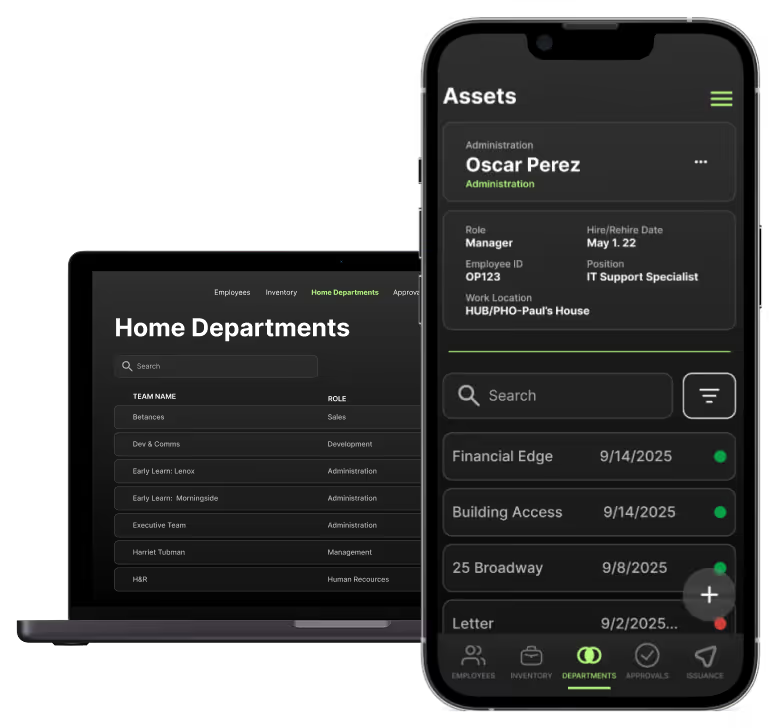
How to Build Workforce Management Apps Using Low-code
Learn how to build workforce management apps using low-code, covering features, workflows, integrations, costs, and best practices for scalable teams.
Business Automation
No-code/Low-code
What Is No-code Automation? (Beginner Guide for 2026)
What is no-code automation? Learn how it works, real use cases, tools, and how to automate workflows without coding in this beginner-friendly 2026 guide.
No-code/Low-code
What Is a Low-code Development Platform? [Full Guide]
Learn what a low-code development platform is, how it works, and why teams use it to build apps faster. Simple explanation with features and examples.
No-code/Low-code
Top no-code web app builders for 2026
Discover the ultimate curated list of top no-code web app builders, empowering you to build web apps without coding.
Mobile App Development
No-code/Low-code
11 Best No-code Mobile App Builders | Don’t Miss Out!
Discover the 11 best no-code mobile app builders to create iOS & Android apps without coding. Compare features & pick the right tool for your needs





![👁 Best 11 No-code Agencies [2026] | Hire the Best one](https://cdn.prod.website-files.com/61cbe22a00483909d327afc6/6a19ce4f7d0b56b04ef8a18d_69318e14a79b823e45f0b8e8_Best%2520No-code%2520Agencies%2520(1).avif)
![👁 What Is a Low-code Development Platform? [Full Guide]](https://cdn.prod.website-files.com/61cbe22a00483909d327afc6/69de878d902970291a8e413c_69b2c79cd1630296914bbb4f_what-is-a-low-code-development-platform.avif)