|
VOOZH | about |
|
VOOZH | about |
We use cookies to improve your experience on our site. By using our site, you are agreeing to the collection and use of data as described in our Privacy Policy.
Cookie Settings×Table of contents
A clear, practical process for managing the product development lifecycle is critical to ensuring new products work smoothly with your customers' existing tech stack and workflows.
Implementing this process is easier said than done. Product managers have to include plans for unforeseen technical complexity, develop tight cross-functional collaboration processes, balance speed with quality carefully, and more.
To help you implement an effective product development lifecycle (PDLC) process successfully, we’ll align on its definition, review the key stages to consider, share best practices for building any, and more.
It’s a structured process for taking a product to market. It includes ideation, planning, design, development, testing, launch, and analysis and maintenance post-launch.
It’s worth clarifying the differences between the PDLC and the broader product lifecycle (PLC). The PDLC focuses on creating and launching a product successfully, while the PLC spans the full arc of a product’s existence—including its later stages of maturity, up until it's deprecated.
Related: What is a product experience strategy? Here’s what you need to know
Most teams follow a familiar set of phases, whether they’re using Agile, Waterfall, or hybrid methodologies. And while exact workflows may vary, the underlying structure remains consistent.
Ideas emerge from customer feedback, competitive analysis, internal discussions, and observed market gaps.
At this stage, teams should focus on problem clarity—what pain points are we solving? For whom? Why now?
It’s also the right time to start identifying external dependencies.
For example, say you learn that your customers will need your product to integrate with their HR software to automate user provisioning. The external dependencies for this product requirement would be the API providers and their endpoints for fetching employee data.
With a promising idea in hand, your team can move on to product planning. This includes defining scope, aligning around product vision, exploring feasibility, and building the business case.
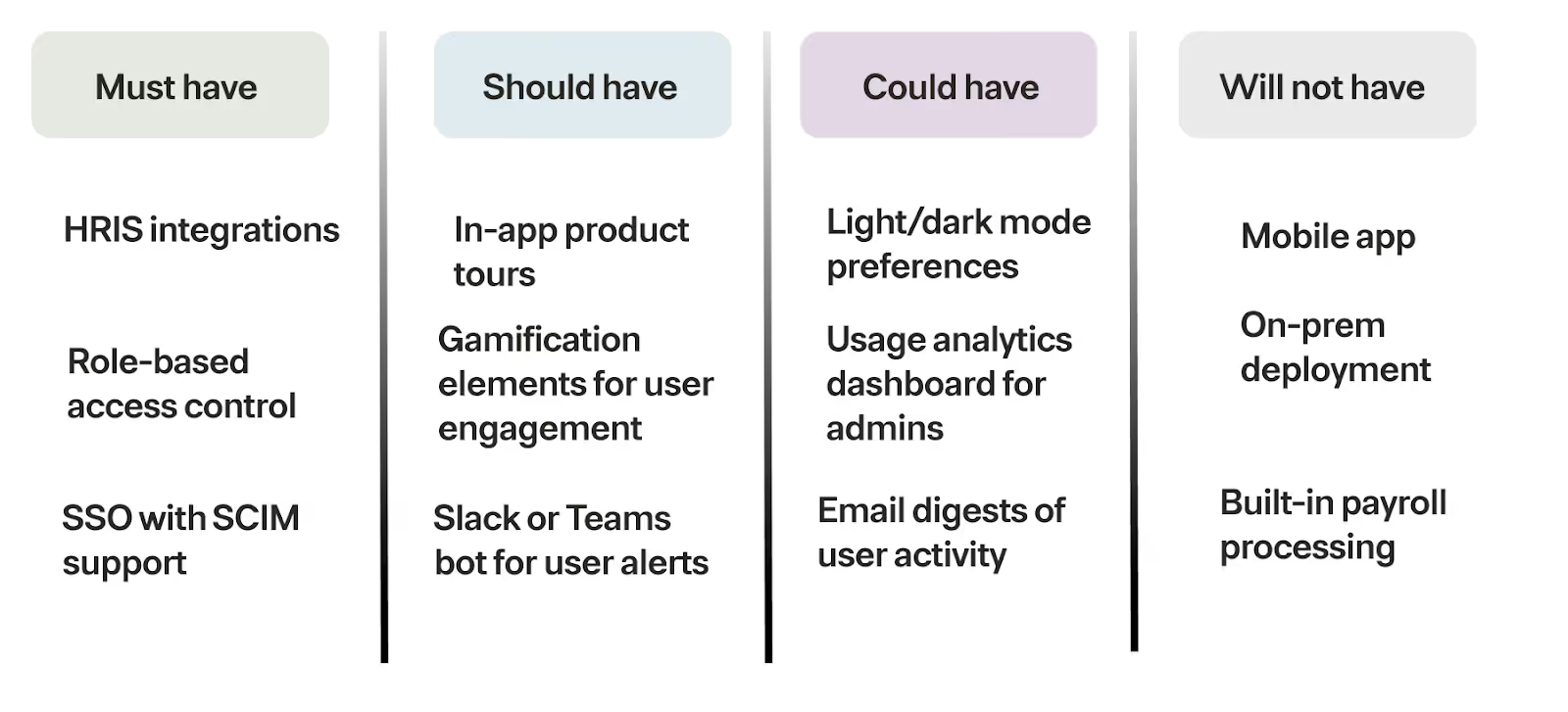
Frameworks like RICE (reach, impact, confidence, and effort) or MoSCoW (must have, should have, could have, won’t have) can help your team prioritize features effectively.
Importantly, this stage should surface the full complexity of what needs to be built, including any integration or compliance requirements that could affect timelines or architecture. This helps minimize surprises later and allows teams to sequence work more effectively.
You should also research and brainstorm potential issues that can go wrong at each step and identify and document the most appropriate contingency plans. Hopefully, this won’t be used, but it’s better to be safe than sorry.
Related: How to design an AI product strategy
With validated priorities, the focus shifts to mocking up product UIs, workflows and gathering feedback.
Successful teams treat this as a collaborative loop between product, design, and engineering. The goal isn’t to create static visuals—it’s to test assumptions early and refine how users will interact with the product.
When ecosystem readiness is part of the product’s value (e.g., the need to exchange data with another tool), it’s critical to prototype those workflows too, not tack them on later.
At this phase, product requirements need to turn into working software.
Common friction points here include scope creep, vague requirements, and poor handoff from design.
Any external dependencies, such as 3rd-party API endpoints getting deprecated or changed in a way that’s backwards incompatible, can also slow things down. Hopefully, the contingency plans defined in the product planning and validation step can be leveraged here to minimize any slowdown in velocity.
Before launch, your product will need to go through rounds of QA, user acceptance testing (UAT), and stakeholder reviews.
The goal is twofold: ensure the product works as intended and ensure it fits the user’s workflow.
Issues caught here are much cheaper to fix than post-release bugs, so now would be the time to seek as much feedback as possible. To that end, you can even try to recruit a design partner that’s eager to adopt your solution. They’ll be aggressive in providing feedback, as they likely have a compelling vision for how they want to use your solution.
Launch isn’t just a technical milestone—it’s a company-wide effort. GTM teams need enablement materials. Support needs documentation. Sales needs demos. Marketing needs to make a big splash—and the list goes on.
The PDLC doesn’t end at launch. Real-world usage often reveals edge cases and pressing fixes that need to be implemented.
Fortunately, there’s countless product management tools that help support this work, including Amplitude, Mixpanel, and Fullstory.
Without a shared framework, product development becomes reactive. Work is rushed, the scope is unclear, and features are misaligned with market needs.
A clearly-defined PDLC helps teams:
Related: Why product objectives are critical
Even with a PDLC, teams often face challenges like delayed roadmaps and communication silos.
To handle these complexities and maintain agility, modern product teams can adopt several best practices:
Ensure representatives from product, engineering, design, and GTM teams are involved from the earliest stages. This shared understanding prevents downstream misalignments and ensures all perspectives are considered for a well-designed product.
Related: Best practices for building a product roadmap
Your product will almost certainly require product integrations with complementary SaaS solutions.
Assuming yours isn't an outlier, you’ll need to treat integrations with the same strategic importance as core product functionalities.
Plan for them from day one, design their UX as an integral part of the user journey, and allocate resources for their development and maintenance to ensure seamless interoperability.
AI tools can help each team manage their respective PDLC tasks faster.
Developers can use AI to generate boilerplate code; product managers can get detailed analysis from user feedback to identify features that need to be prioritized; designers can generate UI mockups from simple text prompts, and the list goes on!
Define clear criteria for moving from one PDLC stage to the next. These "stage gates" ensure necessary activities are completed and key decisions are made before committing further resources.
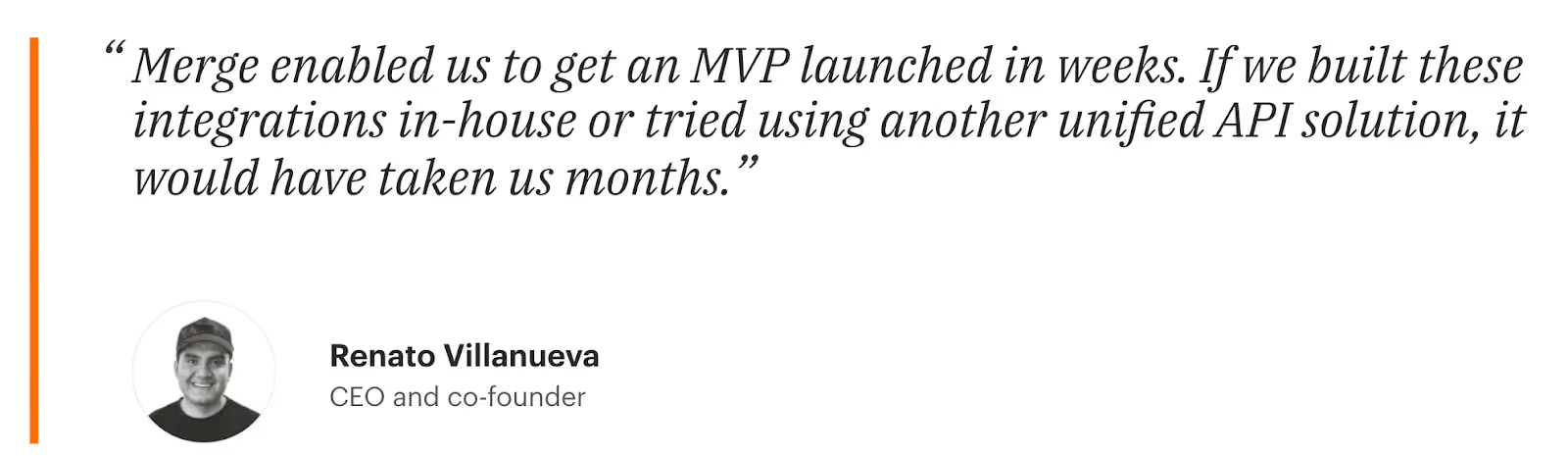
Product integrations can derail your product launches, as they can take engineers months to build.
Fortunately, you can quickly launch a cutting-edge product with all the integrations your users need by leveraging Merge.
Merge offers a single API that lets your users access hundreds of cross-category integrations, making integrations not just easy to build but also a key differentiator for your product.
Learn how Merge can help your PDLC run smoothly by scheduling a demo with one of our integration experts.

.avif)
.avif)


.avif)
.png)