I have found and reviewed appropriate literature, including both the type publication for paramolybdomenite " Pekov, Igor V., et al. "Paramolybdomenite, PbSeO3, a new mineral dimorphous with molybdomenite from the Tolbachik volcano, Kamchatka, Russia."
Mineralogical Magazine: 1-22. " and an occurrence of what is now known as paramolybdomenite from El Dragon, "Zhang, Jingnan; Yang, Hexiong; Gibbs, Ronald B. (2024) Molybdomenite-P21/c, Polymorphous with Molybdomenite and the Natural Analogue of Synthetic α-PbSe4+O3, from the El Dragón Mine, Potosí, Bolivia.
The Canadian Journal of Mineralogy and Petrology, 62 (4). 643-652"
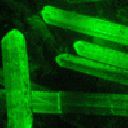
Neither discredit molybdomenite from El Dragon. They both do, however, report that paramolybdomenite occurs at El Dragon, in a habit perhaps distinctive from molybdomenite. In Zhang, paramolybdomenite from El Dragon is described as "thin-bladed crystals. Associated minerals are Co-bearing krut’aite–penroseite, chalcomenite, and dolomite. Molybdomenite- P21/c is pale yellow in transmitted light and has a greasy luster. It is brittle and has a Mohs hardness of 3. " (P21/c polytype is now known as paramolybdemenite).
Thus:
- The two minerals, paramolybdomenite and molybdomenite, are both likely to occur at El Dragon.
- They can be distinguished, according to the above referenced articles, by Raman spectroscopy.
- Until someone does an sufficiently extensive study of molybdomenite to determine if one, the other, or both occur at El Dragon, both minerals should be listed as verified.
I will change the status of molybdomenite back to confirmed, with a note indicating that it can be confused with paramolydomenite.