VOOZH about

URL: https://www.mindat.org/min-314.html

⇱ Arcanite: Mineral information, data and localities.


👁 Image
Now Featuring: The Bruce Carter Collection at Heritage Auctions, Live May 16th
Log InRegister
AboutSupport UsPhotosDiscussionsSearchLearnMore

Arcanite

A valid IMA mineral species - grandfathered
This page is currently not sponsored. Click here to sponsor this page.

About ArcaniteHide

This section is currently hidden. Click the show button to view.
Formula:
K2SO4
Colour:
Colourless, white, yellow
Hardness:
2
Specific Gravity:
2.663
Crystal System:
Orthorhombic
Name:
Named in 1845 by Wilhelm Carl von Haidinger from the Latin "arcanum duplicatum," for double secret, a medieval alchemical name. The original material was an exudate on the surface of discarded railroad track ties that had been used in the Santa Ana tin mine, Trabuco Canyon, Santa Ana Mountains, Orange County, California, USA.
Isostructural with:
Arcanite-Mascagnite Series.

This species was described and named based on artificial material and the type occurrence, which is anthropogenic (pine rail tie in a mine). It has since been identified in nature.

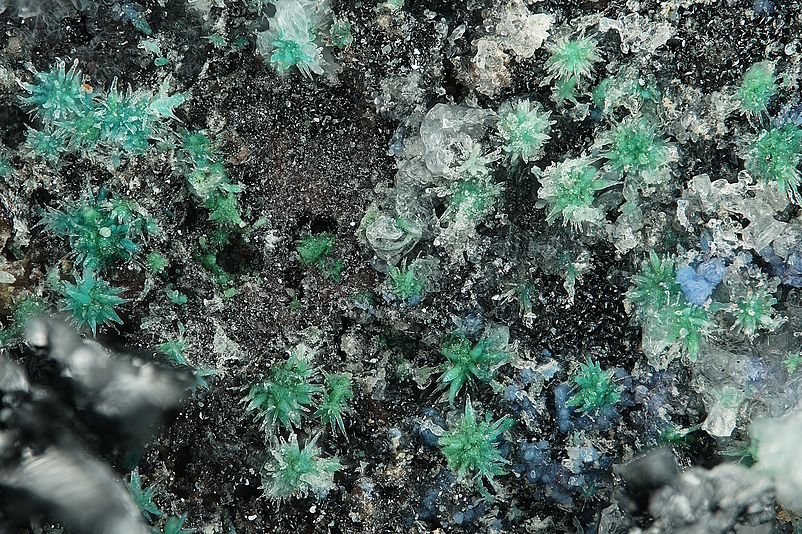
Note: Well-crystalline specimens on the market (e.g. those labelled from Poland, or anything that looks better than the photos of natural material at the head of this page) are grown artificially and are not natural minerals. See also spessartine arcanite.


Unique IdentifiersHide

This section is currently hidden. Click the show button to view.
Mindat ID:
314
Long-form identifier:
mindat:1:1:314:6

Similar NamesHide

This section is currently hidden. Click the show button to view.
AcaniteA synonym of 'Askanite'
AragoniteA valid IMA mineral species - grandfatheredCaCO3
Arcanit (of Haidinger)A synonym of Aphthitalite(K,Na)3Na(SO4)2
ErcinitaA synonym of Harmotome
Ercinite

IMA Classification of ArcaniteHide

This section is currently hidden. Click the show button to view.

Classification of ArcaniteHide

This section is currently hidden. Click the show button to view.
7.AD.05

7 : SULFATES (selenates, tellurates, chromates, molybdates, wolframates)
A : Sulfates (selenates, etc.) without additional anions, without H2O
D : With only large cations
28.2.1.2

28 : ANHYDROUS ACID AND NORMAL SULFATES
2 : A2XO4
25.1.4

25 : Sulphates
1 : Sulphates of the alkali metals and ammonium

Mineral SymbolsHide

This section is currently hidden. Click the show button to view.
As of 2021 there are now IMA–CNMNC approved mineral symbols (abbreviations) for each mineral species, useful for tables and diagrams.

SymbolSourceReference for Standard
AcnIMA–CNMNCWarr, L.N. (2021). IMA–CNMNC approved mineral symbols. Mineralogical Magazine, 85(3), 291-320. doi:10.1180/mgm.2021.43

Physical Properties of ArcaniteHide

This section is currently hidden. Click the show button to view.
Transparency:
Transparent, Translucent
Colour:
Colourless, white, yellow
Hardness:
Cleavage:
Distinct/Good
On {010} and {001}.
Density:
2.663 g/cm3 (Measured)    2.667 g/cm3 (Calculated)

Optical Data of ArcaniteHide

This section is currently hidden. Click the show button to view.
Type:
Biaxial (+)
RI values:
nα = 1.4935 nβ = 1.4947 nγ = 1.4973
2V:
Measured: 67° , Calculated: 70°
Max. Birefringence:
δ = 0.004
Based on recorded range of RI values above.

Interference Colours:
The colours simulate birefringence patterns seen in thin section under crossed polars. They do not take into account mineral colouration or opacity.

Michel-Levy Bar The default colours simulate the birefringence range for a 30 µm thin-section thickness. Adjust the slider to simulate a different thickness.

Grain Simulation You can rotate the grain simulation to show how this range might look as you rotated a sample under crossed polars.

Surface Relief:
Moderate
Dispersion:
r > v strong

Chemistry of ArcaniteHide

This section is currently hidden. Click the show button to view.
Mindat Formula:
K2SO4
Element Weights:
Element% weight
K44.874 %
O36.726 %
S18.401 %

Calculated from ideal end-member formula.

Crystallography of ArcaniteHide

This section is currently hidden. Click the show button to view.
Crystal System:
Orthorhombic
Class (H-M):
mmm(2/m2/m2/m) - Dipyramidal
Cell Parameters:
a = 5.77 Å, b = 10.07 Å, c = 7.48 Å
Ratio:
a:b:c = 0.573 : 1 : 0.743
Unit Cell V:
434.62 ų (Calculated from Unit Cell)
Z:
4
Morphology:
Thin tablets comprised of sixling cyclic twins bounded by {001}, {011}, and {112} (Santa Ana Mine). Artificial crystals frequently twinned.
Twinning:
On {110}, cyclic at times; pseudo-hexagonal groupings.
Comment:
Space Group: P nam (synthetic)

Crystal StructureHide

This section is currently hidden. Click the show button to view.
Load
Unit Cell | Unit Cell Packed
2x2x2 | 3x3x3 | 4x4x4
Show
Big Balls | Small Balls | Just Balls | Spacefill
Polyhedra Off | Si Polyhedra | All Polyhedra
Remove metal-metal sticks
Display Options
Black Background | White Background
Perspective On | Perspective Off
2D | Stereo | Red-Blue | Red-Cyan
View
CIF File    Best | x | y | z | a | b | c
Rotation
Stop | Start
Labels
Console Off | On | Grey | Yellow
Data courtesy of the American Mineralogist Crystal Structure Database. Click on an AMCSD ID to view structure
IDSpeciesReferenceLinkYearLocalityPressure (GPa)Temp (K)
0009456ArcaniteMcGinnety J A (1972) Redetermination of the structures of potassium sulphate and potassium chromate: the effect of electrostatic crystal forces upon observed bond length Acta Crystallographica B28 2845-2852👁 Image
19720293
0018287ArcaniteRobinson M (1958) The crystal structures of beta-K2SO4 and of beta-K2PO3F _cod_database_code 1200011 Journal of Physical Chemistry 62 925-92819580293
CIF Raw Data - click here to close

X-Ray Powder DiffractionHide

This section is currently hidden. Click the show button to view.
Powder Diffraction Data:
d-spacingIntensity
2.903 Å(100)
3.001 Å(77)
2.886 Å(53)
4.176 Å(28)
2.422 Å(25)
2.089 Å(25)
2.082 Å(25)

Geological EnvironmentHide

This section is currently hidden. Click the show button to view.
Paragenetic Mode(s):
Paragenetic ModeEarliest Age (Ga)
Stage 3b: Earth’s earliest hydrosphere>4.45
14 : Hot springs, geysers, and other subaerial geothermal minerals
Stage 7: Great Oxidation Event<2.4
45a : [Sulfates, arsenates, selenates, antimonates]
45b : [Other oxidized fumarolic minerals]
Stage 10a: Neoproterozoic oxygenation/terrestrial biosphere<0.6
50 : Coal and/or oil shale minerals<0.36
52 : Guano- and urine-derived minerals<0.4
Stage 10b: Anthropogenic minerals<10 Ka
54 : Coal and other mine fire minerals (see also #51 and #56)
55 : Anthropogenic mine minerals

Type Occurrence of ArcaniteHide

This section is currently hidden. Click the show button to view.
General Appearance of Type Material:
Thin tablets in wood.
Place of Conservation of Type Material:
University of California, Berkeley, California; Harvard University, Cambridge, Massachusetts, USA, 100763.
Geological Setting of Type Material:
Not applicable.

Synonyms of ArcaniteHide

This section is currently hidden. Click the show button to view.

Other Language Names for ArcaniteHide

This section is currently hidden. Click the show button to view.

Varieties of ArcaniteHide

This section is currently hidden. Click the show button to view.
Taylorite (of Dana)Ammonium-bearing arcanite. Found in guano beds of the Chincha Islands, Peru

Relationship of Arcanite to other SpeciesHide

This section is currently hidden. Click the show button to view.

Common AssociatesHide

This section is currently hidden. Click the show button to view.
Associations Based on Photo Data:
3 photos of Arcanite associated with HematiteFe2O3
2 photos of Arcanite associated with PiypiteK4Cu4O2(SO4)4 · (Na,Cu)Cl
1 photo of Arcanite associated with 'Unnamed (Lyonsite-like Cu-Fe-Vanadate)'(Cu,Zn)2(Fe,Al)2[(V,Mo,S,As)O4]3
1 photo of Arcanite associated with Alunite GroupA0.5-1 B3[SO4]2(OH)6

Related Minerals - Strunz-mindat GroupingHide

This section is currently hidden. Click the show button to view.
7.AD.BubnovaiteK2Na8Ca(SO4)6Trig. 3m : P31c
7.AD.DobrovolskyiteNa4Ca(SO4)3Trig. 3 : R3
7.AD.CalciolangbeiniteK2Ca2(SO4)3 Iso. 23 : P213
7.AD.MurphyitePb(Te6+O4)Mon. 2/m : P21/b
7.AD.CuprodobrovolskyiteNa4Cu(SO4)3Trig. 3 : R3
7.AD.KristjániteKNa2H(SO4)2Mon. 2/m
7.AD.05Mascagnite(NH4)2SO4Orth. mmm(2/m2/m2/m) : Pnma
7.AD.10MercalliteKHSO4Orth. mmm(2/m2/m2/m) : Pbca
7.AD.15MiseniteK8H6(SO4)7Mon.
7.AD.20Letovicite(NH4)3H(SO4)2Tric.
7.AD.25ThénarditeNa2SO4Orth. mmm(2/m2/m2/m) : Fddd
7.AD.25GlauberiteNa2Ca(SO4)2Mon. 2/m : B2/b
7.AD.30MetathénarditeNa2SO4Hex. 6/mmm(6/m2/m2/m) : P63/mmc
7.AD.30AnhydriteCaSO4Orth. mmm(2/m2/m2/m)
7.AD.35BaryteBaSO4Orth. mmm(2/m2/m2/m) : Pnma
7.AD.35CelestineSrSO4Orth. mmm(2/m2/m2/m) : Pnma
7.AD.35OlsacheritePb2(Se6+O4)(SO4)Orth.
7.AD.35AnglesitePbSO4Orth. mmm(2/m2/m2/m) : Pnma
7.AD.40KalistrontiteK2Sr(SO4)2Trig. 3m(32/m) : R3m
7.AD.40PalmieriteK2Pb(SO4)2Trig. 3m(32/m) : R3m
7.AD.45IvsiteNa3H(SO4)2Mon. 2/m : P21/b
7.AD.55MarkhininiteTlBi(SO4)2Tric. 1 : P1

RadioactivityHide

This section is currently hidden. Click the show button to view.
Radioactivity:
Element % Content Activity (Bq/kg) Radiation Type
Uranium (U) 0.0000% 0 α, β, γ
Thorium (Th) 0.0000% 0 α, β, γ
Potassium (K) 44.8737% 13,911 β, γ

For comparison:

  • Banana: ~15 Bq per fruit
  • Granite: 1,000–3,000 Bq/kg
  • EU exemption limit: 10,000 Bq/kg

Note: Risk is shown relative to daily recommended maximum exposure to non-background radiation of 1000 µSv/year. Note that natural background radiation averages around 2400 µSv/year so in reality these risks are probably extremely overstated! With infrequent handling and safe storage natural radioactive minerals do not usually pose much risk.

Interactive Simulator:

Note: The mass selector refers to the mass of radioactive mineral present, not the full specimen, also be aware that the matrix may also be radioactive, possibly more radioactive than this mineral!

Activity:

DistanceDose rateRisk
1 cm
10 cm
1 m

The external dose rate (D) from a radioactive mineral is estimated by summing the gamma radiation contributions from its Uranium, Thorium, and Potassium content, disregarding daughter-product which may have a significant effect in some cases (eg 'pitchblende'). This involves multiplying the activity (A, in Bq) of each element by its specific gamma ray constant (Γ), which accounts for its unique gamma emissions. The total unshielded dose at 1 cm is then scaled by the square of the distance (r, in cm) and multiplied by a shielding factor (μshield). This calculation provides a 'worst-case' or 'maximum risk' estimate because it assumes the sample is a point source and entirely neglects any self-shielding where radiation is absorbed within the mineral itself, meaning actual doses will typically be lower. The resulting dose rate (D) is expressed in microsieverts per hour (μSv/h).

D = ((AU × ΓU) + (ATh × ΓTh) + (AK × ΓK)) / r2 × μshield

Other InformationHide

This section is currently hidden. Click the show button to view.
Health Risks:
No information on health risks for this material has been entered into the database. You should always treat mineral specimens with care.

Internet Links for ArcaniteHide

This section is currently hidden. Click the show button to view.

References for ArcaniteHide

This section is currently hidden. Click the show button to view.

Localities for ArcaniteHide

This section is currently hidden. Click the show button to view.

Showing 44 localities.

This map shows a selection of localities that have latitude and longitude coordinates recorded. Click on the 👁 Image
symbol to view information about a locality. The 👁 Image
symbol next to localities in the list can be used to jump to that position on the map.

Locality ListHide

This section is currently hidden. Click the show button to view.
👁 Image
- This locality has map coordinates listed.
👁 Image
- This locality has estimated coordinates.
ⓘ - Click for references and further information on this occurrence. ? - Indicates mineral may be doubtful at this locality. 👁 Image
- Good crystals or important locality for species.
👁 Image
- World class for species or very significant.
(TL) - Type Locality for a valid mineral species. (FRL) - First Recorded Locality for everything else (eg varieties). Struck out - Mineral was erroneously reported from this locality. Faded * - Never found at this locality but inferred to have existed at some point in the past (e.g. from pseudomorphs).

All localities listed without proper references should be considered as questionable.
Australia
  • Western Australia
    • Dundas Shire
      • Cocklebiddy Roadhouse
[var: Taylorite (of Dana)] Bideaux
      • Madura Roadhouse
[var: Taylorite (of Dana)] Garske (n.d.)
Botswana
  • South-East District
    • Lobatse
Handbook of Mineralogy
Canada
  • Northwest Territories
    • Lac de Gras
      • Ekati Mine
Abersteiner et al. (2018)
  • Saskatchewan
Shang (2000)
Chile
  • Tarapacá
    • Iquique Province
      • Iquique
forum.amiminerals.org (2016)
France
  • Hauts-de-France
    • Pas-de-Calais
      • Lens
Naze-Nancy Masalehdani et al. (2009)
Germany
  • Rhineland-Palatinate
    • Südwestpfalz
      • Hauenstein
        • Wilgartswiesen
Frenzel (1964)
Iran
  • Hormozgan Province
    • Khamir County
Talbot et al. (2009)
Italy
  • Apulia
    • Metropolitan City of Bari
      • Gravina in Puglia
D’Angeli et al. (2022)
  • Lazio
    • Metropolitan City of Rome Capital
      • Cesano geothermal field
Cavarretta et al. (1982) +2 other references
  • Sicily
    • Metropolitan City of Catania
      • Etna Volcanic Complex
Toutain et al. (1995)
Japan
  • Hokkaidō Prefecture
    • Iburi Subprefecture
      • Usu District
The Mineral Species of Japan (5th ed)
Mexico
  • Jalisco
    • Colima volcanic complex
Taran et al. (2000) +1 other reference
Namibia
  • Khomas Region
    • Windhoek Rural
Martini (1992)
Handbook of Mineralogy
  • Kunene Region
    • Khorixas
Handbook of Mineralogy
    • Outjo
Handbook of Mineralogy
  • Otjozondjupa Region
    • Grootfontein Constituency
Handbook of Mineralogy
    • Otavi Constituency
Handbook of Mineralogy
Peru
  • Ica
    • Pisco Province
      • San Clemente District
        • Chincha Islands
[var: Taylorite (of Dana)] Taylor (1859) +1 other reference
Poland
  • Silesian Voivodeship
    • Rybnik
      • Niedobczyce
Kruszewski et al. (2020)
Russia
  • Arkhangelsk Oblast
    • Zimny Bereg District
      • Zimny Bereg kimberlite field
        • Verkhotina occurrence
Golovin et al. (2023)
  • Kamchatka Krai
    • Milkovsky District
Diederik Visser List #39
        • Great Fissure eruption (Main Fracture)
          • Northern Breakthrough (North Breach)
Pavel M. Kartashov analytical data
Zubkova et al. (2018) +1 other reference
    • Yelizovsky District
Okrugin (2004)
  • Sakha
    • Aldan
      • Inagli Massif
Naumov et al. (2008)
Saudi Arabia
  • Mecca Region
Saudi Geological Survey Open-File ... +1 other reference
South Africa
  • Mpumalanga
    • Ehlanzeni District Municipality
      • Kruger National Park
Handbook of Mineralogy
  • Northern Cape
    • Frances Baard District Municipality
      • Sol Plaatje Local Municipality
        • Kimberley
          • KEM JV Mine (Kimberley Ekapa Mining Joint Venture mine; Kimberley Underground mine)
Giuliani et al. (2017) +1 other reference
    • Pixley ka Seme District Municipality
      • Ubuntu Local Municipality
Abersteiner et al. (2024)
Spain
  • Basque Country
    • Biscay
      • Karrantza Harana/Valle de Carranza
        • Donosa quarry (Pozalagua quarry)
Martínez-Arkarazo et al. (2007)
  • Valencian Community
    • Alicante
      • Aspe
Benavente +2 other references
Uganda
  • Western Region
    • Kasese
      • Katwe-Kikorongo volcanic field (Katwe volcanic field)
Kasedde et al. (2014)
USA
  • Arizona
    • Maricopa County
Garvie (2016)
  • California
    • Orange County
      • Trabuco Canyon [town]
        • Trabuco Canyon
Eakle (1908)
    • Riverside County
      • Vivet Eye
Ingalls et al. (1908)
  • New Mexico
Northrop et al. (1996)
    • Eddy County
Hawley +5 other references
Quick NavTopAbout ArcaniteUnique IdentifiersSimilar NamesIMA Classification Classification Mineral SymbolsPhysical Properties Optical Data Chemistry Crystallography Crystal StructureX-Ray Powder DiffractionGeological EnvironmentType Occurrence SynonymsOther LanguagesVarietiesRelationshipsCommon AssociatesStrunz-MindatRadioactivityOther InformationInternet Links References Localities Locality List
Mindat.org® is an outreach project of the Hudson Institute of Mineralogy, a 501(c)(3) not-for-profit organization. Mindat® and mindat.org® are registered trademarks of the Hudson Institute of Mineralogy.
Copyright © mindat.org and the Hudson Institute of Mineralogy 1993-2026, except where stated. Most political location boundaries are © OpenStreetMap contributors. Mindat.org relies on the contributions of thousands of members and supporters. Founded in 2000 by Jolyon Ralph and Ida Chau.
To cite: Ralph, J., Von Bargen, D., Martynov, P., Zhang, J., Que, X., Prabhu, A., Morrison, S. M., Li, W., Chen, W., & Ma, X. (2025). Mindat.org: The open access mineralogy database to accelerate data-intensive geoscience research. American Mineralogist, 110(6), 833–844. doi:10.2138/am-2024-9486.
Privacy Policy - Terms & Conditions - Contact Us / DMCA issues - Report a bug/vulnerability Current server date and time: April 4, 2026 11:44:49 Page updated: March 31, 2026 14:30:54
Go to top of page