VOOZH about

URL: https://www.mindat.org/min-49414.html

⇱ Sand: Mineral information, data and localities.


👁 Image
Now Featuring: The Bruce Carter Collection at Heritage Auctions, Live May 16th
Log InRegister
AboutSupport UsPhotosDiscussionsSearchLearnMore

Sand

A rock classification type
This page is currently not sponsored. Click here to sponsor this page.

About SandHide

This section is currently hidden. Click the show button to view.
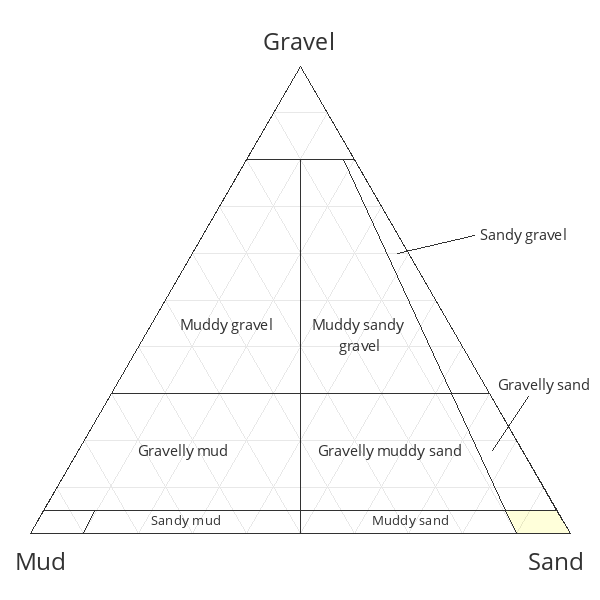
A sand-grade clastic-sediment. Note: the majority of sand can be classed as silicate-sand.

i. A rock fragment or detrital particle smaller than a granule and larger than a coarse silt grain, having a diameter in the range of 1/16 to 2 mm (62 to 2,000 mu m, or 0.0025 to 0.08 in, or 4 to 1 phi units, or a size between that at the lower limit of visibility of an individual particle with the unaided eye and that of the head of a small wooden match), being somewhat rounded by abrasion in the course of transport. In Great Britain, the range of 0.1 to 1 mm has been used.

See Also: coarse sand, fine sand

Ref: AGI

ii. A loose aggregate, unlithified mineral or rock particles of sand size; an unconsolidated or moderately consolidated sedimentary deposit consisting essentially of medium-grained clastics. The material is most commonly composed of quartz, and when the term sand is used without qualification, a siliceous composition is implied; but the particles may be of any mineral composition or mixture of rock or mineral fragments, such as coral sand consisting of limestone fragments. Also, a mass of such material, esp. on a beach, desert, or in a streambed.

Ref: AGI


iii. Separate grains or particles of detrital rock material, easily distinguishable by the unaided eye, but not large enough to be called pebbles; also, a loose mass of such grains, forming an incoherent arenaceous sediment. Building sand, any hard, granular rock material finer than gravel and coarser than dust. The term indicates material comminuted by natural means.

Ref: Fay

iv. Detrital material of size range from 2 to 1/16 mm in diameter. Very coarse, 1 to 2 mm; coarse, 1/2 to 1 mm; medium, 1/4 to 1/2 mm; fine, 1/4 to 1/8 mm; very fine, 1/8 to 1/16 mm.

Ref: AGI

v. Granular material, composed mainly of quartz, that will settle readily in water. In the mechanical analysis of soil, sand--according to international classification--has a size between 0.02 mm and 2.0 mm. It has no cohesion when dry or saturated but has apparent cohesion when damp.

Ref: Nelson


vi. A term used in the United States for a rock or mineral particle in the soil, having a diameter in the range of 0.05 to 2 mm; prior to 1947, the range 1 to 2 mm was called fine gravel. The diameter range recognized by the International Society of Soil Science is 0.02 to 2 mm. A textural class of soil material containing 85% or more of sand, with the percentage of silt plus 1.5 times the percentage of clay not exceeding 15; specif. such material containing 25% or more of very coarse sand, coarse sand, and medium sand, and less than 50% of fine sand or very fine sand. The term has also been used for a soil containing 90% or more of sand.

Ref: AGI


Unique IdentifiersHide

This section is currently hidden. Click the show button to view.
Mindat ID:
49414
Long-form identifier:
mindat:1:1:49414:4

Similar NamesHide

This section is currently hidden. Click the show button to view.
CandA synonym of FluoriteCaF2
SardA variety of 'Chalcedony' [Quartz]SiO2
SaynitA synonym of PolydymiteNi2+Ni23+S4
SuanitA synonym of Suanite
SínítA synonym of 'Syenite'

Classification of SandHide

This section is currently hidden. Click the show button to view.

Sub-divisions of SandHide

This section is currently hidden. Click the show button to view.

Synonyms of SandHide

This section is currently hidden. Click the show button to view.

Common AssociatesHide

This section is currently hidden. Click the show button to view.
Associated Minerals Based on Photo Data:
3 photos of Sand associated with KaoliniteAl2(Si2O5)(OH)4
2 photos of Sand associated with 'Clay'
1 photo of Sand associated with CalciteCaCO3
1 photo of Sand associated with GypsumCaSO4 · 2H2O
1 photo of Sand associated with Garnet GroupX3Z2(SiO4)3
1 photo of Sand associated with QuartzSiO2
1 photo of Sand associated with ZirconZr(SiO4)

Internet Links for SandHide

This section is currently hidden. Click the show button to view.

References for SandHide

This section is currently hidden. Click the show button to view.
Quick NavTopAbout SandUnique IdentifiersSimilar NamesClassification Sub-divisions SynonymsCommon AssociatesInternet Links References
Mindat.org® is an outreach project of the Hudson Institute of Mineralogy, a 501(c)(3) not-for-profit organization. Mindat® and mindat.org® are registered trademarks of the Hudson Institute of Mineralogy.
Copyright © mindat.org and the Hudson Institute of Mineralogy 1993-2026, except where stated. Most political location boundaries are © OpenStreetMap contributors. Mindat.org relies on the contributions of thousands of members and supporters. Founded in 2000 by Jolyon Ralph and Ida Chau.
To cite: Ralph, J., Von Bargen, D., Martynov, P., Zhang, J., Que, X., Prabhu, A., Morrison, S. M., Li, W., Chen, W., & Ma, X. (2025). Mindat.org: The open access mineralogy database to accelerate data-intensive geoscience research. American Mineralogist, 110(6), 833–844. doi:10.2138/am-2024-9486.
Privacy Policy - Terms & Conditions - Contact Us / DMCA issues - Report a bug/vulnerability Current server date and time: April 4, 2026 08:18:13 Page updated: March 8, 2026 09:55:36
Go to top of page