







- FASTA Sequence
- PDBx/mmCIF Format
- PDBx/mmCIF Format (gz)
- BinaryCIF Format (gz)
- Legacy PDB Format
- Legacy PDB Format (gz)
- PDBML/XML Format (gz)
- Structure Factors (CIF)
- Structure Factors (CIF - gz)
- Validation Full (PDF - gz)
- Validation (XML - gz)
- Validation (CIF - gz)
- Validation 2fo-fc coefficients (CIF - gz)
- Validation fo-fc coefficients (CIF - gz)
- Biological Assembly 1 (CIF - gz)
- Biological Assembly 2 (CIF - gz)
- Biological Assembly 1 (PDB - gz)
- Biological Assembly 2 (PDB - gz)
3TN2 | pdb_00003tn2
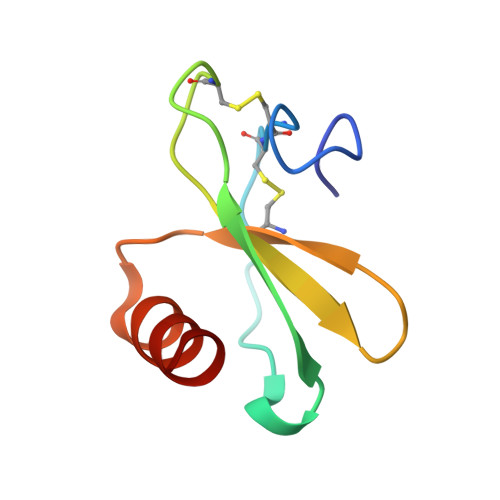
structure analysis of MIP1-beta P8A
- PDB DOI: https://doi.org/10.2210/pdb3TN2/pdb
- Classification: CYTOKINE
- Organism(s): Homo sapiens
- Expression System: Escherichia coli BL21(DE3)
- Mutation(s): Yes
- Deposited: 2011-09-01 Released: 2012-09-05
- Deposition Author(s): Guo, Q., Tang, W.J.
Experimental Data Snapshot
- Method: X-RAY DIFFRACTION
- Resolution: 1.60 Å
- R-Value Free: 0.199 (Depositor), 0.213 (DCC)
- R-Value Work: 0.157 (Depositor), 0.163 (DCC)
- R-Value Observed: 0.159 (Depositor)
wwPDB Validation 3D Report Full Report

- 👁 Image
Download Mendeley

Structures of human CCL18, CCL3, and CCL4 reveal molecular determinants for quaternary structures and sensitivity to insulin-degrading enzyme.
Liang, W.G., Ren, M., Zhao, F., Tang, W.J.(2015) J Mol Biology 427: 1345-1358
- PubMed: 25636406 Search on PubMedSearch on PubMed Central
- DOI: https://doi.org/10.1016/j.jmb.2015.01.012
- Primary Citation Related Structures:
3TN2, 4MHE, 4RA8, 4RAL - PubMed Abstract:
CC chemokine ligands (CCLs) are 8- to 14-kDa signaling proteins involved in diverse immune functions. While CCLs share similar tertiary structures, oligomerization produces highly diverse quaternary structures that protect chemokines from proteolytic degradation and modulate their functions. CCL18 is closely related to CCL3 and CCL4 with respect to both protein sequence and genomic location, yet CCL18 has distinct biochemical and biophysical properties. Here, we report a crystal structure of human CCL18 and its oligomerization states in solution based on crystallographic and small-angle X-ray scattering analyses. Our data show that CCL18 adopts an α-helical conformation at its N-terminus that weakens its dimerization, explaining CCL18's preference for the monomeric state. Multiple contacts between monomers allow CCL18 to reversibly form a unique open-ended oligomer different from those of CCL3, CCL4, and CCL5. Furthermore, these differences hinge on proline 8, which is conserved in CCL3 and CCL4 but is replaced by lysine in human CCL18. Our structural analyses suggest that a mutation of proline 8 to alanine stabilizes a type 1 β-turn at the N-terminus of CCL4 to prevent dimerization but prevents dimers from making key contacts with each other in CCL3. Thus, the P8A mutation induces depolymerization of CCL3 and CCL4 by distinct mechanisms. Finally, we used structural, biochemical, and functional analyses to unravel why insulin-degrading enzyme degrades CCL3 and CCL4 but not CCL18. Our results elucidate the molecular basis for the oligomerization of three closely related CC chemokines and suggest how oligomerization shapes CCL chemokine function.
- Ben May Department for Cancer Research, The University of Chicago, IL 60637, USA.
- Ben May Department for Cancer Research, The University of Chicago, IL 60637, USA. Electronic address: wtang@uchicago.edu.
Organizational Affiliation:
Explore in 3D: Structure | Sequence Annotations | Electron Density | Validation Report | Ligand Interaction (ZN)
Explore in 3D: Structure | Sequence Annotations | Electron Density | Validation Report | Ligand Interaction (ZN)
Global Symmetry: Asymmetric - C1
Global Stoichiometry: Monomer - A1
Find Similar Assemblies
Biological assembly 1 assigned by authors.
Explore in 3D: Structure | Sequence Annotations | Electron Density | Validation Report | Ligand Interaction (ZN)
Global Symmetry: Cyclic - C2 (Explore in 3D)
Global Stoichiometry: Homo 2-mer - A2
Find Similar Assemblies
Biological assembly 2 generated by PISA (software)
Macromolecule Content
- Total Structure Weight: 7.88 kDa
- Atom Count: 600
- Modeled Residue Count: 68
- Deposited Residue Count: 68
- Unique protein chains: 1
Entity ID: 1 | |||||
|---|---|---|---|---|---|
| Molecule | Chains | Sequence Length | Organism | Details | Image |
| C-C motif chemokine 4 | 68 | Homo sapiens | Mutation(s): 1 Gene Names: CCL4, LAG1, MIP1B, SCYA4 | 👁 Image | |
UniProt & NIH Common Fund Data Resources | |||||
Find proteins for P13236 (Homo sapiens) Explore P13236 Go to UniProtKB: P13236 | |||||
PHAROS: P13236 GTEx: ENSG00000275302 | |||||
Entity Groups | |||||
| Sequence Clusters | 30% Identity50% Identity70% Identity90% Identity95% Identity100% Identity | ||||
| UniProt Group | P13236 | ||||
Sequence AnnotationsExpand | |||||
| |||||

| Ligands 1 Unique | |||||
|---|---|---|---|---|---|
| ID | Chains | Name / Formula / InChI Key | 2D Diagram | 3D Interactions | |
| ZN Query on ZN Download Ideal Coordinates CCD File | B [auth A], C [auth A], D [auth A] | ZINC ION Zn PTFCDOFLOPIGGS-UHFFFAOYSA-N | 👁 Image | ||


Experimental Data
- Method: X-RAY DIFFRACTION
- Resolution: 1.60 Å
- R-Value Free: 0.199 (Depositor), 0.213 (DCC)
- R-Value Work: 0.157 (Depositor), 0.163 (DCC)
- R-Value Observed: 0.159 (Depositor)
| Length ( Å ) | Angle ( ˚ ) |
|---|---|
| a = 51.062 | α = 90 |
| b = 36.972 | β = 108.54 |
| c = 31.061 | γ = 90 |
| Software Name | Purpose |
|---|---|
| HKL-3000 | data collection |
| PHASES | phasing |
| REFMAC | refinement |
| HKL-3000 | data reduction |
| HKL-3000 | data scaling |
Deposition Data
- Released Date: 2012-09-05 Deposition Author(s): Guo, Q., Tang, W.J.
Revision History (Full details and data files)
- Version 1.0: 2012-09-05
Type: Initial release - Version 1.1: 2015-05-13
Changes: Database references - Version 1.2: 2018-08-22
Changes: Data collection, Database references, Source and taxonomy, Structure summary - Version 1.3: 2024-11-06
Changes: Data collection, Database references, Derived calculations, Structure summary







