|
VOOZH | about |
|
VOOZH | about |
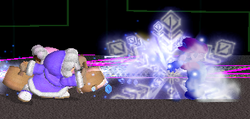
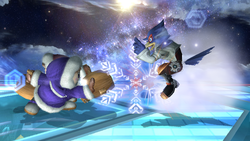
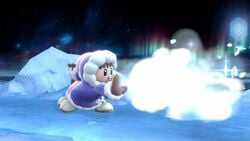
Freezing, also known as ice, is an attack effect in the Super Smash Bros. series, which debuted in Super Smash Bros. Melee and has appeared in every subsequent game. It causes a character to be encased in ice while taking knockback, preventing them from taking action for a certain amount of time in replacement of the hitstun they would usually experience.
Freezing attacks are boosted by Freezing Attack stickers in Super Smash Bros. Brawl's The Subspace Emissary and the support spirit skill Water & Ice Attack ↑, as well as certain Spirit Battle conditions in Super Smash Bros. Ultimate. In Ultimate, the spirit skill or trait Water/Freezing Resist ↑ weakens freezing attacks. The support spirit skill Ice-Floor Immunity prevents the equipped fighter from being frozen or being damaged by Spirit Battle ice floors, but does not affect the damage the player takes from freezing attacks.
In all games, a freezing attack needs to inflict knockback of at least 52.5 units to freeze the target, which matches the minimum knockback required to trigger their heavy flinching animation. When a character gets frozen, their knockback is calculated as usual, but they decelerate slower as they fly away (with a launch speed decay of 0.03 per frame, down from 0.051), and their falling speed is reduced (by 0.7× from Brawl onward), giving them significantly floatier physics and causing them to cover a longer distance. While frozen, characters also take 0.5× damage and 0.25× knockback from subsequent attacks, hindering the effectiveness of KO setups against frozen opponents, with even powerful meteor smashes dealing negligible knockback. Frozen characters have an enlarged hurtbox and cannot be grabbed.
In Melee, being hit by a freezing attack causes a variation of the ping sound to play; only those that deal high enough knockback, such as the Freezie and Articuno's attack, use the actual ping sound. From Brawl onward, freezing attacks use their own sound effects, with the exception of Mr. Game & Watch's Judge #8.
The amount of frames characters are frozen for is determined differently across games, though in all of them, the damage inflicted by the freezing attack is a factor, and it is altered by both button mashing from the victim's part and dealing damage to them while frozen. Additionally, remaining freeze time will begin decaying immediately, even during hitlag, meaning that non-projectile ice attacks effectively have a lower frame advantage. In Melee, the formula for the initial freeze time is 👁 {\displaystyle 12.5d}
, rounded down with d being the damage of the freezing attack; button mashing reduces it by 3 frames per input, and attacks reduce it by 0.75× of the damage they would deal to a non-frozen opponent, even if the attack has a freezing effect. In Brawl and Smash 4, freeze time is reduced overall; the formula is changed to 👁 {\displaystyle 12d}
rounded down, and button mashing reduces freeze time by 4 frames per input (7.2 with buttons in Smash 4, though they cannot be inputted as quickly as stick inputs), while attacks reduce it by 2× of the damage they would deal to a non-frozen opponent. In these three games, hitting a frozen opponent with a flame attack thaws them out immediately.
In Ultimate, freeze time has undergone significant changes. The new formula for the initial freeze time is 👁 {\displaystyle 5d+0.5p}
, rounded down, where d is the damage dealt by the freezing attack (taking the 1v1 multiplier and modifiers such as stale-move negation into account) while p is the target's percent before the attack connects (unlike other status conditions such as burying and sleep, which use the post-hit percent). For example, if a character is hit by a fully charged PK Freeze (which deals 23% damage) at 25%, they are initially frozen for 150 frames in a 1v1, and 127 frames in battles with more players. Additionally, freezing now has a maximum duration of 250 frames. Button mashing still reduces freeze time by 4 frames per input (7.2 with buttons), but attacking frozen opponents has considerably different effects depending on the kind of attack used and the number of times the frozen opponent is attacked (represented by c below, with c=1 being the first hit after being frozen):
Uniquely, Hero's Kacrackle Slash applies a 2× multiplier to the damage portion of the initial freeze time formula, giving him a greater advantage over the opponent compared to other freezing attacks. Furthermore, multi-hit freezing attacks (namely the Ice Climbers' Blizzard) have a new accumulation mechanic that lets them freeze opponents even if they deal less than 52.5 units of knockback. More specifically, each hit's resulting freeze time from the formula (if they would have caused freezing) is added together if the target is kept in hitstun between them, and if the combined value exceeds 263, the opponent is frozen by the hit to have crossed the threshold, using its individual freeze time. For example, in a 1v1 match with stale-move negation disabled, Blizzard can freeze as early as 28.4% with 9 hits; if there is no percent increase between hits (such as by the Fixed Damage option in Training mode), this instead happens at around 37%, which can be verified by the result of (5 * 2.16 + 0.5 * 37) * 9 exceeding 263. As this only takes damage into account, it works regardless of the opponent's weight or knockback modifiers, unless they take no hitstun as a result of either armor or the attack dealing flinchless knockback.
In all games, a frozen character automatically jumps after thawing out, canceling out most of their remaining launch speed, and can perform other actions immediately (except in Melee, where they sustain 16 frames of ending lag), though their horizontal momentum is still temporarily locked. Additionally, they are protected from subsequent freezing attempts for 60 frames after thawing out.
Overall, freezing is unreliable for conventional combos and KO setups compared to other status conditions, due to the opponent's greatly reduced damage and knockback taken during it, as well as lacking any frame advantage when they thaw out. However, it can still be a useful way to build damage, due to button mashing's relatively weak effect on it causing characters to usually remain frozen for a prolonged amount of time. In Ultimate, Lucas' PK Freeze is also notorious for launching at a low angle that is strengthened in effectiveness by its freezing effect, causing characters to fly much farther than usual due to their combination of reduced launch speed decay and longer immobile time, which makes it an excellent edgeguarding and horizontal KO option.
Freezing is one of the more useful effects in The Subspace Emissary: it deals extra damage to flame-based enemies and about half of the bosses, and is only specifically resisted by Glices. However, it cannot cause non-fighter enemies to freeze, and attacks with the freezing effect are rare and almost exclusively indirect, which most enemies and bosses resist; Judge is the only non-indirect freezing attack available in The Subspace Emissary, and it can only be used at random.
| Enemy/Boss | Attack(s) | Games |
|---|---|---|
| Blue Bubble | Ramming into the player | 👁 Super Smash Bros. for Nintendo 3DS |
| Crazy Hand | Tri-Poke (third hit) | 👁 Super Smash Bros. Melee 👁 Super Smash Bros. Brawl |
| Frozen Rope | 👁 Super Smash Bros. Ultimate | |
| Cryogonal | Ice Beam | 👁 Super Smash Bros. for Nintendo 3DS |
| Giga Bowser | Down smash | 👁 Super Smash Bros. Melee 👁 Super Smash Bros. Ultimate |
| Glice | Ice attack | 👁 Super Smash Bros. Brawl 👁 Super Smash Bros. for Nintendo 3DS |
| Marx | Ice balls | 👁 Super Smash Bros. Ultimate |
| Master Hand | Icy Wind | 👁 Super Smash Bros. 4 |
In addition to natural stage hazards, the Spirit Battle condition "The floor is frozen" creates a hazard that inflicts freezing damage.
| Stage | Hazard | Games |
|---|---|---|
| Gerudo Valley | Kotake's ice spell | 👁 Super Smash Bros. for Nintendo 3DS 👁 Super Smash Bros. Ultimate |
| Mushroom Kingdom U | Falling Icicles | 👁 Super Smash Bros. for Wii U 👁 Super Smash Bros. Ultimate |