
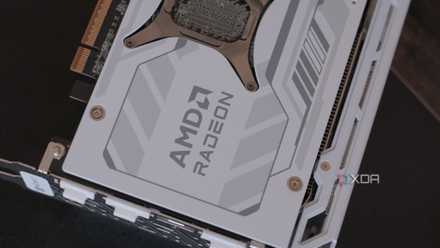
Gaming on Linux is now viable enough that there's little reason to keep Windows installed unless there's an app or service you absolutely must run on Microsoft's OS. The various Linux distros offer impressive gaming experiences, especially on AMD and Intel hardware. AMD recently launched the Radeon RX 90 series, and I played around with the RX 9070 XT using Fedora and version 6.13.5 of the kernel. AMD's Linux drivers are baked into the kernel itself, so nothing else was required to enjoy the latest and greatest AMD GPUs, aside from FSR support.
AMD Linux drivers are pretty solid
So long as you use the right kernel
Rocking day zero drivers can prove troublesome as the influx of game data can help showcase undiscovered bugs that need patching. It's also why we see the brands focus on specific titles with driver updates since optimizations, improvements, and bug fixes can be rolled out. Nvidia controls all aspects of its Linux driver offering but does at least have a GUI that can be used by anyone not too familiar with respective terminal commands. AMD doesn't include Adrenalin for Linux, but the amdgpu driver is rock solid and can be relied upon without installing anything else.
Like previous-gen AMD cards, the RX 9070 XT was detected by Fedora and the preinstalled drivers.
Like previous-gen AMD cards, the RX 9070 XT was detected by Fedora and the preinstalled drivers. Nothing had to be installed or altered. Simply fired up some games, ran some tests for a couple of hours and compared the results to Windows. Interestingly, even running some games through Proton, there wasn't a sizeable performance difference between the two results. That shows how well Proton has evolved over the years but also how bloated Windows is, even on a fresh install. One area that Windows wins, however, is support for FSR.
Games can enable the feature, so long as they support it and a setting is present within the game. If not, you're out of luck, as there are no means to activate and configure FSR, especially FSR 4, per game with AMD's Linux driver. This is something I hope they will address without forcing GPU owners to rely on workarounds, hacks, and other unofficial methods to get everything to work. The marketing around the RDNA 4 launch focused on Hypr-RX and how easy it is to optimize a game with Adrenalin on Windows, but Linux needs a little love there.
Switching back to my trusty Radeon RX 7900 XT, the improvements to RDNA 4 are night and day. While the 9070 XT may be targeting Nvidia cards and the 7900 GRE, I would go so far as to say it bests the 7900 XT. I enjoy having ray tracing enabled in titles that can leverage FSR or DLSS, and the 9070 XT performs extremely well under heavier loads with the architectural changes and improved ray tracing performance. This was always a weak point for the RX 70 series, and the differences were immediately evident in my 9070 reviews.

The AMD Radeon RX 9070 is closer to the RTX 4090 than Nvidia's own RTX 5070
This thing is a mid-level game changer, taking on the latest from Nvidia.
Where AMD could improve
We need Adrenalin (or do we?)
I'm one of those fans of Adrenalin. As a software, it has evolved into something truly useful. The CPU and GPU management are excellent and make trips to the UEFI BIOS almost pointless, unless (again) you're like me and prefer to do everything at the lower level. But the Hypr-RX is brilliant for those who simply wish AMD to automatically optimize games and visual settings, taking into account the currently connected GPU. It's also convenient to quickly enable (or deactivate) FSR and other technologies.
The same cannot be said for Linux since we don't have Adrenalin. All that's required is a simple GUI with a few sliders and buttons for activating various functions per game, as well as checking the status of the GPU and any other AMD products installed on the system. It doesn't have to be extensive but should provide the foundations for something to be refined by the community, or even a basic app offering would suffice. It's great to have open source drivers available for the platform, but the software would go that bit further.
Someone who has never used a Linux distro before installed Fedora and expected Adrenalin to work would be sorely disappointed.
People prefer familiarity, and Adrenalin on Linux (or a version of it) would offer that. The move to Linux can be daunting, and it's the job of any evangelist to ensure that the journey is as painless as possible. Someone who has never used a Linux distro before installed Fedora and expected Adrenalin to work would be sorely disappointed, but it would be the fault of AMD for not completely supporting its product. Drivers are great, but we need some form of software support.
For those of us who don't mind using community-made software, CoreCtrl is a fantastic tool for managing AMD graphics cards through Linux. Here, you can manage not only your supported AMD GPU but also the processor and adjust power limits, fan curves, and more. There's an easy-to-follow wiki guide available with all the information you'd need, and it runs really well with an all-AMD system. So long as you can actually buy one at MSRP, the new RX 90 series is fantastic for gaming on Linux.
4 reasons AMD's RX 9070 XT is the perfect upgrade for RTX 3000 owners
Hear ye, RTX 30 owners, it's finally worth upgrading