
AI was still prevalent at CES, and while a lot of companies continued to beat that drum, Dell was not one of them. During a Q&A period, Dell's head of product, Kevin Terwilliger, confirmed that this wasn't an accident. With regard to AI PCs, Terwilliger said, "What we've learned over the course of this year, especially from a consumer perspective, is [consumers] are not buying based on AI." This is a huge departure from the previous push to integrate AI into literally every aspect of the device experience, and honestly, it's a welcome one.
Dell has smashed the nail on the head; consumers aren't buying Copilot PCs for Copilot, or MacBooks for Apple Intelligence, they're buying them for the same reasons they've always bought them. The addition of an NPU can be nice, and it's useful for a few niche applications, but even for power users, the concept of an "AI PC" is dead and buried, at least as a selling point.

Despite the tighter security precautions, I'm still never using Recall on Windows 11
Try as they may, Microsoft will never convince me to use Recall
AI PCs already have a bad rap with power users
And regular consumers get confused by it
As far as the power user goes, they're not the average consumer. They're typically running more intense workloads, require great stability, and need the horsepower for work and play. The laptops that succeed in providing that still exist, but a lot of them have the "AI PC" label slapped on them.
These aren't the kinds of users that are hitting the Copilot button, not just because their needs are fundamentally different, but because it wouldn't help them with their tasks anyway. They likely already have an LLM they prefer to use elsewhere, perhaps even with a subscription to boot. Most non-power users buying a PC are likely in a similar boat. Microsoft's attempts to integrate things like Recall into the Windows experience also hasn't exactly earned them brownie points with either crowd. I think irrespective of the hardware itself, what a lot of consumers want is for the normal functions of the OS, like search, the settings, local account creation, and others, to just work, and that's really not a lot to ask. Once those ducks are in a row, adding AI functionality would feel like the next logical step, but as of right now, nobody is buying an AI PC for the AI, they're buying it for the PC.

I started self-hosting LLMs and absolutely loved it
Who needs OpenAI when your home lab can do the thinking for you?
Local LLMs are far more useful
They're not accessible to the average person yet
In terms of on-device AI, local LLMs you can run on your own machine already exist in spades. There are entire models you can run on your smartphone, and when you scale that up to a full-size workstation with a ton of RAM and GPU power, it's really impressive what is possible on bare metal. Despite that, it's still not really terribly accessible to the average person yet, both in its requirements and its capabilities.
Setting up an LLM locally, while straightforward for someone who's tech-inclined, doesn't have the same set of capabilities that something like a ChatGPT or Claude has, so even if someone does have the ability to set one up, it's probably not much more useful to them than it would be to just use a chat in a browser. Despite that, they're still far more useful than using the AI that's on a Windows 11 "AI PC", and that's before you mention the benefits for privacy, customization, and responsiveness.

8 frustrating things laptop makers keep doing for some reason
Why are we still dealing with this in 2025?
NPUs have their value
But they're still too niche to be a real selling point
NPUs are essentially accelerators that are designed to make AI features more efficient, and they can be useful. Features like Recall, on-device speech processing and video call effects all rely on the NPU to some degree. But they're still not used for enough to be a true selling point on a device. The primary crux of that being you can't run large local LLMs on them, which is what most people would probably think of if you told them their PC was an "AI PC".

4 ways an on-chip NPU makes your PC better right now
Your next laptop might include an NPU built-in. You won't see it, but it quietly changes how your OC runs, especially behind the scenes.
AI in a browser will continue to be the default for most people
It's a function of familiarity and compute power
The reality is, most consumers will continue to use the AI that they've been using, and for the vast majority of people, these are LLMs that are in a browser. To be clear, Dell hasn't gone as far as to say that part out loud, but they've at least admitted that nobody is making a PC purchasing decision based on which AI is plastered on the front.
This is because they're already familiar with whichever AI they use. They may have a history with it that the model refers to, or perhaps that specific model does well with the programming language they use often. Whatever the case may be, the stage is largely set for AI use until something truly transformative comes along. It'll happen largely in a browser or an app that interfaces with an API elsewhere, and local LLMs will continue to be uncommon amongst normal consumers as long as the hardware requirements continue to be as steep as they are.
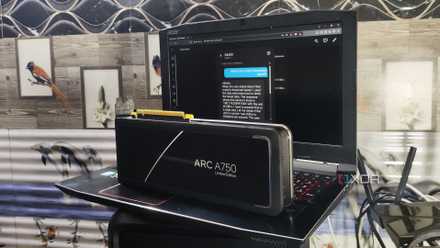
You don't need an "AI PC" to use AI on your PC
Dell saying that consumers aren't buying AI PCs for the AI might sound obvious to anyone who's tuned into the tech space, but it's interesting that such a massive OEM like Dell is the first to break that ice. Local AI isn't a mirage by any means, but the way it's being integrated by Microsoft and Apple, is. Nobody is buying a PC for AI features, but instead, they're buying them for the same reasons they always have: the specs, the operating system, and the physical characteristics of the product.