
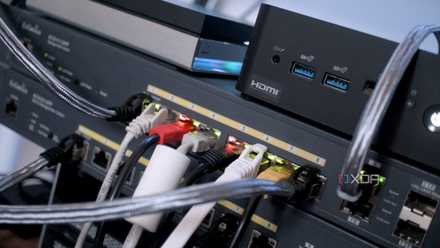
I recently upgraded my home network, including a Wi-Fi 7 access point with 4x4 on each radio band. It's not the first time I've replaced the ISP router, but it will be the last time, especially now that my ISP, FiOS, configures all new installations in my area to go through Ethernet instead of coaxial. I love the convenience of wireless connectivity, especially being able to use it while out on the deck grilling, but I've still got a ton of hardwired devices, and they're going to stay that way.
Whether it's to use Power over Ethernet (PoE) to keep lower-powered devices running without having to worry about where a power socket is situated, or to provide high-speed connectivity to my NAS, which hosts a bunch of services I use daily, I'm still planning out more wire drops. The best home network for your needs might be all-wireless, or maybe it's completely wired up, but for my needs, it's a hybrid of the two and will always be that way.

When should you use wired or wireless internet?
There are certain times where you may need wired or wireless internet, and you can follow this guide to help you figure out if you need to switch.
5 For stability and reliability
I love the convenience of wireless, but it's not always the best way
While wireless internet is undoubtedly more convenient, it's not without its downsides. Depending on how many neighbors you have and how your home is arranged, you can get plenty of wireless interference, and everything inside your walls also reduces reliability and range. That's not to say you can't figure out ways to improve your Wi-Fi speed and reliability. Still, it will likely never rival the stability and reliability of a wired connection. Whether large data transfers for backups, streamed media, or online gaming, wired connections are still key for getting the best experience.
With my current setup of prosumer gear, the only time the Wi-Fi will outperform my cabled devices is if one of my cables has a fault, which is a handy troubleshooting indicator for me to redo that cable run. But I will be redoing that cable run, because the Ethernet links in my home are essential to the rest of my network performing optimally.

7 things you need to know to wire your home network like a pro
Running Ethernet through your walls seems scary, but it's really not that bad.
4 Because my NAS has 10GbE
I have a need for speed and I'm not sorry
My NAS is the heart of my digital home, hosting media servers, remote access tools, knowledge repositories, and all kinds of other tools. It's also where Home Assistant keeps the rest of my smart home devices in line, and that means it's always transferring data around my network. To give it enough bandwidth, it's connected to my network via a 10GbE cable, and I might use link aggregation to give it even more bandwidth, as it often handles backup tasks from devices. Even if I wanted to use wireless, my NAS doesn't have wireless connectivity, so it has to stay hardwired, even if the rest of my network changes.

5 reasons you need 10GbE in your home network
Explore the fantastic advantages of 10GbE networking and explain why you need to build your network around it
3 For security
Some things are just better transferred over cables
While Wi-Fi has good security now with WPA3, not every device on my network can use it yet. MAC-based whitelisting can be easily spoofed, new ways of cracking wireless signals are found all the time, and I like to use every layer of security at my disposal for my home network. It also needs physical access to get onto, and even though I know current wireless security is much better, old habits die hard, and I've been using Wi-Fi for a very long time, when even passkey authentication was easy to crack.
4 ways wired technology is more secure than wireless
Even with advances in wireless encryption methods, wired networking is still more secure.
2 Data-heavy transfers
Yes my Steam library is hosted on my NAS
Before the upgrade, I ran a mesh network and Ethernet around my house. Even in the smaller apartment we lived in before this, that was the home network configuration, partly because of my media server. I wanted fast Ethernet between my NAS, where the server lived, and the Wi-Fi mesh nodes that connected to most of our streaming devices, to give us plenty of bandwidth to stream 4K content with surround-sound audio, without taking up all the bandwidth for other devices or users.
That's still the situation now, but I'm self-hosting more than just media. I've started putting the contents of my Steam library on my NAS for quick storage so that I can install the titles I use for reviewing faster. Plus, my home came with cable runs, and I should use those wherever possible to take the strain off the wireless APs.

I tried storing all of my Steam games on a NAS - here's how it went
The experience wasn't all that bad thanks to the amazing iSCSI protocol
1 Because I don't want to upgrade all my devices
Plenty of my computers still have older Wi-Fi cards, and I'm in no hurry to update
I've got a lot of wireless devices in my home, and that number gets even higher all the time as I regularly have multiple laptops and other devices being tested. That many devices over the airwaves could lead to congestion, but I reduce the chatter by wiring up as many other devices as I can. Plus, my Wi-Fi 7 AP can handle many more devices at once than my mesh network, as it's an enterprise model designed for offices, schools, or other semi-public locations with lots of users.
Even then, I'm not upgrading all my devices to Wi-Fi 7, because there's no need. High-traffic devices like phones, laptops, and desktops already have Wi-Fi 7 radios or are hardwired to a managed switch, so they get the bandwidth they need. Low-traffic devices like my IoT devices are on their own 2.4GHz radio that nothing else uses, so they can't interfere with Zoom calls, or multiple Netflix streams don't make my smart lights slow to respond.

5 things to consider before buying a Wi-Fi adapter for your PC
Okay, you want your computer to have wireless connectivity but which adapter do you need?
I got a Wi-Fi 7 AP because I outgrew my mesh network, not because I need Wi-Fi 7 on everything
My mesh network was struggling with the number of devices connected to it, which was already a replacement for the all-in-one Wi-Fi router I had previously. The jump up to a more powerful Wi-Fi 7 AP wasn't because I needed Wi-Fi 7, but more that I needed a more capable AP that could handle more connected devices. I could have
gone for a cheaper AP, but I wanted 6 GHz so that meant Wi-Fi 6E as a minimum, and the price difference wasn't that bad. Plus, now I don't have to worry for some time, because Wi-Fi 8 isn't finalized, and even when it does come out, all I have to replace is the access point, not the rest of my networking gear.