
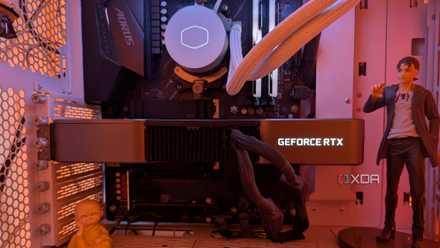
The first few years of this decade were tough for PC gamers. The supply chain crisis born out of the pandemic, combined with high cryptocurrency prices and increased demand, meant that virtually no one was able to buy GPUs at reasonable prices. I still remember calling countless retailers for a good deal on any RTX 3060 Ti model I could find, but to no avail. Fortunately, I won an RTX 3080 gaming PC in mid-2022, proving to be a godsend during that time. Nvidia's RTX 3080 was one of the last few objectively good offerings the company has put out in recent memory. It was a significant improvement over its predecessor despite being considerably cheaper. It may not be high-end anymore, but it still doesn't feel old in the latest titles.
I overclocked my 5-year-old GPU instead of buying a new one in a terrible market
A GPU upgrade is out of the question, so I decided to optimize my existing card
The RTX 3080 was kind of an anomaly
A diamond in the rough
You need to remember that prior to the launch of the RTX 30 series, consumers had seen Nvidia put out a horribly priced RTX 20 series. Ray tracing debuted on the Turing cards, and they carried the RT tax, especially on the high-end SKUs like the RTX 2080 and RTX 2080 Ti. The RTX 3080 launched at $699, an MSRP it shared with that of the RTX 2080, but it was almost 30% faster than the Turing flagship, the $999 RTX 2080 Ti. The pricing came as a genuine surprise to everyone watching the launch event. Featuring second-gen ray tracing cores, the RTX 3080 felt like a value-for-money 80-class GPU for a long time.
Even if you jump down the timeline and fast-forward to the RTX 40 series, the RTX 4080 provided a nearly 50% increase in performance over the RTX 3080, but its $1,200 MSRP completely tanked its value proposition. Nvidia wasn't in the mood for a repeat of the 30 series, and charged whatever it wanted. And the less said about the RTX 5080, the better. This made the RTX 3080 an incredibly rare occurrence, and the gamers who managed to score one at MSRP still talk fondly about it.
In terms of 2026 performance, it still holds its ground. Whether I'm playing Cyberpunk 2077 at Ultra ray tracing or Alan Wake 2 at High ray tracing settings, I manage to get a near 60 FPS experience at 1440p ultrawide resolution. Even in more recent titles like Indiana Jones and the Great Circle, Black Myth: Wukong, and Battlefield 6, it's still possible to cross 60 FPS, sometimes even 80 FPS, with ray tracing and DLSS performance (or FSR balanced mode) enabled. Sure, I need to use medium ray tracing settings in Black Myth: Wukong, but the RTX 3080 still puts up an impressive performance. Strictly speaking, I do not need to upgrade my PC right now, considering what it's still capable of. The 10GB VRAM is a limitation, sure, but it still hasn't proved detrimental to my overall gaming experience.

I tried gaming on a 6-year-old GPU, and it wasn’t the disaster I expected
This old card is the strongest case against your 'planned obsolescensce' narrative
Undervolting keeps my 1% lows in check
A consistent FPS is far more impressive than higher peaks
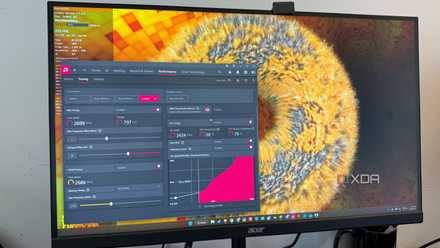
I manage to get a pretty playable 60 FPS with my RTX 3080 in most games, but that isn't the only metric that matters. The minimum FPS is arguably more important, since it determines how smooth your game will actually feel. A wildly fluctuating FPS might still result in a 60+ FPS average, but it'll be much more annoying than a stable gaming experience. This is why the 1% and 0.1% lows are so critical. Undervolting my GPU might not give me a massive boost in peak performance, but it takes care of my minimum FPS. Thanks to the additional thermal headroom, it can sustain the boost clocks longer, resulting in better frame times. This helps me get a more consistent experience with minimal stutters, and the card stays cool and silent, which is a welcome bonus.
I undervolted my GPU and got the upgrade I actually wanted
It brought my RX 9070 XT to life
My upgrade plans are shelved anyway
Thank you, ChatGPT
Unless you've been living under a rock, you know the PC hardware market is going through one of the worst times in recent history. What started with DRAM shortage as manufacturers prioritized AI demand quickly ballooned into sky-high RAM prices, steadily rising storage prices, and yet another GPU pricing hell. Even if I wanted to upgrade from my RTX 3080 to the RTX 5080, I'm not about to spend $1,500 on a new GPU right now. The RTX 5070 Ti and RX 9070 XT are also grossly inflated in my region right now, and anything lower than that won't be a great improvement over my existing card.
The right time to upgrade is usually when your system doesn't do what you need it to. For me, the RTX 3080 does fall short in extremely demanding games, but only if I stick to the highest graphics preset. The moment I'm willing to tweak the settings a bit, it still powers through like the champ it is. Of course, I would have loved to get myself an RTX 5080 at MSRP, or even the RTX 4080 Super before Nvidia discontinued the 40 series, but I missed out on that opportunity. Thankfully, I'm not struggling with the latest titles yet, and I feel I can easily last another two years with my RTX 3080. In the meantime, I'll keep watching GPU prices like a hawk, and will grab a high-end GPU the moment it drops to a somewhat reasonable price.
7 older GPUs that still hold their own against the RTX 50 series
Most gamers are considering upgrading, but only those without these GPUs.
When does a high-end GPU stop feeling high-end?
The RTX 3080 was one of the fastest GPUs when it launched, but today, it's only slightly faster than the RTX 5060 Ti. While this doesn't exactly feel good to an RTX 3080 owner like myself, such is the nature of technology. It's actually impressive, or unfortunate, that a 60-class card from two generations later still can't beat the RTX 3080. I can weather the ongoing PC hardware storm for another two years, thanks to my GPU's capabilities, even 5 years after its launch.