
It's not really news to anyone that gamers aren't exactly lining up for Nvidia's RTX 50 series (not that they're in stock anyway). I was among the many hoping to upgrade to the RTX 5080 from the RTX 3080, but that ship has sailed. Nvidia offered no compelling reasons to make the switch, plus the prices and availability have been horrendous, to say the least. While I had initially decided to wait it out, I now have some alternatives in mind.
The simplest thing to do is to do nothing — keep using my RTX 3080 for the foreseeable future. The next option is to hunt for a good deal on the RTX 4080 Super (believe me, it isn't easy). And the only remaining alternative I see is moving to an AMD GPU. The RX 9070 XT has been officially unveiled, and looks like a decent upgrade over my RTX 3080, provided it's actually available for around $600.

3 reasons I'll be skipping Nvidia's RTX 50 series
Nvidia's RTX 50 series is a fantastic series of graphics cards, but
Retain my RTX 3080
Still going strong in 2025
The famed RTX 3080 was the last time Nvidia truly offered a compelling high-end graphics card, at least for those who got it at or around the $699 MSRP. I was one of those few, and have been using it for around two-and-a-half years now, enjoying smooth 1440p gaming with any title I threw at it. Flight Simulator 2020, Dying Light 2, Cyberpunk 2077, and Alan Wake 2 — these were the most demanding titles I've played on it till now, and it hasn't disappointed me.
All the 80-class cards Nvidia has launched since then haven't come close to offering the value of the RTX 3080. Whether it was the badly priced RTX 4080, the cheaper RTX 4080 Super, or the latest RTX 5080, the price-to-performance ratio suffered due to, well, the price or the performance. The RTX 5080 is the most underwhelming upgrade I've seen in years, and doesn't offer anything over the RTX 4080 Super. Speaking of which, that's where my second alternative comes in.
Find a well-priced RTX 4080 Super
"Prepare for your quest, adventurer!"
Since the third-party reviews of the RTX 50 series went live, I've been hunting for RTX 4080 Super units for a decent price. It turns out the stock for the RTX 40 series is as non-existent as that of the RTX 50 series. Whether you check Amazon or Newegg, you won't find an RTX 4080 Super under $2,000 — a GPU that should cost under $999 by now.
Nvidia reportedly stopped the production of high-end 40 series GPUs months ago, so this isn't a surprise, but it's disappointing nonetheless. I was hoping that some retailers would have leftover stock that I could get an attractive deal on, grabbing an RTX 4080 Super or even the RTX 4080. However, the GPU drought has created an impossible situation, where I might have to look at the pre-owned market. The sellers won't part with their 40 series GPUs for reasonable prices, however, since the demand-supply equation is in their favor at the moment.
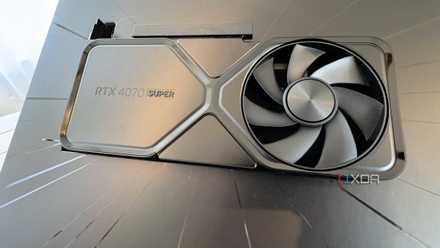
These 6 features make Nvidia's RTX 40 series better than the 50 series
The RTX 40 series might be previous-gen now, but it's still better than RTX 50 for these 6 reasons
Upgrade to the RX 9070 XT
Making the best of a bad situation
We were all hoping AMD would not fumble its delayed RX 9000 launch, and for the most part, it didn't. The RX 9070 XT is a $599 MSRP graphics card going head-to-head with the RTX 5070 Ti, offering similar performance at a theoretical $150 discount. These are AMD's numbers, so our RTX 5070 Ti review could paint a worse picture for Team Red. Nevertheless, we are looking at much improved ray tracing performance from AMD's new GPUs.
This wouldn't be as game-changing an upgrade to, say, the RTX 4080 Super, but the investment could also be significantly lower. If the reports of AMD building RX 9000 series stocks these last few weeks are indeed true, I could find an RX 9070 XT around MSRP, which would be a much more attractive deal compared to the $1,000+ RTX 5070 Ti listings (when they are in stock, that is).
AMD's RX 9070 and RX 9070 XT offer 16GB of VRAM compared to the 12GB on the RTX 5070 Ti, and the FSR 4 looks vastly improved from FSR 3.1. The native ray tracing performance of these RX 9000 cards still lags behind the RTX 50 series in many games, so I might have to compromise on that front. However, turning DLSS or FSR on might not leave much difference in the perceived experience when playing these demanding ray-traced titles.

Nvidia may be planning a counterattack against AMD's RX 9070 as the RTX 5070 is delayed
Things are heating up in the GPU world.
Nvidia's disappointing RTX 50 series has made things clearer
The RTX 50 series might be a far cry from what consumers hoped for, but this has made things clearer for those looking to upgrade their GPU right now. For 40 series owners, there's no reason to even consider the latest cards, and for 30 series owners like myself, upgrading to the 40 series or one of AMD's RX 9000 series GPUs seems more reasonable. Of course, you could also wait for the RTX 60 series if your existing card is high-end enough, opting for a much more impactful upgrade in late 2026 or early 2027.