
Nvidia and Apple are very different companies, but now, more than ever, they're both working off of the same playbook. Taking up the second and first slots, respectively, for the world's wealthiest companies, Nvidia and Apple enjoy the position of being the rulers of a particular market. They have a dominant position in their respective fields, and they're leveraging that position to maintain a grip on the product categories they sell.
Although Nvidia and Apple are two tech companies going after wildly different markets, they're looking a lot alike these days. Here's how.
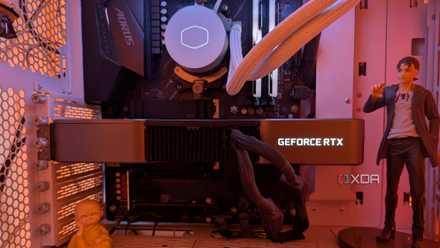
5 reasons my RTX 3080 to RTX 5080 upgrade dream is ruined
I hoped the RTX 5080 would replace my RTX 3080, but the dream is dead.
The iPhone moment of AI
You've probably heard Nvidia's CEO Jensen Huang say the following: "This is the iPhone moment of artificial intelligence." That exact quote comes from a few years back when ChatGPT first burst onto the scene, but it's a sentiment that Nvidia and the tech industry at large have shared ad nauseam. If you just take the quote at face value, it means a turning point in technology; AI will change everything and develop the next "killer app" that everyone needs to have. But you can read into Nvidia's position a bit deeper.
The iPhone was not successful at first. It's a popular piece of trivia, but it wasn't successful for a reason. Lacking features compared to the burgeoning smartphone market and priced above the competition, it was dead on arrival. A couple of generations on, Apple introduced the iPhone 3G and the App Store. And, well, the rest is history. Apple built the hardware, and then it went back to creating a closed ecosystem of software — one it has tried to maintain a firm grasp on ever since.
Nvidia has seen a similar trajectory, though it played out over a much longer period of time. Nvidia developed its CUDA software stack in 2007, but about a decade ago, development started focusing specifically on neural networks. This came after AlexNet entered into a contest for neural networks and swept the competition. The big change was that Alex Krizhevsky, the developer, found that training a neural network with two Nvidia GPUs was significantly faster than a general-purpose CPU.
Seeing the rising tide, Nvidia doubled down on CUDA development with a focus on neural networks, building tall walls around its garden to ensure it would be at the forefront whenever AI hit the mainstream. And with the release of ChatGPT, it did. Nvidia now commands over 90% of the AI GPU market — the exact number changes depending on who you ask — and that comes down largely to CUDA.
The parallel between Apple and Nvidia is striking. Both companies invested in originally unsuccessful ventures, building a closed ecosystem of software that would ensure longevity later down the line. Those gambles clearly worked. There's a reason Nvidia and Apple are the two wealthiest companies in the world.
That's the big shift, but Nvidia has carried this idea into the consumer market, too. With desktop graphics cards, Nvidia has focused its efforts on DLSS. No, DLSS isn't as significant as CUDA, but it represents a way for Nvidia to control its position in the GPU market. Not only is Nvidia on the cutting edge of what's possible with upscaling and frame generation, but it also invests heavily in developer relationships to ensure DLSS shows up in the latest games and applications.

7 ways Nvidia's DLSS 4 is making the future of gaming happen today
DLSS 4 shows upscaling is the future of gaming.
In both the enterprise and the PC, the actual hardware is less important than the software. Nvidia builds out the software stack to encourage purchasing its hardware, even if that hardware isn't particularly impressive — see our RTX 5070 review for an example of that. It's a vessel to get you integrated into Nvidia's software ecosystem. And that focus sounds an awful lot like another company valued at nearly $3 trillion.
The marketing of scarcity
Scarcity is a powerful tool. There's established research that when consumers perceive a product as rare, they're more likely to buy it, regardless of price. This is something most companies are aware of, and Apple and Nvidia certainly are. Even now, when the launch of a new iPhone has lost some luster, massive lines form for the release of a new iPhone and pre-orders sell out in minutes.
GPUs are in a slightly different position. During the pandemic years, shortages of GPUs led to significantly higher prices. It didn't matter what Nvidia (or AMD) said the price of a graphics card was; the price you'd pay was solely down to demand. You couldn't find a GPU in stock, so if something showed up for a comparatively reasonable price — basically anything below double list price at the time -- you needed to buy it immediately.
Even without a pandemic to contend with, that's happening right now. The RTX 5090 should cost $2,000, but it doesn't. Nvidia's board partners have officially raised their prices, with even the cheapest models listed for closer to $2,500 now. They're all sold out, too. If you want to buy an RTX 5090 right now, you'll spend close to $4,000 on eBay. So, when you're browsing your local Micro Center a few months down the road and happen upon a lone RTX 5090 at $2,400, you might pull the trigger. After all, that's one heck of a deal given how expensive they've been.
That's the power of scarcity. It's a tool both Nvidia and Apple leverage to great effect, even if they're after different outcomes. It's impossible to say how much Nvidia itself can lean on scarcity, but it's working. Even system integrators are being charged upwards of $3,000 for an RTX 5090. It's not just the flagship, either. The scarcity works its way down to cards like the RTX 5070, which is selling for close to $800 despite a list price of $550 and generally unfavorable reviews.
In generations past, this scarcity was justified. There was a boom in cryptocurrency, causing GPUs to fly off the shelves, or there was a pandemic to contend with, where a sudden surge in home-bound buyers led to overwhelming demand. Today, there isn't much of a justification. It's just hard to find a GPU now, especially at launch, and prices continue to climb after the fact. I won't go as far as to say Nvidia designed this scarcity, but it's certainly in the company's best interest.
Underhanded performance data
A few years back, Apple made an egregious claim when it announced the M1 Ultra. It said its new flagship silicon could outclass the "highest-end discrete GPU" at the time, referring to the RTX 3090. One look at the chart above, which Apple shared when it announced the M1 Ultra, brings up a ton of questions. How exactly is Apple measuring performance here? When the chart says "relative performance," what does it mean? There are just lines on what appears to be a graph, but they're not measuring much of anything. It's a visual that appears to back up the claim that the M1 Ultra is faster than an RTX 3090.
As a surprise to no one, the M1 Ultra could not best the RTX 3090, but that doesn't matter. The claim had already made the rounds online, and regardless of whether your reaction to it was a scoff or a gleeful shout, Apple got you to care about its new chip. Apple's claim, and its accompanying visual, has the aura of real data, but make no mistake; it's just another frivolous marketing point with no basis in reality. Apple used something seemingly objective to lie, pure and simple.
Nvidia made a similarly egregious claim with the announcement of the RTX 5070. It said the card could deliver the performance of an RTX 4090 for just $550. It doesn't, of course, but Nvidia still made the claim, which promptly turned into headlines. Nvidia was able to say the RTX 5070 is faster than the RTX 4090 due to the former card's use of Multi-Frame Generation (MFG), but that's not exactly what you're looking for when talking about the performance of a new GPU. You're looking for an apples-to-apples comparison.
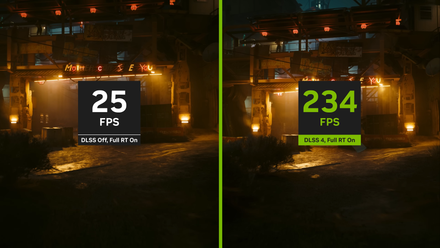
Nvidia's DLSS 4 multi frame generation works best when it doesn't make sense to use it
If you want to use Nvidia's new multi frame generation, keep in mind that there are very specific times where it can actually make a difference.
Although Nvidia hasn't abstracted the data to nearly the degree that Apple has, the strategy is the same. Nvidia leveraged semantics and an aura of objective data to make a claim that is detached from reality. And with the increasing prominence of DLSS, Nvidia has continued to rely on these abstractions of performance, going as far as to try to redefine the term through a lens that benefits its products the most.
Pushing toward a new normal
Even with threats like Deepseek, Nvidia is on top of the world right now. The company has never seen this much success, and that's true across both the enterprise and consumer markets. With such a prominent position, Nvidia is changing its strategy to maintain its position rather than trying to claw its way to the top. And that strategy looks an awful lot like what we've seen from Apple over the past several years.
That strategy doesn't just show up in one area. Nvidia is using similar marketing strategies. It has created a scarcity mindset around new releases and maintains control over a closed software ecosystem that ultimately sells its products. Nvidia and Apple may be different companies, but there's a reason they're so successful. They're pulling from the same playbook.