
-
Best general purpose
Raspberry Pi 5
- CPU
- Arm Cortex-A76 (quad-core, 2.4GHz)
- Memory
- Up to 8GB LPDDR4X SDRAM
- Operating System
- Raspberry Pi OS (official)
- Ports
- 2× USB 3.0, 2× USB 2.0, Ethernet, 2x micro HDMI, 2× 4-lane MIPI transceivers, PCIe Gen 2.0 interface, USB-C, 40-pin GPIO header
- GPU
- VideoCore VII
- Starting Price
- $60
The Raspberry Pi 5 is the best general-use single-board computer around, with a powerful quad-core processor, capable GPU, and a large assortment of I/O ports to power mini-PCs, smart devices, and a wide range of other DIY computing projects.
Pros & Cons- Powerful quad-core Arm Cortex-A76 processor
- 4GB or 8GB models
- Thriving community of support
- Gets warm without active cooling
- More expensive than previous generations
-
Best for AI workloads
Nvidia Jetson Nano Developer Kit
- Storage
- 16 GB eMMC 5.1
- CPU
- Arm Cortex-A57 (quad-core, 1.43GHz)
- Memory
- 4 GB 64-bit LPDDR4
- Operating System
- Nvidia JetPack
- Ports
- 4x USB-A 3.0, 1x USB 2.0 Micro-B, 1x HDMI 2.0, 1x DisplayPort 1.3, Gigabit Ethernet, M.2 Key E, GPIO, I2C, I2S, SPI, UART, MIPI CSI-2 camera connectors, 5V barrel jack
- GPU
- NVIDIA Maxwell architecture with 128 NVIDIA CUDA cores
The Nvidia Jetson Nano Developer Kit has everything you need to start dabbling with deep learning, computer vision, GPU computing, and more, all wrapped in a tiny System-on-Module (SoM). The CUDA cores in its GPU mean efficient real-time processing of data and AI models, in a low-power package.
Pros & Cons- 472 GFLOPS of compute performance
- 128-core Nvidia Maxwell architecture GPU
- Software support direct from Nvidia
- System-on-Module needs add-on board for I/O
- No wireless connectivity
- Developer Kit is now EOL
If you're looking for a single-board computer to start some DIY computing projects, it's likely that you've come across the Raspberry Pi 5. It's easily one of the most recognizable name in maker boards, with great community support for beginners to get started with programming. However, that doesn't mean it's always the best choice. Nvidia's Jetson series of SBCs are designed for embedded use of AI workloads on robotics projects, as they bring the power of CUDA cores to prototyping projects. The Jetson Nano is slightly more expensive than the Raspberry Pi 5, and is no longer being produced, but is it better for specialized workloads?
Raspberry Pi 5 review: The holy grail of DIY projects got even better (and rarer)
The Raspberry Pi 5 is one of the most powerful consumer-grade SBCs out there. Sadly, its limited stock means you'll have a hard time finding one.
Price, specs, & availability
The Raspberry Pi 5 was announced in September 2023 and released to the public on October 23, roughly a month later. The Raspberry Pi Foundation released two versions: a base model with 4GB of memory and a $60 price tag and an 8GB variant priced at $80. There is also a newer variant with 2GB of memory and a $50 price tag, if your application doesn't need the larger RAM amounts.
The Nvidia Jetson Nano Developer Kit is End-of-Life, so any boards you see for sale are leftover stock. The replacement in Nvidia's stack is the Jetson Orin Nano, which costs $500 and is "up to 80 times faster," according to the company.
Nvidia released the Jetson Nano in March 2019 as a low-cost development board for AI projects. The board comes in two versions: a $99 Developer Kit that has the Jetson Nano System-on-Module (SoM) and a carrier board with I/O ports and a heatsink and a $129 Jetson Nano SoM that is production-ready for edge AI systems. The Jetson Nano Developer Kit is EOL as of December 2023, but you can still get carrier boards from Nvidia's hardware partners.
-
Raspberry Pi 5 Nvidia Jetson Nano Developer Kit CPU Arm Cortex-A76 (quad-core, 2.4GHz) Arm Cortex-A57 (quad-core, 1.43GHz) Memory Up to 8GB LPDDR4X SDRAM 4 GB 64-bit LPDDR4 Operating System Raspberry Pi OS (official) Nvidia JetPack Ports 2× USB 3.0, 2× USB 2.0, Ethernet, 2x micro HDMI, 2× 4-lane MIPI transceivers, PCIe Gen 2.0 interface, USB-C, 40-pin GPIO header 4x USB-A 3.0, 1x USB 2.0 Micro-B, 1x HDMI 2.0, 1x DisplayPort 1.3, Gigabit Ethernet, M.2 Key E, GPIO, I2C, I2S, SPI, UART, MIPI CSI-2 camera connectors, 5V barrel jack GPU VideoCore VII NVIDIA Maxwell architecture with 128 NVIDIA CUDA cores Starting Price $60 From $99 Wireless Connectivity Bluetooth 5.0, Dual-band 802.11ac Wi-Fi None
Design and form factor
Technically, the Jetson Nano needs two boards
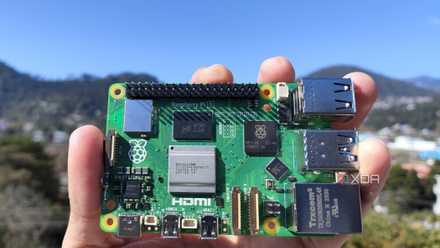
The Raspberry Pi 5 keeps the same credit-card PCB size as its earlier models while upgrading components and shifting them around somewhat. It's what most people would consider a single-board computer, with all the I/O arranged around the edges of the board and components like the CPU, GPU, and memory in the center. It's pocket-sized, although you wouldn't want to slip it into your jeans without a case around it as the exposed pins would hurt.
The Nvidia Jetson Nano is different in that the System-on-Module (SoM) design puts the CPU, GPU, and memory on a small add-in card that's roughly the same size and shape as a SODIMM memory module for a laptop. That makes it smaller for integrating into robots, smart security cameras, or other applications where you would want the processing power to be on-device and as close to the data source as possible. For development purposes, Nvidia sold a Dev Kit that consisted of the SoM and a carrier board to slot it into, which also included the standard ports you'd expect on an SBC, like Ethernet, USB-A, GPIO, and MIPI-CSI camera connectors.
Both SBCs have a similar layout and port selection and can be used for many of the same purposes. The Jetson Nano is easier to stash in a smaller space due to its module, but it does require designing the electronics of your device around the necessary socket, so it's best for custom applications. This feels like a tie unless you need edge computing in a smaller space.

Ports, I/O, and performance
Raspberry Pi is more versatile
The Raspberry Pi 5 has a newer quad-core Arm Cortex-A76 processor compared to the quad-core Arm Cortex-A57 in the Jetson Nano. That will mean higher computing performance in CPU-based tasks, but that's not quite the whole picture. The Jetson Nano has a 128-core Maxwell GPU with CUDA cores which enables GPU-accelerated AI tasks. While these are older CUDA cores, they might give the Nano the edge in specific computing tasks. That said, the Tegra X1, on which the Jetson Nano was based, came out in 2015, so the newer Arm processor in the Raspberry Pi 5 comes with benefits for power usage and speed.
With Wi-Fi and Bluetooth 5.0 support straight out of the box, the Raspberry Pi 5 has a better selection of I/O and connectivity. You can add an M.2 Wi-Fi card to the Jetson Nano, but it's an additional cost to an already more expensive SBC. Both boards have GPIO, Ethernet, four USB-A ports, multiple ways to power them on, and two MIPI connectors that can be used for cameras if you want to do stereo computer vision experiments. The Raspberry Pi 5 also has two micro HDMI outputs, while the Jetson Nano Dev Kit has one full-sized HDMI 2.0 and a DisplayPort 1.3. That means both can technically run dual displays at 4K60.
Since the Raspberry Pi 5 comes with Wi-Fi and Bluetooth out of the box, it just squeaks ahead of the Jetson Nano for connectivity and I/O. The new Arm cores in its processor are also significantly faster and use less power. The only caveat is that if you need the CUDA support of the GPU cores in the Jetson Nano, that's always going to be your pick.

You might replace your PC with an SBC one day
PCs are big and bulky, whereas SBCs are getting more powerful.
Operating system
The Pi has wider support
Part of the mass-market appeal of the Raspberry Pi 5 is the software and operating system support, combined with the large enthusiast community, which is always adding new options for utilization. The official Raspberry Pi OS is powerful, constantly being updated, and runs faster than Ubuntu or any other distro on the Pi. But even if you don't want to run that, there are many other options from purpose-built distros for turning the Raspberry Pi 5 into a retro-gaming powerhouse or a media center. It could even be made to run Android or Windows 11 if you prefer.
The Jetson Nano uses Nvidia JetPack SDK to run AI applications on top of a Linux core. That's not too far from the Pi, except that the Jetson Nano only really works properly with Jetson Linux, the distro that is supplied with JetPack. That's because it has drivers for the CUDA cores in the Nano's GPU so that they can be used for accelerating AI workflows. Without those drivers working, the Nano loses its most important specification because running AI tasks on the CUDA cores is generally faster than on CPU cores.
The winner here depends on what you are planning to build. The Raspberry Pi 5 is supported by many more operating systems, and can be used for a wider range of projects. The Jetson Nano uses Jetson Linux officially, which provides Nvidia drivers, toolchains, and more, in one handy package. It uses an older Ubuntu kernel, however, and Nvidia has said it will not update it to the newest version. For any projects needing the newest Linux kernel, the Raspberry Pi 5 is the one to choose.

From gaming to robotics, these are the top 5 DIY projects you should do with an SBC
Don't miss out on all the fun, grab an SBC and start one of these great DIY projects
Raspberry Pi 5 vs Nvidia Jetson Nano: General support or AI-focused
While both of these SBCs are powerful development tools, the Raspberry Pi 5 is better for a much wider range of DIY computing projects. It has a faster quad-core Arm processor for general tasks, has all of its I/O available without needing a carrier board, and has onboard Wi-Fi and Bluetooth. It also has a thriving community of makers, coders, and developers, constantly improving the various operating systems that the Pi can run and documenting new and wonderful projects to try out next, from running local LLMs to running an automated Etch-a-Sketch.
Raspberry Pi 5
- CPU
- Arm Cortex-A76 (quad-core, 2.4GHz)
- Memory
- Up to 8GB LPDDR4X SDRAM
- Operating System
- Raspberry Pi OS (official)
- Ports
- 2× USB 3.0, 2× USB 2.0, Ethernet, 2x micro HDMI, 2× 4-lane MIPI transceivers, PCIe Gen 2.0 interface, USB-C, 40-pin GPIO header
- GPU
- VideoCore VII
- Starting Price
- $60
The Raspberry Pi 5 is the best general-use single-board computer around, with a powerful quad-core processor, capable GPU, and a large assortment of I/O ports to power mini-PCs, smart devices, and a wide range of other DIY computing projects.
If you know your workload is going to deal with AI, machine learning, or other applications that need real-time data processing, the Nvidia Jetson Nano Developer Kit is a perfect place to start. That's partly because it uses the same JetPack SDK that powers the rest of Nvidia's more expensive machine-learning boards. It's great for prototyping embedded systems for robotics, computer vision, and object identification. The only thing is that the Developer Kit is now EOL as of December 2023, even if the module will be available until January 2027. That will affect pricing, and might also affect support as Nvidia plans to phase out the module entirely.
The successor is the Jetson Orin Nano, which costs $500 for the developer kit, but is significantly faster than the previous module. That doesn't help you if you need multiple for your application, but at least you get significantly more power from the Ampere GPU used in the new module.
Nvidia Jetson Nano Developer Kit
- Storage
- 16 GB eMMC 5.1
- CPU
- Arm Cortex-A57 (quad-core, 1.43GHz)
- Memory
- 4 GB 64-bit LPDDR4
- Operating System
- Nvidia JetPack
- Ports
- 4x USB-A 3.0, 1x USB 2.0 Micro-B, 1x HDMI 2.0, 1x DisplayPort 1.3, Gigabit Ethernet, M.2 Key E, GPIO, I2C, I2S, SPI, UART, MIPI CSI-2 camera connectors, 5V barrel jack
- GPU
- NVIDIA Maxwell architecture with 128 NVIDIA CUDA cores
The Nvidia Jetson Nano Developer Kit has everything you need to start dabbling with deep learning, computer vision, GPU computing, and more, all wrapped in a tiny System-on-Module (SoM). The CUDA cores in its GPU mean efficient real-time processing of data and AI models in a low-power package.