
Summary
- Local LLMs have swiftly improved and can rival cloud models on capable hardware.
- Setup, research, and driver headaches make local AI feel niche and frustrating for mainstream users.
- Drop friction with friendlier installers, UIs, and hardware detection to make local AI mainstream.
For the longest time, the conversation around local AI models revolved around quality. They were either too slow, too dumb, too small, or too incapable to match what the titans over at OpenAI, Anthropic, and Google are doing with ChatGPT, Claude, and Gemini, respectively. That gap, however, is shrinking a lot faster than most people realize, even though it does exist in some areas. For the most part, though, modern local models have become genuinely impressive, and are capable of writing, summarizing, coding, and reasoning on capable hardware, of course.
However, at the end of the day, local AI still feels niche, and that's because it is. The models aren't bad at all, but everything surrounding them is downright exhausting. As someone who ran into a full week of friction from various directions before actually getting any true value out of their local LLM, it's easy to see just why a lot of people continue to avoid using local AI models. Hardware constraints come later — the multiple layers of research, setup, and troubleshooting hold local AI back from mainstream adoption.
I finally found an open-source local LLM that actually competes with cloud AI
Open-source is catching up
There's a burden of research before you even begin
You have to become a researcher before becoming a user
There's nothing easier than opening ChatGPT or Claude in a browser tab and immediately getting value out of it. All you have to do is type in a prompt, and the model responds. The experience begins instantly in this scenario, while local AI flips that equation entirely on its head. Before you even touch the model itself, you have to make decisions about model types and parameter sizes. Potential users are just expected to spend hours researching quantization formats, context lengths, inference backends, and hardware compatibility. The truth is that most average users simply don't know what half of those terms mean, let alone which combinations are actually right for them.
In fact, it gets worse the deeper you get. You spend hours scrolling through Reddit threads, GitHub pages, Discord servers, and forum discussions trying to figure out whether a 7B Q4_K-M model is better than a 14B Q5 variant for your specific GPU and workload, only to have ten different people tell you two (or three, or five) different things. That's because most benchmarks and first-hand write-ups you come across while researching models are written by and for researchers and developers, not normal people. For normal people who just want a good offline chatbot, even a basic question like "Will this run well on my system?" won't have a clean answer.
You could end up spending an entire evening researching, downloading a 10GB or 15GB model, setting everything up, and still discover the experience isn't what you imagine. It might be too slow, or the responses might feel too weak. Your GPU's VRAM limitations might end up crippling performance. Again, this is an example of all the complexity coming before the value. With cloud AI, you get value immediately, and the complexity only comes later if you choose to dive deeper.

I served a 200 billion parameter LLM from a Lenovo workstation the size of a Mac Mini
This mini PC is small and ridiculously powerful.
The setup process turns into a gauntlet
The onboarding experience is designed for developers, not people
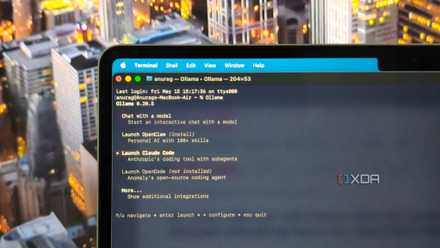
In my own experience, once I had decided on a model, the actual setup process felt like a punishment for being curious. There's no denying that everyone associates polished, ChatGPT-like interfaces with AI, but local AI doesn't start there. Instead, I found myself staring at a terminal window, typing commands into a black screen like it's 2001 again. Eventually, tools like Ollama or Docker environments come into play for recreating an experience that vaguely represents a cloud AI model from the web.
Now, this is all fine for enthusiasts, but it's deeply alienating for everyone else. Even downloading models usually involves typing in terminal commands you don't entirely know the meaning of. The "supporting" documentation is almost always written with the assumption that you have knowledge of CUDA, Python, or ROCm. There's a reason almost every single person who knows how to operate a phone can use ChatGPT, while self-hosting AI models is still an enthusiast's game. The difference is nothing short of comical.
Having gotten into self-hosting an LLM locally on Windows, I was hit especially hard. I ran into driver conflicts, PATH variable issues, even a couple of missing DLL files and bizarre errors, all of which became part of the experience rather quickly. The first two models I downloaded turned out to be too big for my GPU's 12GB VRAM, meaning I had to undo almost an hour of downloading and once again find out which model would deliver the closest results to what I wanted on the "limited" VRAM I had.
Local AI enthusiasts often underestimate how intimidating this is because they've already normalized it. But for mainstream users, this cold-start gauntlet alone is enough to make many of them quit before they ever experience what local AI is actually capable of. It's rather difficult to tough it out, but it's also mandatory.

Running local LLMs every day for five months broke every assumption I had about them
It’s worth it, with caveats
Local AI still feels like a hobby instead of an appliance
The barrier to entry is steep and off-putting
Cloud AI platforms quietly handle almost everything for you. They update their models overnight and introduce features you hear about in the news. Any improvements to memory systems and performance are done server-side, too. Most of the time, users just wake up to a better product, without ever having to lift a finger. On the other hand, local AI proves to be the complete opposite. Maintenance becomes part of the lifestyle, and that lifestyle flirts dangerously with unpaid IT work.
In order to know when a newer or better version of your favorite model has been released, you must stay tapped into communities. Then, of course, comes the manual downloading, swapping, testing, benchmarking, and inevitable comparison phase where you try to decide whether the new model actually feels better than the old one. In fact, even a rollback becomes a hassle if the updated variant doesn't quite sit right with you. Individually speaking, none of these parts are difficult, but melded together, they create constant background friction which never really goes away.

I’d do these 5 things differently if I started self-hosting LLMs today
From trial-and-error to a cleaner local AI workflow.
The friction makes people assume local AI is bad
You think it's TEMU Gemini, but it's really not
There's also a deeply psychological problem that local AI and its notion have to fight, and it's one I've noticed, clear as day, even in myself. If something is free and local, part of your brain tends to automatically assume that it must be worse than the polished subscription product backed by billion-dollar companies. Even before entering the first prompt, a lot of users approach local AI models while expecting compromise and preparing for it. They assume that at best, their self-hosted local LLM will be a watered-down imitation of ChatGPT, Claude, or Gemini.
Sadly, all of the early friction that a user goes through reinforces this bias, and perfectly so. Everyone's first few hours with local AI are spent reading documentation, troubleshooting errors, downloading giant files, and fighting with terminal commands. Naturally, their brain, by no fault of its own, will associate the experience with inconvenience and disappointment. By the time the model responds, the user realizes that they were already expecting less from it. That's a perception problem that thousands of first-time users run into, and it's difficult to shake.
Even though modern local LLMs are extremely capable when it comes to offline productivity, they rarely get a fair chance of showing it off, just because the surrounding experience sabotages them before the actual intelligence does. In the minds of many users, early friction ends up becoming a proof of inferiority, so to speak, even when the model itself may already be more than what they need for day-to-day usage.
Ollama
Ollama is a platform to download and run various open-source large language models (LLM) on your local computer.
My local LLM can call Claude when it's stuck, and it changed everything about my local-first setup
Local LLMs aren't very good on their own
The future of local AI depends on removing friction
Local AI needs to feel less like a research project to become more mainstream.
Much like any problem, this one, too, is solvable. We already see local AI models improving at a ridiculous pace. Now, the ecosystem around them, too, is slowly becoming less hostile. What local AI needs more of in order to become mainstream are better frontends, smarter installers, and automatic hardware detection, all of which would lead to a more consumer-friendly experience. Local AI has to start feeling more like an appliance and much less like a research project.
Once the friction does drop, the appeal of local AI will become undeniable. You won't have subscriptions piling up across multiple services, or rate limits and paywalls stopping you from getting work done. Most importantly, users will have real control and privacy over the data they put into their local LLM. The people who stick through the awkward early phase of local AI now will be the ones who ultimately end up benefiting the most once the ecosystem finally catches up to the quality of the models themselves.