
For months now, the upcoming Steam Machine from Valve has been catching flak online for its supposedly "meager" specs, awkward market positioning, and now, thanks to AI-driven RAM shortages, an increasingly uncertain future and price tag. Every fresh rumor seems to trigger another wave of hot takes about how it's dead on arrival.
But here's the thing: we're evaluating it like a midrange PC tower, which it really isn't. It's a console-style gaming system built for the PC ecosystem, and once you look at it through that lens, the entire conversation changes.
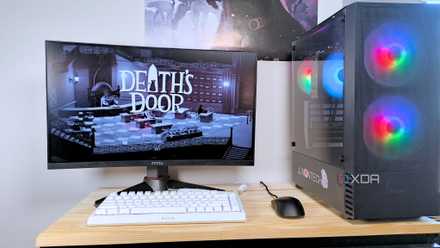
I built a Steam Machine out of spare PC parts and you can, too
If you have old PC hardware lying around or an aging Windows laptop, you might be able to breathe new life into it with SteamOS
The Steam Machine is competing with consoles, not PCs
This is a PlayStation 5 rival, not a DIY rig
The Steam Machine isn't here to battle our custom towers. It's competing with the PlayStation 5 and the Xbox Series X instead. We've long accepted that modern consoles are effectively midrange PCs with elite optimization and aggressive upscaling. That's how they produce such impressive visuals on modest hardware. The Steam Machine plays the same game, except it does it inside the PC ecosystem.
This is a compact box that still manages to go toe-to-toe with today's leading consoles, and, in some scenarios, may even outscore them in performance benchmarks thanks to SteamOS efficiencies. That's the market it's entering, and that's the comparison that matters. Judging the Steam Machine against desktop builds running bloated Windows installs completely misses the point. This is console philosophy applied to PC gaming — curated, streamlined, and optimized from the ground up.

6 things PC gaming doesn't warn console gamers about
More freedom, more games, more problems.
Proton and SteamOS change everything
Valve's own OS on powerful AMD hardware will be remarkable
Thanks to Proton and SteamOS, almost every game that runs on the Steam Deck already runs here too, except this hardware is roughly six times more powerful in the Steam Machine. More importantly though, SteamOS simply treats hardware better than Windows at comparable specs. With less overhead, fewer background services, and better resource management, games run significantly better on SteamOS than on Windows. The real-world performance boost is undeniable.
Writing this off as "just a 7600 XT box that can't do true 4K" misses the point entirely. True native 4K remains out of reach for the vast majority of players and typically requires 4080-class hardware or better. Everyone else is already relying on upscaling, and so will the Steam Machine. That's where SteamOS would be doing most of the heavy lifting. Pair it with modern reconstruction tech like FSR 3, and suddenly, those "midrange" specs stretch much further than raw numbers suggest. This efficiency is what could help the Steam Machine stay relevant well beyond launch, through to the end of this console generation, and perhaps beyond that, too.

You may not like them, but AI upscalers are currently saving PC gaming
DLSS is playing a large part in why old hardware is still capable right now
Most people don't own flagship GPUs
Spec sheet culture has warped our expectations
We've somehow convinced ourselves that everyone and their dog owns bleeding-edge hardware when they really don't. Only a tiny percentage of users run cards like an RTX 4070 Ti Super or above. The overwhelming majority are on midrange builds with similar VRAM and system memory to what the Steam machine is going to ship with.
Even at its inflated, RAM-shortage-influenced pricing, this is still a thousand-dollar-capable gaming box (that hopefully costs less than that). An NVIDIA RTX 4060 or a Radeon RX 7600 XT — equivalents to the Steam Machine's GPU — are still fantastic graphics cards, and that's why they both continue to sell well, new and used. These are cards people plan to run for years.
I personally run a 4070 Ti, and I've got friends on RTX 5080 systems as well. However, that doesn't change the fact that most of my friend group still plays on 30-series or 20-series cards. Most client builds I spec out are midrange. We've become obsessed with theoretical ceilings and measuring every new piece of tech against the bleeding edge of the time instead of just being practical and grounded in reality. That has skewed how we judge hardware like the Steam Machine.
It's a fantastic entry point into PC gaming
The Steam Machine isn't for enthusiasts, and that's okay
For someone looking to step into PC gaming without assembling parts or posting build lists on Reddit, the Steam Machine makes perfect sense. It's one company, one ecosystem, and one familiar console-style experience backed by the world's largest PC game library. If you're a complete newbie, what's not to like or trust?
If it isn't for you, that's fine, too. You might already have hardware capable of matching the Steam Machine, but for someone else, it's a straightforward on-ramp into PC gaming with no cable spaghetti, no compatibility anxiety, and no configuration rabbit holes.
Agreed, the RAM shortages have made its future murkier than anyone would like, but even with that uncertainty, the core idea remains solid. Valve's Steam machine isn't aimed at hardware purists, and it never was. It's aimed at players who just want to sit down, boot up, and play, and there's absolutely nothing wrong with that.

Midrange hardware isn't a weakness
It's what most of us actually use
Midrange hardware is the backbone of PC gaming, and it always has been. The RTX 4060 and the RX 7600 XT are both phenomenal in their own segment, and paired with SteamOS, the GPU inside the Steam machine will deliver vastly better performance than the benchmarks we're used to seeing on Windows. Add to that the fact that modern upscalers improve significantly with each update, and suddenly, the silicon inside the Steam Machine will look comfortable punching above its weight.
Steam Machine
- CPU
- AMD 6-core Zen 4 x86, up to 4.8 GHz, 30W TDP
- Graphics
- Semi-custom AMD RDNA3 28CU (8GB GDDR6, 2.45GHz max sustained clock, 110W TDP)
- Memory
- 16GB DDR5 SODIMMs
- Storage
- 512GB or 2TB models, microSD card slot
- Ports
- DisplayPort 1.4, HDMI 2.0, Ethernet (1Gbps), USB Type-C 3.2 Gen 2, 2x USB Type-A Gen 3 (front), 2x USB Type-A Gen 2 (rear)
- Operating System
- SteamOS

I tried gaming in 360p with DLSS 4.5, and the results left me shocked
Night City at 360p is remarkable, to say the least
The Steam Machine is not a replacement for our custom rigs
We spent years demanding accessibility in PC gaming only to mock the first serious attempt at delivering it.
At the end of the day, the Steam Machine doesn't need to redefine PC gaming to justify its existence. It just needs to meet players where they already are — in a world of midrange hardware, smart upscaling, and console-like convenience.
We've spent years demanding accessibility in PC gaming, only to turn around and mock the first serious attempt at delivering it in a polished, unified package. That contradiction says more about us than it does about the machine, honestly. It's not a replacement for your custom rig or mine, but it's more of a bridge, and for a lot of people, that bridge might be exactly what finally brings them into PC gaming, without fear or friction, and without needing to care about spec wars.