
When most people look at NAS devices, they mostly see them as a storage solution for files and backups. After all, it's in the name — network-attached storage.
I was also guilty of this, which meant that for years I underutilized my NAS's true capabilities. But as I learned more about self-hosting, I realized that my NAS was the perfect solution for hosting services for round-the-clock access.
I finally started switching my self-hosted services to my NAS and here's what I've learned
It has started off well, but there are some trade-offs
When I first got my NAS, I didn't realize everything it could do
This meant it wasn't all that useful
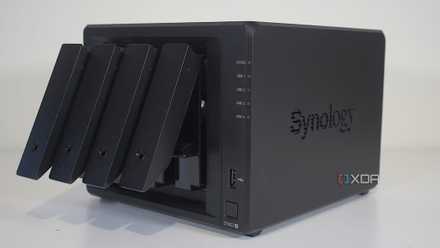
I received my Synology DS420+ as part of my job. This meant that I had to test out the device's storage and backup features. As a result, I approached its features from a strictly storage-focused mindset.
I set it up to store backups of my desktop PC. I also used Synology's various file backup solutions, such as Synology Photos and Synology Drive. But I didn't really explore the device's features past this.
I knew that I could also use it to store media files, but its limited CPU and RAM meant that I never really explored those features. As a result, for years, I barely used it. After all, I was already heavily embedded in Google's ecosystem with Google Drive and Google Photos. Meanwhile, the Plex server I use is hosted on a VPS.
When I started exploring self-hosting in 2025, however, I realized that my NAS could serve as the perfect device for my containers. Self-hosting on my main PC came with certain drawbacks, but my NAS would ensure 24-hour access to my most important services. I stopped treating it as just a place to store files, and instead I recognized that it is an energy-efficient computer with significant potential. This new mindset turned it from a glorified, overpriced external drive into something that I use daily.
My NAS is now home to some of my most useful services
Notes, checklists, tasks, and automation
While my NAS isn't very powerful, I host some of my favorite services with just 2GB of RAM. These include Home Assistant, Jotty Page, and Donetick. I also host the Cloudflare container, which enables me to connect to my services from outside my network via a Cloudflare tunnel.
Jotty Page replaced Google Keep for me, making it one of my most useful services. Having a self-hosted solution that allows me to rely on Google less is incredibly helpful. Meanwhile, I've been using Donetick for almost a year to keep track of my chores.
These types of self-hosted services are quite niche, but helped me at a time when mainstream productivity apps were failing me. They allowed me to find user-friendly features that weren't trying to extract a subscription from me.
I've also deployed services like HomeBox for keeping track of items around the home and Glance for keeping all my feeds on one page.
In a single year, I've gotten more use out of my NAS than the three years before I started self-hosting. While my main PC may sit unused for a few days depending on my schedule, my NAS hums along constantly.
An upgrade will help make my NAS even more useful
I could host more services
While my NAS is arguably the most useful PC in my home, it's definitely not the most powerful. With only 2GB of RAM, I can't host all the services I would like to.
I successfully deployed Immich and Paperless-ngx on my NAS, but the containers became unstable because of its limited RAM. I also can't create a VM to host Home Assistant OS, which would allow me to easily use add-ons, due to the lack of RAM. This means I host Home Assistant in a container instead.
I want to upgrade its capacity, but there's currently limited stock of the upgrade kit I need. When I finally get the chance to buy it, I know it will greatly increase my ability to host additional services. My hope is to deploy even more services that allow me to rely less on Big Tech.
That said, Synology's moves in recent years have made me more skeptical about the platform. In addition to this, Container Manager continues to be a source of frustration for me.

8 smart ways a NAS can simplify your digital life at home
It’s more than just plain old data storage
Explore your NAS's features to see what it can do
If you're anything like I was, you might not be using your NAS to its full potential. While storage and backups are the main uses associated with a NAS, there's plenty you can use the device for.
Self-hosting is just one way you can use your NAS beyond storage. You can also use a NAS as a media server if you're tired of relying on streaming platforms. You can use it as a server for CCTV footage or even use it as a network ad blocker.
However, just like any computer, hardware will always play an important role in exactly what your NAS can do. Regardless, it's worth exploring what it can do past storage — you may just find your next favorite service.