
When reviewers started raising concerns around VRAM back in 2020, many gamers thought it was a niche problem that would only affect high-end gaming, that too, in the distant future. In two short years, however, GPUs with 8GB of VRAM began causing performance issues in AAA titles like Dying Light 2 and A Plague Tale: Requiem. These titles were soon followed by Hogwarts Legacy, The Last of Us Part I, Star Wars Jedi: Survivor, Alan Wake 2, and many more games. The same GPU model with lower VRAM often saw performance fall off a cliff, especially on older systems limited to PCIe 3.0 and PCIe 4.0. This proved that, more than anything else, VRAM became the deciding factor in GPU longevity. Modern games, local AI workloads, video editing, and other productivity tasks demand more VRAM than ever, and most people simply don't have GPUs with enough of it. The old graphics cards that managed to break the 8GB VRAM barrier have aged far better than others.
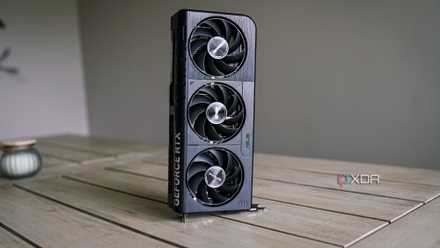
No one wants GPUs with 8GB of VRAM, but here's why they're not going anywhere
Smarter AI tricks and adverse market conditions are reasons why
Unlike raw horsepower, low VRAM doesn't give your GPU an easy out
You need enough VRAM capacity to enter
If your 5-year-old GPU still has decent compute capability, relative to modern budget cards, it has a good chance of aging gracefully. You have enough tools at your disposal to skirt around the older-gen cores. You can lower your graphics settings, implement aggressive upscaling without losing much in terms of visual quality, and use third-party tools like Lossless Scaling. In a nutshell, your GPU can scale down in gradual steps. In contrast, insufficient VRAM usually gives you an either-or choice, especially in modern AAA titles. Many of them won't even launch on GPUs with outdated VRAM capacity. The ones that work will tank your framerates if you have 8GB or even 10GB VRAM. For context, my RTX 3080's 10GB framebuffer has been struggling to maintain 60 FPS in ray-traced titles for the last two years, even with upscaling. I know ray tracing is optional, but this gives you an idea of the limitations of low VRAM graphics cards in 2026.
The moment a game exceeds your GPU's VRAM capacity, it can become downright unplayable due to incomplete textures, horrible stutters, and crashes. Even if your old GPU had the necessary horsepower to maintain playable framerates, it can't do much to fight the VRAM bottleneck. The RTX 3070 is a prime example of a relatively powerful GPU that was let down by its measly 8GB VRAM. Back then, it didn't create many glaring issues, but today, insufficient VRAM is a problem even at 1080p settings. Around 25% of gamers are on 1440p (including 3440 x 1440), which isn't a small number. 1080p still dominates with over 50% share, but 1440p and 4K gaming are catching up, holding around a 30% combined share. This has made low VRAM GPUs a burning issue, and with Nvidia dominating the GPU market, most gamers are at the whims of Team Green.
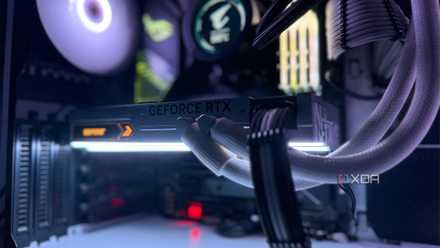
The GTX 1080 Ti was legendary, but this 4-year-old Nvidia GPU may age even better
Years from now, we'll probably say the same thing about this RTX GPU.
Modern workloads have made VRAM more important than ever
It's not just about gaming
Gaming isn't the only area where your GPU performance suffers due to low VRAM. With productivity workloads like video editing, 3D rendering, and local LLMs becoming more common than ever, sufficient VRAM isn't optional anymore. Editing 4K videos in Premiere Pro or loading LLMs with 14B or more parameters in your GPU's memory becomes borderline impossible with 8GB of VRAM. If a model fails to reside in your GPU's memory, after accounting for the OS overhead, the performance is basically unusable. As the model offloads layers to the system RAM and CPU, the inference speed crawls to a halt, making you question why you decided to try local AI on your old GPU.
VRAM has become a longevity spec as both games and memory-intensive programs become more demanding than ever. Optimized games are a rarity as developers shift the burden to the gamers. Quantization and Mixture-of-experts models can only do so much if your GPU features an outdated framebuffer. Graphics cards like the RTX 3060 12GB, RTX 2080 Ti (11GB), and even the GTX 1080 Ti (11GB) are still going strong primarily because of their VRAM capacities. They might be too old in terms of raw compute, but the additional VRAM buffer enables them to stay relevant for longer.
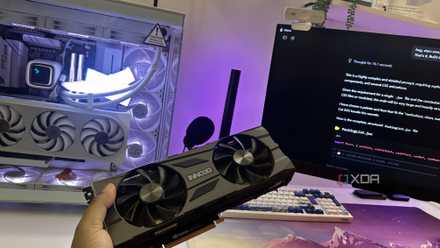
Local AI is more accessible than ever, but with one major GPU-sized caveat
Your system specs still matter if you want decent performance from your local AI stack
Your GPU's low VRAM hurts its value on the pre-owned market
Take the future into account when buying a GPU
You can see the impact of low VRAM even on the used market when you list your old GPU for sale. Cards with still-decent raw performance but outdated VRAM capacity aren't in high demand. While GPUs like the RTX 3070 (8GB) are able to fetch around $230 on eBay, AMD equivalents like the RX 6800 (16GB) still command over $350. In fact, the older RTX 2080 Ti (11GB), which has similar raw performance, goes for around the same price as the RTX 3070. Your GPU's resale value is legitimately taking a hit due to its insufficient VRAM, which wasn't a problem when you bought it, but has turned into a big one in recent years. You can see this play out on the two variants of the RTX 3060, where the 8GB model trends close to $200, while the 12GB one sits closer to $300 on eBay. So, it's not just a question of whether your GPU has enough VRAM "now"; you also need to take its future resale value into account when buying a new GPU in this market.

A used RTX 3090 remains the value king for local AI, even after Nvidia's 50 series
The VRAM per dollar of the RTX 3090 is hard to beat even in 2026
VRAM silently became the driving factor for GPU longevity
Around 5 years ago, no one was worrying about low VRAM on their GPUs. As games and productivity applications started demanding more memory, and GPU manufacturers didn't ramp up VRAM capacities accordingly, things started to change. VRAM has now become one of the most important specs on a GPU, both for existing usability and future resale value.