
IPv4 has supposedly been on its way out for decades now, with IPv6 poised to take over the world. But here in 2024, we're all still using IPv4, and IPv4 exhaustion is just as pressing a problem as ever. Why is it so difficult for the world to escape from IPv4's clutches, and will IPv6 ever truly replace IPv4?
What is IPv4 exhaustion?👁 ipv4-pricing
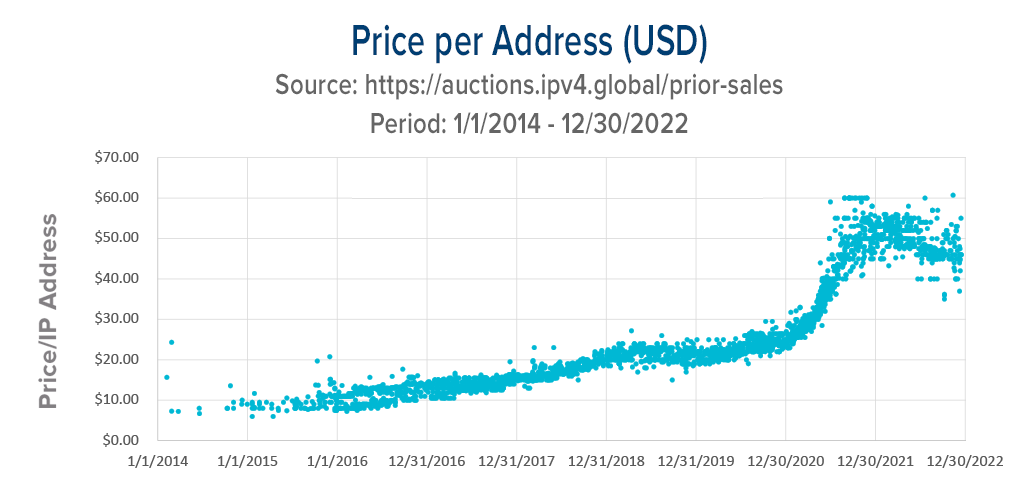
IPv4 is probably the IP standard you're familiar with. 10.0.0.1, 35.67.89.20, and 192.168.0.1 are all IPv4 addresses. They're everywhere, and power addressing the vast majority of our entire internet infrastructure. They're used to locate computers on the internet, in the same way that your address and ZIP code are used to locate your house or street. But IPv4 has one major, modern problem.
When the IPv4 standard was devised, connected computer networks were in their infancy. Computers were machines of research and big business, and the idea that every household might have one was far-fetched to say the least. Networks were also slow, and memory, buffer, and register space on computers were in short supply. As a result, the designers of the IPv4 standard made a simple and sensible decision, but one with big consequences we are still living with today. They limited the amount of space in an IPv4 packet used to store the address to 4 bytes, or 32 bits, limiting the size of an IP address from 0.0.0.0 to 255.255.255.255, leaving us a meager 4.3 billion IP addresses to work with.

Do you even need Ethernet if you have a Wi-Fi 7 router and devices? It's complicated
Wi-Fi 7 is starting to catch on, and it might be good enough to replace a cable for some people — at least, on paper.
At the time, this must have seemed like plenty. But as the internet evolved, it quickly became clear that we would run out of IPv4 addresses to use, prompting the development of IPv6. In the years since, the availability of IPv4 addresses (especially in larger blocks) has waned, and the price of IPv4 addresses has risen several times over. In the early days of the internet, IP addresses were effectively free, and many large institutions like universities were given huge blocks of IPv4 space to use. Now, that space can be worth tens of millions of dollars.
If you'd like to learn more about how IP addressing and networking works, review our guide for more details.
IPv6 saves the day
IPv6 was developed squarely with this problem in mind, and expands the address space to a whopping 128 bits. This is enough for about 340 undecillion unique devices, which is more than the number of atoms on the surface of the earth. It added a few new features as well, like device autoconfiguration, mandatory IPSec, and improved routing; however, these all took a backseat compared to the address depletion problem. The first IPv6 standards were published in the mid 1990s, and were completed in 1998.
IPv6 has been in migration hell for decades👁 A screenshot of Google's IPv6 adoption graph.
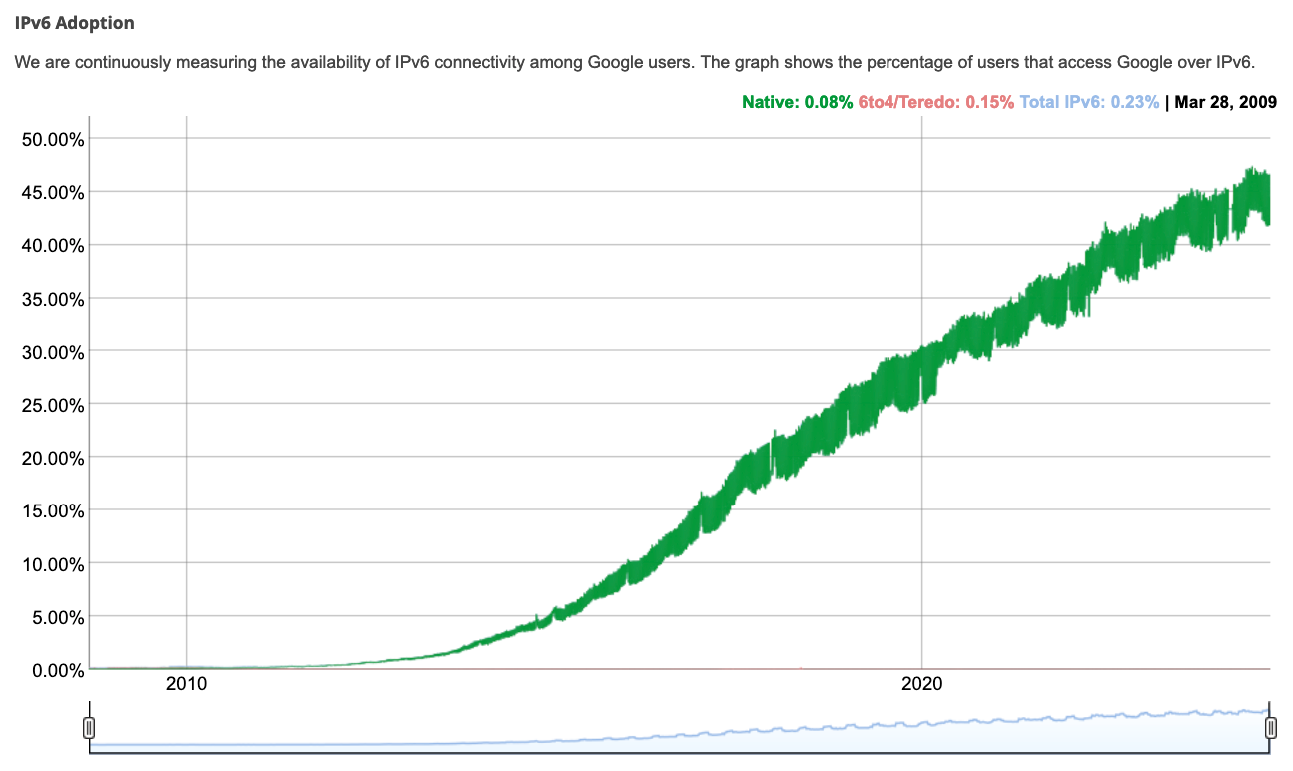
The year is 2024 though, and the internet still runs on IPv4. So where did it all go wrong? IPv6 has been in migration hell for decades, with every kind of possible initiative to improve IPv6 adoption falling flat, from an official World IPv6 Day in 2011, the World IPv6 'launch' in 2012, and several US Federal government action plans in 2005, 2010, and 2020 (including mandating IPv6 readiness for government networks - a deadline initially set at 2012 and now extended to 2025). There have been numerous incentives for schools and businesses, promotional campaigns from registries and ISPs, conferences, and education campaigns.
IPv6 adoption is boring and expensive
However, IPv6 adoption has remained slow and sticky for a range of reasons. As of 2024, Google's data on IPv6 availability among its users puts the number at ~44%. There are lots of reasons for this, but the main crux of the issue is that IPv4 and IPv6 are not directly compatible. A system which only supports IPv4 will not be able to communicate with an IPv6 system, and vice versa. Most organizations on the internet have handled this by adopting a 'dual-stack' approach, where they support both IPv4 and IPv6 simultaneously. However, this is complex and costly, without clear business benefits. Everyone already supports IPv4, so most customers won't even notice they're using IPv6 even if you do support it. IPv6 is also not inherently faster, and most of its feature benefits are hidden far away from the domain of a casual browser of the web. You might well be reading this article over IPv6, depending on your ISP, and likely have no idea.
As of 2024, Google's data on IPv6 availability among its users puts the number at ~44%
There's no benefit down the pipeline for businesses either, as IPv4 support can't be dropped completely until all customers have migrated to IPv6. This creates a chicken-and-egg problem, where companies and organizations see little incentive to support IPv6 when they're required to maintain IPv4 support anyway.
Network Address Translation (NAT) to the rescue
Another serious problem that's faced IPv6 adoption is NAT. NAT is a technology which was designed in 1994 to reduce the number of global IPv4 addresses needed. It allows devices on a private network to share a single IP address, and is present in almost all home routers (and has been for decades). NAT is the reason why your computer has an 'internal' IP address, and needs port forwarding to be accessible directly from the internet (firewall aside). NAT has allowed us to continue to grow the number of devices online well past the exhaustion point of IPv4 to a whopping 30 billion devices.
Confusion around NAT has been rife for years, as NAT has the other benefit of acting as a de-facto firewall, preventing outside devices from connecting directly to your computer. While IPv6 was developed to eliminate the need for NAT (with NAT seen as a bridging mechanism), it has now become so widely adopted that it's become a core part of our network infrastructure, undoubtedly slowing IPv6 adoption overall. There are other technologies we won't touch on here that also help provide NAT at an enterprise or ISP level, reducing your ISPs reliance on IPv4 space to keep customers onboard.
[NAT] allows devices on a private network to share a single IP address, and is present in almost all home routers
IPv4 is here to stay, but expect IPv6 adoption to continue
Ultimately, it's unlikely we'll be completely rid of IPv4 any time in the coming decades. Even as IPv6 adoption continues to grow, the effort and investment involved in making a complete transition remains huge. That said, certain areas of the internet are likely to move over faster than others. As small, internet connected devices (once known as the Internet of Things) become more ubiquitous, the IP space needed to address them will continue to grow. Devices like these, or virtualized servers, containers, or clusters inside cloud providers, are big candidates to help drive the switch towards IPv6. The same applies for mobile carriers and some extended consumer ISPs.
The move to IPv6 has been a long, long-fought battle, and it's not going to be over any time soon. The transition to IPv6 was "just on the horizon" during the early years of my own Computer Science degree back in 2016, and while some progress has been made since then, it's been slow at best. But the demand for IPv4 IP addresses isn't disappearing any time soon, nor is our endless desire for more and more internet-connected devices. IPv6 has struggled to provide a compelling reason for most users to migrate, and while IPv4 is still alive, there will always be corners of the internet that resist the extra complexity required to upgrade. This problem has no solution, and while IPv6 adoption among big businesses is improving, total adoption is still a significant hurdle for IPv6 to overcome before it can truly replace IPv4.