


| Messier 66 | |
|---|---|
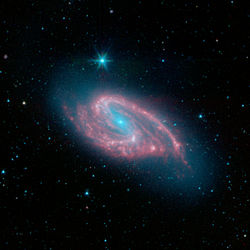
| 👁 Image A colour-composite image of M66 | |
| Observation data (J2000 epoch) | |
| Constellation | Leo |
| Right ascension | 11h 20m 15.026s[1] |
| Declination | +12° 59′ 28.64″[1] |
| Redshift | 0.002425±0.000010[2] (696.3±12.7 km/s)[3] |
| Distance | 31 Mly (9.6 Mpc)[4] |
| Apparent magnitude (V) | 8.9[2] |
| Characteristics | |
| Type | SAB(s)b[5] |
| Size | 85,200 ly (26.12 kpc) (estimated)[6] |
| Apparent size (V) | 9.1′ × 4.2′[6] |
| Notable features | Galaxy in the Leo Triplet |
| Other designations | |
| Arp 16, NGC 3627, PGC 34695, UGC 6346[7] | |


Messier 66 or M66, also known as NGC 3627, is an intermediate spiral galaxy located around 31 million light years from Earth in the equatorial half of the Leo constellation. This galaxy is a member of the Leo Triplet (M66 group), a small group of galaxies that includes M65 and NGC 3628.[8] M66 has a morphological classification of SABb, indicating that is has a spiral shape with a weak bar feature and loosely wound arms.[5]
It was discovered by French astronomer Charles Messier[9] on 1 March 1780, who described it as "very long and very faint".[10] Messier 65 and Messier 66 are a common object for amateur astronomic observation, being separated by only 20′.[10]
Characteristics
[edit]Messier 66 is a intermediate spiral galaxy. It has a weak bar and a loosely wounded spiral structure. [3] It is about 95 thousand light-years across.[11] The galaxy has striking dust lanes and bright star clusters along its spiral arms. It also has a well-developed central bulge.[12] The isophotal axis ratio is 0.32, indicating that it is being viewed at an angle.[5]
The galaxy has a high rate of star formation occurring in the spiral arms.[12] Its rate of star formation is about 0.05 solar masses per year. These young stars ionize their surrounding environment.[13]
Interaction
[edit]Gravitational interaction from its past encounter with neighboring NGC 3628 has resulted in an extremely high central mass concentration and a high molecular to atomic mass ratio. This also resulted in a resolved non-rotating clump of H I material apparently removed from one of the spiral arms. The latter feature shows up visually as an extremely prominent and unusual spiral arm and dust lane structures as originally noted in the Atlas of Peculiar Galaxies.[14]
Supernovae
[edit]Five supernovae have been observed in M66:
- SN 1973R (Type II, mag. 14.5) was discovered by Leonida Rosino on 19 December 1973.[15][16]
- SN 1989B (Type Ia, mag. 13) was discovered by Robert Evans on 30 January 1989.[17][18]
- SN 1997bs (type uncertain, mag. 17) was discovered by the Lick Observatory Supernova Search (LOSS) on 15 April 1997.[19][20] This event was initially classified as a Type IIn supernova, but later analysis suggests that it is instead either a luminous blue variable,[21] a "gap" transient,[22] or a luminous red nova.[23]
- SN 2009hd (Type II, mag. 15.8) was discovered by Libert (Berto) Monard on 2 July 2009.[24][25]
- SN 2016cok (Type IIP, mag. 16.6) was discovered by the All Sky Automated Survey for Supernovae on 28 May 2016.[26][27][28]
Gallery
[edit]-
Infrared false color view of M66 from the Spitzer Space Telescope
-
Infrared false color view of M66 from the James Webb Space Telescope
-
Messier 66 by 2MASS
-
An ultraviolet image of Messier 66 by GALEX



See also
[edit]References
[edit]- ^ a b Skrutskie, Michael F.; Cutri, Roc M.; Stiening, Rae; Weinberg, Martin D.; Schneider, Stephen E.; Carpenter, John M.; Beichman, Charles A.; Capps, Richard W.; Chester, Thomas; Elias, Jonathan H.; Huchra, John P.; Liebert, James W.; Lonsdale, Carol J.; Monet, David G.; Price, Stephan; Seitzer, Patrick; Jarrett, Thomas H.; Kirkpatrick, J. Davy; Gizis, John E.; Howard, Elizabeth V.; Evans, Tracey E.; Fowler, John W.; Fullmer, Linda; Hurt, Robert L.; Light, Robert M.; Kopan, Eugene L.; Marsh, Kenneth A.; McCallon, Howard L.; Tam, Robert; Van Dyk, Schuyler D.; Wheelock, Sherry L. (1 February 2006). "The Two Micron All Sky Survey (2MASS)". The Astronomical Journal. 131 (2): 1163–1183. Bibcode:2006AJ....131.1163S. doi:10.1086/498708. ISSN 0004-6256. S2CID 18913331.
- ^ a b de Vaucouleurs, G.; et al. (1991), Third reference catalogue of bright galaxies, 9, New York: Springer-Verlag.
- ^ a b van den Bosch, Remco C. E.; et al. (May 2015), "Hunting for Supermassive Black Holes in Nearby Galaxies With the Hobby-Eberly Telescope", The Astrophysical Journal Supplement Series, 218 (1): 13, arXiv:1502.00632, Bibcode:2015ApJS..218...10V, doi:10.1088/0067-0049/218/1/10, S2CID 117876537, 10.
- ^ Tully, R. Brent; et al. (August 2016), "Cosmicflows-3", The Astronomical Journal, 152 (2): 21, arXiv:1605.01765, Bibcode:2016AJ....152...50T, doi:10.3847/0004-6256/152/2/50, S2CID 250737862, 50.
- ^ a b c Ann, H. B.; et al. (2015), "A Catalog of Visually Classified Galaxies in the Local (z ~ 0.01) Universe", The Astrophysical Journal Supplement Series, 217 (2): 27–49, arXiv:1502.03545, Bibcode:2015ApJS..217...27A, doi:10.1088/0067-0049/217/2/27, S2CID 119253507.
- ^ a b "NASA/IPAC Extragalactic Database", Results for NGC 3627, retrieved 31 August 2006.
- ^ "NGC 3627". SIMBAD. Centre de données astronomiques de Strasbourg. Retrieved 2 December 2018.
- ^ Adam, Len (2018), Imaging the Messier Objects Remotely from Your Laptop, The Patrick Moore Practical Astronomy Series, Springer, p. 290, Bibcode:2018imor.book.....A, ISBN 978-3319653853
- ^ Frommert, Hartmut; Kronberg, Christine (15 June 2016), Spiral Galaxy M66, retrieved 3 December 2018.
- ^ a b O'Meara, Stephen James (2014), Deep-Sky Companions: The Messier Objects, Cambridge University Press, p. 248, ISBN 978-1107018372 It is recorded as discovered by Pierre Méchain, but apparently this is an error.
- ^ Per the small angle formula: 31 Mly × tan( 9.1′ ) = ~82 kly. diameter
- ^ a b information@eso.org. "A dusty beauty". www.eso.org. Retrieved 26 February 2026.
- ^ Nikolic, B.; Bolton, R. C. (2012-09). "90 GHz continuum observations of Messier 66". Monthly Notices of the Royal Astronomical Society. 425 (2): 1257–1263. arXiv:1205.1770. doi:10.1111/j.1365-2966.2012.21517.x. ISSN 0035-8711.
{{cite journal}}: Check date values in:|date=(help) - ^ Zhang, Xiaolei; et al. (1993), "High-Resolution CO and H i Observations of the Interacting Galaxy NGC 3627", Astrophysical Journal, 418: 100, Bibcode:1993ApJ...418..100Z, doi:10.1086/173374.
- ^ Rosino, L. (3 January 1974). "Supernova in NGC 3627". Central Bureau for Astronomical Telegrams. 2615. Smithsonian Astrophysical Observatory, IAU: 1. Bibcode:1974IAUC.2615....1R. Retrieved 15 August 2025.
- ^ "SN1973R". Transient Name Server. IAU. Retrieved 3 December 2024.
- ^ Evans, R. O.; McNaught, R. H. (1989). "Supernova 1989B in NGC 3627". International Astronomical Union Circular (4726): 1. Bibcode:1989IAUC.4726....1E.
- ^ "SN1989B". Transient Name Server. IAU. Retrieved 3 December 2024.
- ^ Treffers, R. R.; Peng, C. Y.; Filippenko, A. V.; Richmond, M. W.; Barth, A. J.; Gilbert, A. M. (1997). "Supernova 1997bs in NGC 3627". International Astronomical Union Circular (6627): 1. Bibcode:1997IAUC.6627....1T.
- ^ "SN1997bs". Transient Name Server. IAU. Retrieved 3 December 2024.
- ^ Van Dyk, Schuyler D.; Peng, Chien Y.; King, Jennifer Y.; Filippenko, Alexei V.; Richards, R. R.; Li, Weidong; Richmond, Michael W. (2000). "SN 1997bs in M66: Another Extragalactic η Carinae Analog?". Publications of the Astronomical Society of the Pacific. 112 (778): 1532–1541. arXiv:astro-ph/0009027. Bibcode:2000PASP..112.1532V. doi:10.1086/317727.
- ^ Ransome, C. L.; Habergham-Mawson, S. M.; Darnley, M. J.; James, P. A.; Filippenko, A. V.; Schlegel, E. M. (2021). "A systematic reclassification of Type IIn supernovae". Monthly Notices of the Royal Astronomical Society. 506 (4): 4715–4734. arXiv:2107.02179. doi:10.1093/mnras/stab1938.
- ^ Reguitti, A.; Pastorello, A.; Valerin, G. (2025). "The fate of the progenitors of Luminous Red Novae: Infrared detection of LRNe years after the outburst". arXiv:2504.14592 [astro-ph.SR].
- ^ Monard, L. A. G. (2009). "Supernova 2009hd in M66". Central Bureau Electronic Telegrams (1867): 1. Bibcode:2009CBET.1867....1M.
- ^ "SN2009hd". Transient Name Server. IAU. Retrieved 3 December 2024.
- ^ Sutaria, Firoza; Ray, Alak (June 2016), "No X-ray detection of SN2016cok by Swift XRT", The Astronomer's Telegram, 9189: 1, Bibcode:2016ATel.9189....1S.
- ^ "SN2016cok". Transient Name Server. IAU. Retrieved 2 December 2024.
- ^ Lewis, Danny. "Spy Two Supernovae in June's Night Sky". Smithsonian. Retrieved 22 November 2019.

External links
[edit]

- Spiral Galaxy M66
- Astronomy Picture of the Day – Unusual Spiral Galaxy M66 from Hubble – 2010 April 13
- Messier 66 Close Up, APOD June 13, 2024
- Merrifield, Mike; Szymanek, Nik. "M66 – Spiral Galaxy". Deep Sky Videos. Brady Haran.
- Messier 66 on WikiSky: DSS2, SDSS, GALEX, IRAS, Hydrogen α, X-Ray, Astrophoto, Sky Map, Articles and images


