


This article has multiple issues. Please help improve it or discuss these issues on the talk page. (Learn how and when to remove these messages)
(Learn how and when to remove this message)
|


| Messier 71 | |
|---|---|
| 👁 Image The globular cluster Messier 71 by the Hubble Space Telescope. | |
| Observation data (J2000 epoch) | |
| Class | X–XI |
| Constellation | Sagitta |
| Right ascension | 19h 53m 46.49s[1] |
| Declination | +18° 46′ 45.1″[1] |
| Distance | 13.0 kly (4.0 kpc)[2] |
| Apparent magnitude (V) | 8.2[3] |
| Apparent dimensions (V) | 7.2' |
| Physical characteristics | |
| Mass | 1.7×10⁴[4] M☉ |
| Radius | 13 ly[5] |
| Metallicity | [Fe/H] = –0.78[6] dex |
| Estimated age | 9–10 Gyr |
| Other designations | M71, NGC 6838, Cr 409, GCl 115[7] |
| See also: Globular cluster, List of globular clusters | |


Messier 71 (also known as M71, NGC 6838, or the Angelfish Cluster) is a globular cluster in the small northern constellation Sagitta. It was discovered by Philippe Loys de Chéseaux in 1745 and included by Charles Messier in his catalog of non-comet-like objects in 1780. It was also noted by Koehler at Dresden around 1775.[8] Messier 71 is also known as NGC 6839, though this identification is very uncertain.[9]
This star cluster is about 13,000 light years away from Earth and spans 27 light-years (8 pc). The irregular variable star Z Sagittae is a member.[10]


M71 was for many decades thought (until the 1970s) to be a densely packed open cluster and was classified as such by leading astronomers in the field of star cluster research due to its lacking a dense central compression, and to its stars having more "metals" than is usual for an ancient globular cluster; furthermore, it lacks the RR Lyrae "cluster" variable stars that are common in most globulars. However, modern photometric photometry has detected a short "horizontal branch" in the H–R diagram (chart of temperature versus luminosity) which is characteristic of a globular cluster. The shortness of the branch explains the lack of RR Lyrae variables and is due to the globular's relatively young age of 9–10 billion years. Taking in many or only late series (Population I) stars explains relatively its stars. Hence today M71 is designated as a very loosely concentrated globular cluster, much like M68 in Hydra. M71 has a mass of about 53,000 M☉ and a luminosity of around 19,000 L☉.[11]


See also
[edit]References
[edit]- ^ a b Goldsbury, Ryan; et al. (December 2010), "The ACS Survey of Galactic Globular Clusters. X. New Determinations of Centers for 65 Clusters", The Astronomical Journal, 140 (6): 1830–1837, arXiv:1008.2755, Bibcode:2010AJ....140.1830G, doi:10.1088/0004-6256/140/6/1830, S2CID 119183070.
- ^ Hessels, J. W. T.; et al. (November 2007), "A 1.4 GHz Arecibo Survey for Pulsars in Globular Clusters", The Astrophysical Journal, 670 (1): 363–378, arXiv:0707.1602, Bibcode:2007ApJ...670..363H, doi:10.1086/521780, S2CID 16914232.
- ^ "Messier 71". SEDS Messier Catalog. Retrieved 30 April 2022.
- ^ Marks, Michael; Kroupa, Pavel (August 2010), "Initial conditions for globular clusters and assembly of the old globular cluster population of the Milky Way", Monthly Notices of the Royal Astronomical Society, 406 (3): 2000–2012, arXiv:1004.2255, Bibcode:2010MNRAS.406.2000M, doi:10.1111/j.1365-2966.2010.16813.x, S2CID 118652005. Mass is from MPD on Table 1.
- ^ distance × sin( diameter_angle / 2 ) = 13 ly. radius
- ^ Boyles, J.; et al. (November 2011), "Young Radio Pulsars in Galactic Globular Clusters", The Astrophysical Journal, 742 (1): 51, arXiv:1108.4402, Bibcode:2011ApJ...742...51B, doi:10.1088/0004-637X/742/1/51, S2CID 118649860.
- ^ "M 71". SIMBAD. Centre de données astronomiques de Strasbourg. Retrieved 2006-11-17.
- ^ "New General Catalog Objects: NGC 6800–6849". cseligman.com. Retrieved 2021-03-11.
- ^ "Your NED Search Results". ned.ipac.caltech.edu. Retrieved 2024-08-28.
- ^ "Z Sge". The International Variable Star Index. AAVSO. Retrieved 1 March 2021.
- ^ Dalgleish, H.; Kamann, S.; Usher, C.; Baumgardt, H.; Bastian, N.; Veitch-Michaelis, J.; Bellini, A.; Martocchia, S.; Da Costa, G. S.; Mackey, D.; Bellstedt, S.; Pastorello, N.; Cerulo, P. (March 2020). "The WAGGS project-III. Discrepant mass-to-light ratios of Galactic globular clusters at high metallicity". Monthly Notices of the Royal Astronomical Society. 492 (3): 3859–3871. arXiv:2001.01810. Bibcode:2020MNRAS.492.3859D. doi:10.1093/mnras/staa091.
Gallery
[edit]-
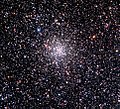
Till Credner and Sven Kohle, Calar Alto Observatory.
-
M71 in visible light by the NOAO.



External links
[edit]- Messier 71 on WikiSky: DSS2, SDSS, GALEX, IRAS, Hydrogen α, X-Ray, Astrophoto, Sky Map, Articles and images
- Messier71 @ SEDS Messier pages
- Messier 71, Galactic Globular Clusters Database page
- Messier 71, LRGB CCD image based on two hours total exposure
- Messier 71: an Unusual Globular Cluster, ESA\Hubble picture of the week.
- McCormac, James; Szymanek, Nik. "M71 – Globular Cluster". Deep Sky Videos. Brady Haran.


