


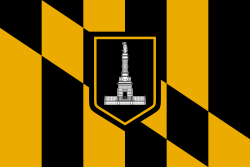
Baltimore (/ˈbɔːltɪmɔːr/ BAWL-tim-or, locally: /ˌbɔːldɪˈmɔːr/ BAWL-dim-OR or /ˈbɔːlmər/ BAWL-mər), also known as Baltimore City, is the most populous city in the U.S. state of Maryland. It is the 30th-most populous U.S. city with a population of 585,708 at the 2020 census and estimated at 569,997 in 2025, while the Baltimore metropolitan area at 2.86 million residents is the 22nd-largest metropolitan area in the nation. The city is also part of the Washington–Baltimore combined statistical area, which had a population of 9.97 million in 2020. Baltimore was designated as an independent city by the Constitution of Maryland in 1851. Though not located under the jurisdiction of any county in the state, it forms part of the Central Maryland region together with the surrounding county that shares its name.
The land that is present-day Baltimore was once used as hunting ground by Paleo-Indians. In the early 1600s, the Susquehannock began to hunt there. People from the Province of Maryland established the Port of Baltimore in 1706 to support the tobacco trade with Europe and established the Town of Baltimore in 1729. During the American Revolutionary War, the Second Continental Congress briefly moved its deliberations to the Henry Fite House from December 1776 to February 1777 prior to the capture of Philadelphia to British troops, which permitted Baltimore to serve briefly as the nation's capital before it returned to Philadelphia. The Battle of Baltimore was pivotal during the War of 1812, culminating in the British bombardment of Fort McHenry, during which Francis Scott Key wrote a poem that became "The Star-Spangled Banner", which was designated as the national anthem in 1931. During the Pratt Street Riot of 1861, the city was the site of some of the earliest violence associated with the American Civil War. (Full article...)
Selected article - show another


The Great Baltimore Fire raged in Baltimore, Maryland from Sunday February 7 to Monday February 8, 1904. More than 1,500 buildings were completely leveled, and some 1,000 severely damaged, bringing property loss from the disaster to an estimated $100 million, or $3.6 billion in 2026. 1,231 firefighters helped bring the blaze under control, both professional paid truck and engine companies from the Baltimore City Fire Department (B.C.F.D.) and volunteers from surrounding counties and outlying towns, as well as out-of-state units that arrived on the major railroads. The fire destroyed much of central Baltimore, including over 1,500 buildings covering an area of some 140 acres (57 ha).
From North Howard Street in the west and southwest, the flames spread north through the retail shopping area as far as Fayette Street and began moving eastward, pushed by the prevailing winds. Narrowly missing the new 1900 Circuit Courthouse, now the Clarence M. Mitchell Jr. Courthouse, fire passed the historic Battle Monument Square from 1815 to 1827 at North Calvert Street, and the quarter-century-old Baltimore City Hall, built in 1875 on Holliday Street; and finally spread further east to the Jones Falls stream which divided the downtown business district from the old East Baltimore tightly-packed residential neighborhoods of Jonestown (also known as Old Town) and newly named "Little Italy". The fire's wide swath burned as far south as the wharves and piers lining the north side of the old "Basin" (today's "Inner Harbor") of the Northwest Branch of the Baltimore Harbor and Patapsco River facing along Pratt Street. (Full article...)
Selected picture - show another
👁 Image
Fort McHenry, which served as the inspiration for The Star-Spangled Banner


Categories


WikiProjects


Selected biography - show another
_(cropped).png)

Felix Agnus (4 May 1839 – 31 October 1925) (born Antoine-Felix) was a French-born sculptor, newspaper publisher and soldier who served in the Franco-Austrian War and the American Civil War. Agnus studied sculpture before enlisting to fight in the Franco-Austrian War. Upon the conclusion of the war, he travelled to the United States and again briefly worked as a sculptor. In 1861, upon the outbreak of the American Civil War, Agnus enlisted in the 5th New York Volunteer Infantry, and served with merit, rising to brevet brigadier-general before being mustered out of service. Agnus was then inspector general of the Department of the South and supervised the dismantling of Confederate forts.
After the war, Agnus settled in Baltimore and worked for the Baltimore American, eventually becoming publisher of the paper. Charles Fulton, the previous publisher, was his father-in-law, Agnus having married Fulton's daughter Annie on 13 December 1864. As the publisher, Agnus was an original member of the Associated Press, and a prominent citizen in Baltimore. He was offered political positions, including as a United States Senator and a United States Consul, both of which he declined. He served on several local and national commissions. Agnus died in 1925. A funerary statue formerly placed on his grave, known as Black Aggie, is the subject of urban legends. (Full article...)
Did you know...
- ... that viruses can be catalogued into seven groups in the Baltimore classification?
- ... that Robert Baker Park in Baltimore was named after Robert Lewis Baker, whose personal garden was recreated at the city's Flower and Garden Show the year after his death?
General images - load new batch
-
The Baltimore riot of 1861 (from History of Baltimore)
-
John E. Hurst Building, site of the fire's outbreak (from Great Baltimore Fire)
-
👁 Image 3View of Baltimore from Chapel Hill, by Francis Guy, 1802-03 (Brooklyn Museum) (from History of Baltimore)View of Baltimore from Chapel Hill, by Francis Guy, 1802-03 (Brooklyn Museum) (from History of Baltimore)
-
West Baltimore (from List of Baltimore neighborhoods)
-
👁 Image 5Map of Chesapeake Bay area by John Senex, 1719, with Baltimore County labeled near Maryland's border with Pennsylvania. (from History of Baltimore)Map of Chesapeake Bay area by John Senex, 1719, with Baltimore County labeled near Maryland's border with Pennsylvania. (from History of Baltimore)
-
Sharp Street Church was established 1787, the existing building having been erected in 1898 (from History of Baltimore)
-
Same view in 1906, 2 years after the fire (from Great Baltimore Fire)
-
Baltimore Street Map, 1838 (from History of Baltimore)
-
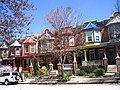
👁 Image 9Some of the more upscale rowhouses in Baltimore, like these brightly painted homes in Charles Village, have complete porches instead of stoops (from Culture of Baltimore)Some of the more upscale rowhouses in Baltimore, like these brightly painted homes in Charles Village, have complete porches instead of stoops (from Culture of Baltimore)
-
👁 Image 10An illustration of the aftermath of the Great Baltimore Fire in February 1904 (from Great Baltimore Fire)An illustration of the aftermath of the Great Baltimore Fire in February 1904 (from Great Baltimore Fire)
-
Baltimore Street Map, 1892 (from History of Baltimore)
-
South Baltimore (from List of Baltimore neighborhoods)
-
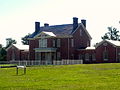
Mount Clare Mansion, known today as the Mount Clare Museum House, is the oldest Colonial-era structure in Baltimore. (from History of Baltimore)
-
👁 Image 16Marble steps in need of a scrubbing with Bon Ami powder and a pumice stone. East Fort Avenue, Locust Point, August 2014 (from Culture of Baltimore)Marble steps in need of a scrubbing with Bon Ami powder and a pumice stone. East Fort Avenue, Locust Point, August 2014 (from Culture of Baltimore)
-
View of Baltimore by William Henry Bartlett (1809–1854) (from History of Baltimore)
-
👁 Image 18Child labor at J.S. Farrand Packing Company in Baltimore, 1909. Photo by Lewis Hine. (from History of Baltimore)Child labor at J.S. Farrand Packing Company in Baltimore, 1909. Photo by Lewis Hine. (from History of Baltimore)
-
Baltimore & Ohio Railroad engine and passenger car from the 1830s. (from History of Baltimore)
-
👁 Image 20Great Baltimore Fire of 1904, looking West from East Pratt and North Gay Streets (from Great Baltimore Fire)Great Baltimore Fire of 1904, looking West from East Pratt and North Gay Streets (from Great Baltimore Fire)
-
Blue crabs (from Culture of Baltimore)
-
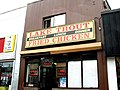
Storefront of establishment selling Lake Trout in Baltimore (from Culture of Baltimore)
-
👁 Image 24Worker assembling an aircraft at the Glenn L. Martin plant in Baltimore (from History of Baltimore)Worker assembling an aircraft at the Glenn L. Martin plant in Baltimore (from History of Baltimore)
-
👁 Image 25Row houses like these in Locust Point historically comprised much of Baltimore's housing. (from Culture of Baltimore)Row houses like these in Locust Point historically comprised much of Baltimore's housing. (from Culture of Baltimore)
-
An 1864 map of Baltimore (from History of Baltimore)
-
👁 Image 27Marylanders steam blue crabs, usually in water, beer and Old Bay Seasoning. (from Culture of Baltimore)Marylanders steam blue crabs, usually in water, beer and Old Bay Seasoning. (from Culture of Baltimore)


.jpg)










.jpg)


News
No recent news
Related portals


Topics


Associated Wikimedia
The following Wikimedia Foundation sister projects provide more on this subject:
-
Commons
Free media repository -
Wikibooks
Free textbooks and manuals -
Wikidata
Free knowledge base -
Wikinews
Free-content news -
Wikiquote
Collection of quotations -
Wikisource
Free-content library -
Wikiversity
Free learning tools -
Wikivoyage
Free travel guide -
Wiktionary
Dictionary and thesaurus


