A book is a written work of substantial length created by one or more authors. They can be distributed in various forms such as printed books, audiobooks, and electronic books (ebooks). Books are broadly classified into fiction, containing invented narrative or other imaginary content; and non-fiction, containing content intended as factual truth.
The term may also refer to the physical or electronic object containing such a work. Modern books are typically printed in a codex format, composed of many pages bound together and protected by a cover. Before the wide adoption of the modern printing press, codices were used to create handwritten manuscripts. Older writing media include scrolls and clay tablets.
The book publishing process is the series of steps involved in its creation and dissemination, often undertaken in modern times by a commercial publishing company. The publishing industry has recently seen major changes due to new technologies, including ebooks and audiobooks (recordings of books read aloud). Awareness of the needs of people with print disabilities has led to a rise in accessible publishing formats such as braille printing and large-print editions. Google Books estimated in 2010 that roughly 130 million total unique books have been published.
Books are sold at general retail stores and specialized bookstores, as well as online, and can be borrowed from libraries or public bookcases. The reception of books has led to several social consequences, including censorship.
Boenga Roos dari Tjikembang (Indonesian pronunciation:[ˌbuŋaˌrʊsˌdaritʃikəmˈbaŋ]; translated to English as The Rose of Cikembang) is a 1927 vernacular Malay-language novel written by Kwee Tek Hoay. The seventeen-chapter book follows a plantation manager, Aij Tjeng, who must leave his beloved njai (concubine) Marsiti so that he can be married. Eighteen years later, after Aij Tjeng's daughter Lily dies, her fiancé Bian Koen discovers that Marsiti had a daughter with Aij Tjeng, Roosminah, who greatly resembles Lily. In the end Bian Koen and Roosminah are married.
Inspired by the lyrics to the song "If Those Lips Could Only Speak" and William Shakespeare's A Midsummer Night's Dream, Boenga Roos dari Tjikembang was initially written as an outline for the stage drama troupe Union Dalia. Kwee intermixed several languages other than Malay, particularly Dutch, Sundanese, and English; he included two quotes from English poems and another from an English song. The novel has been interpreted variously as a promotion of theosophy, a treatise on the Buddhist concept of reincarnation, a call for education, an ode to njais, and a condemnation of how such women are treated. (Full article...)
The Log from the Sea of Cortez is an English-language book written by American author John Steinbeck and published in 1951. It details a six-week (March 11 – April 20) marine specimen-collecting boat expedition he made in 1940 at various sites in the Gulf of California (also known as the Sea of Cortez), with his friend, the marine biologistEd Ricketts. It is regarded as one of Steinbeck's most important works of non-fiction chiefly because of the involvement of Ricketts, who shaped Steinbeck's thinking and provided the prototype for many of the pivotal characters in his fiction, and the insights it gives into the philosophies of the two men.
The Log from the Sea of Cortez is the narrative portion of an earlier work, Sea of Cortez: A Leisurely Journal of Travel and Research, which was published by Steinbeck and Ricketts shortly after their return from the Gulf of California, and combined the journals of the collecting expedition, reworked by Steinbeck, with Ricketts' species catalogue. After Ricketts' death in 1948, Steinbeck dropped the species catalogue from the earlier work and republished it with a eulogy to his friend added as a foreword. (Full article...)
The Hickmans began work on Ravenloft in the late 1970s, intent on creating a frightening portrait of a vampire in a setting that combined Gothic horror with the D&D game system. They play-tested the adventure with a group of players each Halloween for five years before it was published. Strahd has since appeared in a number of D&D accessories and novels. The module has inspired numerous revisions and adaptations, including a campaign setting of the same name and a sequel. In 1999, on the 25th anniversary of Dungeons & Dragons, two commemorative versions of Ravenloft were released. (Full article...)
👁 Image Gather Together in My Name is a 1974 memoir by American writer and poet Maya Angelou. It is the second book in Angelou's series of seven autobiographies. Written three years after the publication of and beginning immediately following the events described in I Know Why the Caged Bird Sings, it follows Angelou, called Rita, from the ages of 17 to 19. The title is taken from the Bible, but also conveys how one Black female lived in the white-dominated society of the U.S. following World War II.
Angelou expands upon many themes that she started discussing in her first autobiography, including motherhood and family, racism, identity, education and literacy. Rita becomes closer to her mother in this book, and goes through a variety of jobs and relationships as she tries to provide for her young son and find her place in the world. Angelou continues to discuss racism in Gather Together, but moves from speaking for all Black women to describing how one young woman dealt with it. The book exhibits the narcissism of young people, but describes how Rita discovers her identity. Like many of Angelou's autobiographies, Gather Together is concerned with Angelou's on-going self-education. (Full article...)
The Halo Graphic Novel is a graphic novel anthology published by Marvel Comics in partnership with Bungie, set in the universe of the science fiction franchise Halo. The Halo Graphic Novel was the series' first entry into the sequential art medium, and features aspects of the Halo universe which until then had not been discussed or seen in any medium.
The majority of the book is divided into four short stories by different writers and artists from the computer game and comic industries. Each story focuses on different aspects of the Halo universe, revealing stories that are tangential to the main plot of the game. Apart from the stories, the book also contains an extensive art gallery compiled of contributions from Bungie, Marvel and independent sources. (Full article...)
The wordless novel is a narrative genre that uses sequences of captionless pictures to tell a story. As artists have often made such books using woodcut and other relief printing techniques, the terms woodcut novel or novel in woodcuts are also used. The genre flourished primarily in the 1920s and 1930s and was most popular in Germany.
The wordless novel has its origin in the German Expressionist movement of the early 20th century. The typically socialist work drew inspiration from medieval woodcuts and used the awkward look of that medium to express angst and frustration at social injustice. The first such book was the Belgian Frans Masereel's 25 Images of a Man's Passion, published in 1918. The German Otto Nückel and other artists followed Masereel's example. Lynd Ward brought the genre to the United States in 1929 when he produced Gods' Man, which inspired other American wordless novels and a parody in 1930 by cartoonist Milt Gross with He Done Her Wrong. Following an early-1930s peak in production and popularity, the genre waned in the face of competition from sound films and anti-socialist censorship in Nazi Germany and the US. (Full article...)
The book received mainly positive reviews and its recipes were selected for inclusion in The Best American Recipes 2003–2004. The St. Petersburg Times classed it as among the "most interesting and unique cookbooks" published, the Pittsburgh Post-Gazette highlighted it in the article "Favorite Cookbooks for 2002" and The Denver Post included it in a list of best cookbooks of 2002. A review in the Toronto Star criticized Perry's lack of creativity in her choice of recipes. Recipes from the work have been featured in related cookbooks. (Full article...)
Some Thoughts Concerning Education is a 1693 treatise on the education of gentlemen written by the English philosopher John Locke. For over a century, it was the most important philosophical work on education in England. It was translated into almost all of the major written European languages during the eighteenth century, and nearly every European writer on education after Locke, including Jean-Jacques Rousseau, acknowledged its influence.
In his Essay Concerning Human Understanding (1690), Locke outlined a new theory of mind, contending that the mind is originally a tabula rasa or "blank slate"; that is, it did not contain any innate ideas at birth. Some Thoughts Concerning Education explains how to educate that mind using three distinct methods: the development of a healthy body; the formation of a virtuous character; and the choice of an appropriate academic curriculum. (Full article...)
Christgau's reviews are informed by an interest in the aesthetic and political dimensions of popular music, a belief that it could be consumed intelligently, and a desire to communicate his ideas to readers in an entertaining, provocative, and compact way. Many of the older reviews were rewritten for the guide to reflect his changed perspective and matured stylistic approach. He undertook an intense preparation process for the book during 1979 and 1980, which temporarily hindered both his awareness of current music and his marriage to fellow writer Carola Dibbell, whom he later credited as an influence on his work. (Full article...)
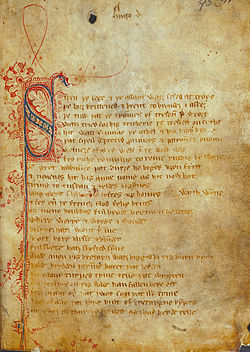
First page of the only surviving manuscript, c. 14th century
Sir Gawain and the Green Knight is a late 14th-century chivalric romance in Middle Englishalliterative verse. The author is unknown; the title was given centuries later. It is one of the best-known Arthurian stories, with its plot combining two types of folk motifs: the beheading game and the exchange of winnings. Written in stanzas of alliterative verse, each of which ends in a rhyming bob and wheel, it draws on Welsh, Irish, and English stories, as well as the French chivalric tradition. It is an important example of a chivalric romance, which typically involves a hero who goes on a quest that tests his prowess. It remains popular in modern English renderings from J. R. R. Tolkien, Simon Armitage, and others, as well as through film and stage adaptations.
The story describes how Sir Gawain accepts a challenge from a mysterious "Green Knight" who dares any man to strike him with his axe if he will take a return blow in a year and a day. Gawain accepts and beheads him, after which the Green Knight stands, picks up his head, and reminds Gawain of the appointed time. In his struggles to keep his bargain, Gawain demonstrates chivalry and loyalty until his honour is called into question by a test involving the lord and the lady of the castle at which he is a guest. The poem survives in one manuscript, Cotton Nero A.x., which also includes three religious narrative poems: Pearl, Cleanness, and Patience. All four are written in a NorthWest Midlands dialect of Middle English, and are thought to be by the same author, dubbed the "Pearl Poet" or "Gawain Poet". (Full article...)
True at First Light is a book by American writer Ernest Hemingway about his 1953–54 safari in Kenya with his fourth wife Mary. It was released posthumously in his centennial year in 1999. In the book, which blends memoir and fiction, Hemingway explores conflict within a marriage, the conflict between the European and native cultures in Africa, and the fear a writer feels when his work becomes impossible. True at First Light includes descriptions of his earlier friendships with other writers and digressive ruminations on the nature of writing.
Hemingway began writing the book after he and his wife were involved in two plane crashes in the African bush in a two-day period in January 1954. He spent much of the next two years in Havana, recuperating and writing the manuscript of what he called "the Africa book", which remained unfinished at the time of his suicide in July 1961. Hemingway's son Patrick edited the work to half its original length to strengthen the underlying storyline and emphasize the fictional aspects. (Full article...)
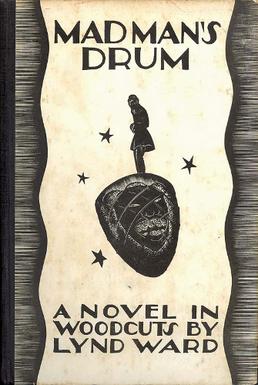
Madman's Drum is a wordless novel by American artist Lynd Ward (1905–1985), published in 1930. It is the second of Ward's six wordless novels. The 118 wood-engraved images of Madman's Drum tell the story of a slave trader who steals a demon-faced drum from an African he murders, and the consequences for him and his family.
Ward's first wordless novel was Gods' Man of 1929. Ward was more ambitious with his second work in the medium: the characters are more nuanced, the plot more developed and complicated, and the outrage at social injustice more explicit. Ward used a wider variety of carving tools to achieve a finer degree of detail in the artwork, and was expressive in his use of symbolism and exaggerated emotional facial expressions. (Full article...)
William Barley (1565?–1614) was an English bookseller and publisher. He completed an apprenticeship as a draper in 1587, but was soon working in the London book trade. As a freeman of the Drapers' Company, he was embroiled in a dispute between it and the Stationers' Company over the rights of drapers to function as publishers and booksellers. He found himself in legal tangles throughout his life.
Barley's role in Elizabethan music publishing has proved to be a contentious issue among scholars. The assessments of him range from "a man of energy, determination, and ambition", to "somewhat remarkable", to "surely to some extent a rather nefarious figure". His contemporaries harshly criticised the quality of two of the first works of music that he published, but he was also influential in his field. (Full article...)
An early version of the modern self-help book, the 18th-century British conduct book drew on many literary traditions, such as advice manuals and religious narratives. There was an explosion in the number of conduct books published during the second half of the 18th century, and Wollstonecraft took advantage of this burgeoning market when she published Thoughts. However, the book was only moderately successful: it was favourably reviewed, but only by one journal and it was reprinted only once. Although it was excerpted in popular contemporary magazines, it was not republished until the rise of feminist literary criticism in the 1970s. (Full article...)
... that Crossing a Line compares Palestinian political expression on either side of the Green Line between Israel and the occupied Palestinian territories?
... that Marion Wiesel translated 14 of her husband's books from French?
... that "Australasia" by William Charles Wentworth, the first book of verse by a native-born Australian, "celebrates the development of a new Britannia in another world"?
... that My Dad, the first entry in My Family Member, a series of illustrated children books, was inspired by the author's discovery of his father's old gown?
👁 Image The May Pamphlet is a collection of six anarchist essays written and published by Paul Goodman in 1945. Goodman discusses the problems of living in a society that represses individual instinct through coercion. He suggests that individuals resist such conditions by reclaiming their natural instincts and initiative, and by "drawing the line", an ideological delineation beyond which an individual should refuse to conform or cooperate with social convention. While themes from The May Pamphlet—decentralization, peace, social psychology, youth liberation—would recur throughout his works, Goodman's later social criticism focused on practical applications rather than theoretical concerns.
The pamphlet was originally published piecemeal in small, New York anarchist journals and was first compiled as a set among literary essays in Art and Social Nature (1946). The essays were not well known before Goodman's 1960 book Growing Up Absurd led to a resurgence of interest in his oeuvre, including the pamphlet's republication in Drawing the Line (1962). The May Pamphlet was Goodman's principal contribution to anarchist theory and a primary influence on Colin Ward, who later dedicated Anarchy in Action to Goodman's memory. (Full article...)
The book praises Dallaire's commitment to his peacekeeping mission, but is critical of MacKenzie, who is depicted as being ignorant of the Bosnian political situation. In response to Off's portrayal of him, MacKenzie said he would consider suing for libel, but never did. The book praises Arbour's efforts at building the legitimacy of International Criminal Tribunals and her efforts in indicting alleged war criminals from the massacres in Rwanda and Bosnia. Through these biographies, the book addresses themes of morality and UN effectiveness. (Full article...)
Dragonlance is a shared universe created by the American fantasy writers Laura and Tracy Hickman, and expanded by Tracy Hickman and Margaret Weis under the direction of TSR, Inc. into a series of fantasy novels. The Hickmans conceived Dragonlance while driving in their car on the way to TSR for a job interview. Tracy Hickman met his future writing partner Margaret Weis at TSR, and they gathered a group of associates to play the Dungeons & Dragonsrole-playing game. The adventures during that game inspired a series of gaming modules, a series of novels, licensed products such as board games, and lead miniature figures.
In 1984, TSR published the first Dragonlance game module, Dragons of Despair, and the first novel, Dragons of Autumn Twilight. The novel began the Chronicles trilogy, a core element of the Dragonlance world. While the authoring team of Tracy Hickman and Margaret Weis wrote the setting's central books, numerous other authors contributed novels, short stories and game supplements to the setting. Over 190 novels have used the Dragonlance setting; the Dragonlancecampaign setting has also been used for multiple editions of Dungeons & Dragons and for the SAGA System. Following Wizards of the Coast's acquisition of TSR in 1997, Wizards licensed Dragonlance to Margaret Weis's company Sovereign Press to produce game materials; this licensing agreement ran from 2001 to 2007. Dragonlance returned in 2022 with a new adventure module and the start of a new novel trilogy. (Full article...)
White Dog, released in France as Chien Blanc, is a non-fiction autobiographical novel written by Romain Gary. Originally published as a short story in Life in 1970 (9 October), the full novel was published in 1970 in French in France by Éditions Gallimard. Gary's English version of the novel was published in North America in the same year by New American Library. The novel provides a fictionalized account of Gary and his wife's experiences in the 1960s with a stray Alabama police dog trained to attack black people on sight, and their attempts to have the dog reprogrammed.
Gary uses the novel as a vehicle to denounce both racism and the activists supporting African-American rights, including his own ex-wife Jean Seberg and Marlon Brando. He also examines whether human responses to situations, including racism, are learned social behavior and whether they can be unlearned. In 1981, it was adapted into the controversial film of the same name, in which director Samuel Fuller made various changes to the novel's story to focus more on the dog and present a more pessimistic ending than the original novel. The film's American release after negative press from the National Association for the Advancement of Colored People (NAACP) led to concerns of boycotts. Anaïs Barbeau-Lavalette released a more faithful adaptation of the book in 2022. (Full article...)
Madonnaland: And Other Detours in Fame and Fandom is a non-fiction book written by American essayist and musician Alina Simone. It is a biography of American singer Madonna, as well the author's own analysis of music and pop culture. Upon its release on March 3, 2016 by University of Texas Press, Madonnaland received positive reviews from critics, who praised her writing and bold subject choice. Rolling Stone magazine listed it as one of the 10 Best Music Books released in 2016.
Consisting of six chapters, Madonnaland finds Simone visiting Madonna's birthplace, Bay City, Michigan, where she spoke with the local people about the singer. The book also analyses Madonna's career and fame, with the author delving into her own music career and obscure Bay City bands. Simone had been initially commissioned to write a new biography about the singer. However, due to already available excess content on her, the author felt she would not be able to find anything new. Instead, she ended up writing Madonnaland about her own failure to create a Madonna biography, why Bay City did not have any commemoration for the singer, as well as unknown music bands, pop culture and celebrity life. (Full article...)
Goldacre argues in the book that "the whole edifice of medicine is broken", because the evidence on which it is based is systematically distorted by the pharmaceutical industry. He writes that the industry finances most of the clinical trials into its own products and much of doctors' continuing education, that clinical trials are often conducted on small groups of unrepresentative subjects and negative data is routinely withheld, and that apparently independent academic papers may be planned and even ghostwritten by pharmaceutical companies or their contractors, without disclosure. Describing the situation as a "murderous disaster", he makes suggestions for action by patients' groups, physicians, academics and the industry itself. (Full article...)
Etymologiae (Latin for 'Etymologies'), also known as the Origines ('Origins'), usually abbreviated Orig., is an etymological encyclopedia compiled by the influential Christian bishop Isidore of Seville (c. 560–636) towards the end of his life. Isidore was encouraged to write the book by his friend Braulio, Bishop of Saragossa. Etymologiae summarized and organized a wealth of knowledge from hundreds of classical sources; three of its books are derived largely from Pliny the Elder's Natural History. Isidore acknowledges Pliny, but not his other principal sources, namely Cassiodorus, Servius, and Gaius Julius Solinus. Etymologiae covers an encyclopedic range of topics. Etymology, the origins of words, is prominent, but the work also covers, among other things, grammar, rhetoric, mathematics, geometry, music, astronomy, medicine, law, the church and heretical sects, pagan philosophers, languages, cities, humans, animals, the physical world, geography, public buildings, roads, metals, rocks, agriculture, war, ships, clothes, food, and tools. (Full article...)
Geographia Neoteriki (Greek: Γεωγραφία ΝεωτερικήModern Geography) is a geography book written in Greek by Daniel Philippidis and Grigorios Konstantas and printed in Vienna in 1791. It focused on both the physical and human geography features of the European continent and especially on Southeastern Europe, and is considered one of the most remarkable works of the modern Greek Enlightenment. The authors of the Geographia Neoteriki adopted new geographical methodologies for that time, which were primarily based on personal examination of the described areas and used as sources a number of contemporary European handbooks.
The work, written in a vernacular language, also described the contemporary social developments and expressed ideas that were considered revolutionary and anticlerical, and addressed the political and economic decay of the Ottoman Empire. Geographia Neoteriki was welcomed with enthusiasm by western intellectual circles, especially in France, but on the other hand, it was largely neglected by Greek scholars. (Full article...)
White Plume Mountain was well received by critics. It was ranked the 9th greatest Dungeons & Dragons adventure of all time by Dungeon magazine in 2004. One judge, commenting on the ingenuity required to complete the adventure, described it as "the puzzle dungeon to end all puzzle dungeons." A review for British magazine White Dwarf gave it an overall rating of 8/10, noting that the adventure focuses on problem solving. It is also the favorite adventure of Wired magazine's Ken Denmead, who described it as the "amusement park of dungeons". Other adventures in the S series include Tomb of Horrors, Expedition to the Barrier Peaks, and Lost Caverns of Tsojcanth. (Full article...)
The 1980s and 1990s saw increasing disputes among Canadian historians, splitting between political and social historians. The historian Adam Chipnick describes Who Killed Canadian History? as "the pinnacle" of these disputes, termed the "history wars". According to Granatstein, the expanding reach of social historians in the history departments of Canadian universities has resulted in ineffectual and uneducated graduates. He further argues that poor teaching standards and political correctness have led to historical ignorance among Canadians, leaving them unable to properly appreciate their present and future. He suggests a number of measures to increase historical awareness, including implementing national teaching standards. (Full article...)
Written in vernacularItalian, the Summa is the first printed work on algebra, and it contains the first published description of the double-entry bookkeeping system, which had been invented in the 13th century but was not yet widely known. It set a new standard for writing and argumentation about algebra, and its impact upon the subsequent development and standardization of professional accounting methods was so great that Pacioli is sometimes referred to as the "father of accounting". (Full article...)
👁 Image 1955 edition The Maxwell House Haggadah is an English–Hebrew PassoverHaggadah introduced by the Maxwell House company as a marketing promotion in 1932 and printed continuously since that time. With over 50 million copies in print, it is the best known and most popular Haggadah among American Jews, and is considered a cultural icon. It is used at Passover Seders in homes, schools, senior centers, prisons, and the United States Army, and was the edition used by President Obama and his guests at the White House Passover Seder conducted yearly from 2009 to 2016. In 2011 a new English translation replaced archaic phrases in the original and also incorporated gender-neutral language. (Full article...)
The reviews of the work were mixed, with most reviewers finding this encyclopedia to be a commendable effort, but criticizing the work for being not comprehensive enough yet overpriced (at $349.95). (Full article...)
... that the world's largest book(pictured) has 730 leaves and 1460 pages; each page is three and a half feet wide, five feet tall and five inches thick?
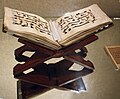
... that before the invention and adoption of the printing press, almost all books were copied by hand, making books expensive and comparatively rare?
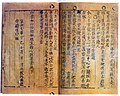
Image 3Jikji, Selected Teachings of Buddhist Sages and Seon Masters, the earliest known book printed with movable metal type, 1377. Bibliothèque Nationale de France, Paris. (from History of books)
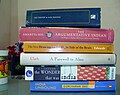
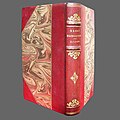
Image 4The spine of the book is an important aspect in book design, especially in the cover design. When the books are stacked up or stored in a shelf, the details on the spine is the only visible surface that contains the information about the book. In a book store, it is often the details on the spine that attract the attention first. (from Book design)
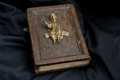
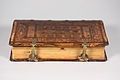
Image 32Sammelband of three alchemical treatises, bound in Strasbourg by Samuel Emmel c. 1568, showing metal clasps and leather covering of boards (from Bookbinding)


![👁 Image 1 Cover, second printing (1930) Boenga Roos dari Tjikembang (Indonesian pronunciation: [ˌbuŋa ˌrʊs ˌdari tʃikəmˈbaŋ]; translated to English as The Rose of Cikembang) is a 1927 vernacular Malay-language novel written by Kwee Tek Hoay. The seventeen-chapter book follows a plantation manager, Aij Tjeng, who must leave his beloved njai (concubine) Marsiti so that he can be married. Eighteen years later, after Aij Tjeng's daughter Lily dies, her fiancé Bian Koen discovers that Marsiti had a daughter with Aij Tjeng, Roosminah, who greatly resembles Lily. In the end Bian Koen and Roosminah are married. Inspired by the lyrics to the song "If Those Lips Could Only Speak" and William Shakespeare's A Midsummer Night's Dream, Boenga Roos dari Tjikembang was initially written as an outline for the stage drama troupe Union Dalia. Kwee intermixed several languages other than Malay, particularly Dutch, Sundanese, and English; he included two quotes from English poems and another from an English song. The novel has been interpreted variously as a promotion of theosophy, a treatise on the Buddhist concept of reincarnation, a call for education, an ode to njais, and a condemnation of how such women are treated. (Full article...)](https://upload.wikimedia.org/wikipedia/en/d/d2/Blank.png)




.jpg)


_Madman%27s_Drum_cover.jpg)


.jpg)







_-_Google_Art_Project.jpg)






.jpg)












.jpg)