

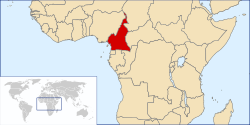
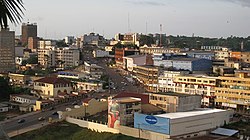
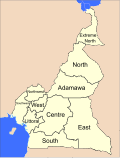
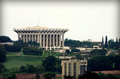
Cameroon, officially the Republic of Cameroon, is a country in Central Africa. It shares boundaries with Nigeria to the west and north, Chad to the northeast, the Central African Republic to the east, and Equatorial Guinea, Gabon, and the Republic of the Congo to the south. Its coastline lies on the Bight of Biafra, part of the Gulf of Guinea, and the Atlantic Ocean. Due to its strategic position at the crossroads between West Africa and Central Africa, it has been categorized as being in both geostrategic locations. Cameroon's population of nearly 31 million people speak 250 native languages, in addition to the national tongues of English and French. The capital city of the country is Yaoundé. Cameroon became a German colony in 1884 known as Kamerun. After World War I, it was divided between France and the United Kingdom as League of Nations mandates until independence in 1960 and 1961 respectively. The Union of the Peoples of Cameroon (UPC) political party advocated independence but was outlawed by France in the 1950s, leading to a national liberation insurgency between French Armed Forces and the Union of the Peoples of Cameroon (UPC) until January 1971. In 1960, the French-administered part of Cameroon became independent, as the Republic of Cameroun, under President Ahmadou Ahidjo. The southern part of British Cameroons federated with it in 1961 to form the Federal Republic of Cameroon. The federation was abandoned in 1972. The country was renamed the United Republic of Cameroon in 1972 and back to the Republic of Cameroon in 1984 by a presidential decree by President Paul Biya. Biya, the incumbent president, has led the country since 1982 following Ahidjo's resignation; he previously held office as prime minister from 1975 onward. Cameroon is governed as a unitary presidential republic. The official languages of Cameroon are French and English. Christianity is the majority religion in Cameroon, with significant minorities practising Islam and traditional faiths. It has experienced tensions from the English-speaking territories, where politicians have advocated for greater decentralisation and even complete separation or independence (as in the Southern Cameroons National Council). In 2017, tensions over the creation of an Ambazonian state in the English-speaking territories escalated into open warfare. Large numbers of Cameroonians live as subsistence farmers. The country is often referred to as "Africa in miniature" for its geological, linguistic, and cultural diversity. Its natural features include beaches, deserts, mountains, rainforests, and savannas. Cameroon's highest point, at almost 4,100 metres (13,500 ft), is Mount Cameroon in the Southwest Region. (Full article...) Selected article - show anotherYaoundé (UK: /jɑːˈʊndeɪ,-ˈuːn-/; US: /ˌjɑːʊnˈdeɪ/, French pronunciation: [ja.unde]) is the capital city of Cameroon. It has a population of more than 2.8 million, which makes it the second-largest city in the country after the port city Douala. It lies in the Centre Region of the nation at an elevation of about 750 metres (2,500 ft) above sea level. The outpost of Epsumb or Jeundo was founded between the Nyong and Sanaga rivers at the northern edge of the area's forests in 1887 by German explorers as a trading base for rubber and ivory. A military garrison was built in 1895 which enabled further colonization. After Imperial Germany's defeat in World War I, France held eastern Cameroon as a mandate, and Yaoundé was chosen to become the capital of the colony in 1922. Douala remained the more important settlement, but Yaoundé saw rapid growth and continued as the seat of government for the Republic of Cameroon upon its independence in 1960. Most of Yaoundé's economy is still centred on the administrative structure but major industries in Yaoundé include tobacco, dairy products, beer, clay, glass goods and timber. The city has many striking monuments and buildings, such as the Presidential Palace and Palais des Congrès. (Full article...) Did you know (auto-generated)
More did you know - show another
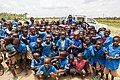
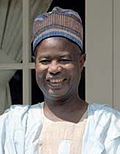
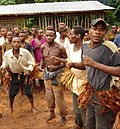
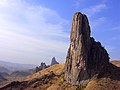
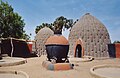
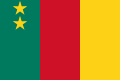
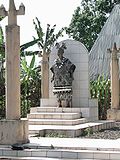
General images - show anotherThe following are images from various Cameroon-related articles on Wikipedia.
WikiProjectsTopicsCategoriesRelated portalsAssociated WikimediaThe following Wikimedia Foundation sister projects provide more on this subject:
Discover Wikipedia using portals | |||
 |
VOOZH | about |






















.svg)



.svg)


