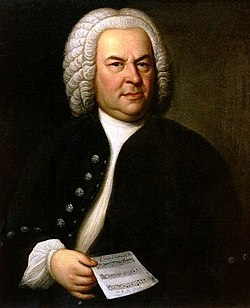
The Bach family had already produced several composers when Johann Sebastian was born in Eisenach, the youngest child of the city musician Johann Ambrosius Bach. After being orphaned at age 10, he lived for five years with his eldest brother, Johann Christoph, then continued his musical education in Lüneburg. In 1703 he returned to Thuringia, working as a musician for Protestant churches in Arnstadt and Mühlhausen. Around that time he also paid extended visits to the courts in Weimar, where he expanded his organ repertory, and the reformed court at Köthen, where he was mostly engaged with chamber music. By 1723 he was hired as Thomaskantor, church music director of the city of Leipzig and thus responsible for music in four Lutheran city churches and for the St. Thomas School. He decided to compose annual cycles of church cantatas, and also wrote music for Leipzig University's student ensemble, Collegium Musicum. In 1726 he began publishing his organ and other keyboard music. In Leipzig, he had difficult relations with his employer, as he had during some of his earlier positions. This situation was somewhat remedied when his sovereign, Augustus III of Poland, granted him the title of court composer of the Elector of Saxony in 1736. In the last decades of his life, Bach reworked and extended many of his earlier compositions. He died due to complications following eye surgery in 1750 at the age of 65. Four of his twenty children, Wilhelm Friedemann, Carl Philipp Emanuel, Johann Christoph Friedrich, and Johann Christian, became composers. (Full article...)
The classical period falls between the Baroque and Romantic periods. It is mainly homophonic, using a clear melody line over a subordinate chordal accompaniment, but counterpoint was by no means forgotten, especially in liturgical vocal music and, later in the period, secular instrumental music. It also makes use of style galant which emphasizes light elegance in place of the Baroque's dignified seriousness and impressive grandeur. Variety and contrast within a piece became more pronounced than before, and the orchestra increased in size, range, and power. (Full article...)
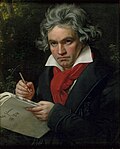
The Symphony No. 5 in C minor, Op. 67 (occasionally known as the Fate Symphony, German: Schicksalssinfonie), is a symphony composed by Ludwig van Beethoven between 1804 and 1808. It is one of the best-known of all symphonies and one of the most frequently played. First performed in Vienna in 1808, the work achieved its strong critical reputation not long afterward; E. T. A. Hoffmann described it as "one of the most important works of the time".
The 5th Symphony has 4 movements. It begins with a distinctive 4-note "short-short-short-long" motif, often characterized as "fate knocking at the door", the Schicksals-Motiv (fate motif). Sometimes this motif is remembered as "da-da-da-dum" or "da da da DUM". (Full article...)
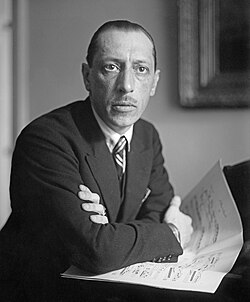
Igor Fyodorovich Stravinsky (17 June [O.S. 5 June] 1882 – 6 April 1971) was a Russian composer and conductor with French (from 1934) and American citizenship (from 1945). He is widely considered one of the most important and influential composers of the 20th century and a pivotal figure in modernist music.
👁 Image Sergei Rachmaninoff in 1901 Six moments musicaux (French for "Six Musical Moments"; Russian: Шесть музыкальных моментов, romanized: Shest’ muzykál’nykh moméntov), Op. 16, is a set of solo piano pieces composed by the Russian composer Sergei Rachmaninoff between October and December 1896. Each Moment musical reproduces a musical form characteristic of a previous musical era. The forms that appear in Rachmaninoff's incarnation are the nocturne, song without words, barcarolle, virtuosoétude, and theme and variations.
The individual pieces have been described as "true concert works, being best served on a stage and with a concert grand." Although composed as part of a set, each piece stands on its own as a concert solo with individual themes and moods. The pieces span a variety of themes ranging from the funeral march of number three to the canon of number six, the Moments musicaux are both Rachmaninoff's return to and revolution of solo piano composition. A typical performance lasts 30 minutes. (Full article...)
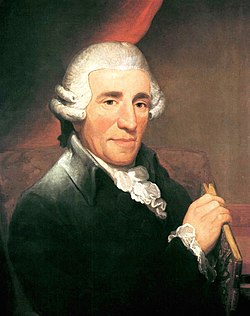
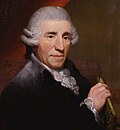
Haydn arose from humble origins, the child of working people in a rural village. He established his career first by serving as a chorister at St. Stephen's Cathedral, Vienna, then through an arduous period as a freelance musician. Eventually he found career success, spending much of his working life as music director for the wealthy Esterházy family at their palace of Eszterháza in rural Hungary. Though he had his own orchestra there, it isolated him from other composers and trends in music so that he was, as he put it, "forced to become original". During this period his music circulated widely in publication, eventually making him the most celebrated composer in Europe. Notable works include the Paris and London symphonies. With the death of his patron Nikolaus Esterházy in 1790, Haydn was free to travel, and augmented his fame as a performer before the public in both London and Vienna. Late in life, he composed the oratoriosThe Creation (1798) and The Seasons (1801). The last years of his life (1803–1809) were spent in a state of debility, unable to compose due to poor health. He died in Vienna in 1809 at the age of 77. (Full article...)
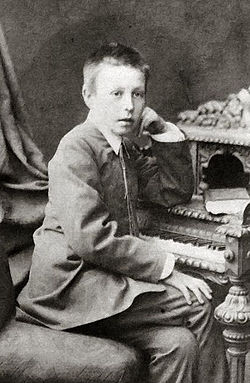
👁 Image Rachmaninoff, pictured here at age 10, produced most of the pieces not included in his opus before he was 14. The composer Sergei Rachmaninoff produced a number of solo piano pieces that were either lost, unpublished, or not assigned an opus number. While often disregarded in the concert repertoire, they are nevertheless part of his oeuvre. Sixteen of these pieces are extant; all others are lost. Ten of these pieces were composed before he completed his Piano Concerto No. 1, his first opus, and the rest interspersed throughout his later life. In these casual works, he draws upon the influence of other composers, including Frédéric Chopin and Pyotr Tchaikovsky.
The more substantial works, the Three Nocturnes and Four Pieces, are sets of well-thought out pieces that are his first attempts at cohesive structure among multiple pieces. Oriental Sketch and Prelude in D minor, two pieces he composed very late in his life, are short works that exemplify his style as a mature composer. Whether completed as a child or adult, these pieces cover a wide spectrum of forms while maintaining his characteristic Russian style. (Full article...)
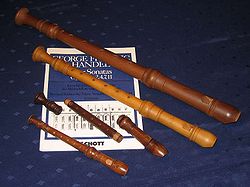
Various recorders (second from the bottom disassembled into its three parts)
The recorder is a family of woodwindmusical instruments and a member of the family of duct flutes that includes tin whistles and flageolets. It is the most prominent duct flute in the western classical tradition. A recorder can be distinguished from other duct flutes by the presence of a thumb-hole for the upper hand and holes for seven fingers: three for the upper hand and four for the lower.
Recorders are made in various sizes and ranges. The sizes most commonly in use today are the soprano (also known as descant, lowest note C5), alto (also known as treble, lowest note F4), tenor (lowest note C4), and bass (lowest note F3). Recorders were traditionally constructed from wood or ivory. Modern professional instruments are wooden, often boxwood; student and scholastic recorders are commonly made of moulded plastic. The recorders' internal and external proportions vary, but the bore is generally reverse conical (i.e. tapering towards the foot) to cylindrical, and all recorder fingering systems make extensive use of forked fingerings. (Full article...)
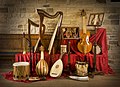
👁 Image Historical instrumentsA musical instrument is a device created or adapted to make musical sounds. In principle, any object that produces sound can be considered a musical instrument—it is through purpose that the object becomes a musical instrument. A person who plays a musical instrument is known as an instrumentalist.
The history of musical instruments dates to the beginnings of human culture. Early musical instruments may have been used for rituals, such as a horn to signal success on the hunt, or a drum in a religious ceremony. Cultures eventually developed composition and performance of melodies for entertainment. Musical instruments evolved in step with changing applications and technologies. (Full article...)
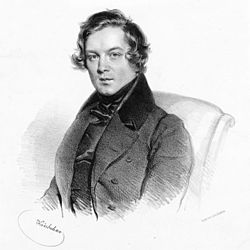
Robert Schumann (/ˈʃuːmɑːn/; German:[ˈʁoːbɐ̯tˈʃuːman]; 8 June 1810 – 29 July 1856) was a German composer, pianist, and music critic of the early Romantic era. He composed in all the main musical genres of the time, writing for solo piano, voice and piano, chamber groups, orchestra, choir and the opera. His works typify the spirit of the Romantic era in German music.
Schumann was born in Zwickau, Saxony, to an affluent middle-class family with no musical connections, and was initially unsure whether to pursue a career as a lawyer or to make a living as a pianist-composer. He studied law at the universities of Leipzig and Heidelberg but his main interests were music and Romantic literature. From 1829 he was a student of the piano teacher Friedrich Wieck, but his hopes for a career as a virtuoso pianist were frustrated by a worsening problem with his right hand, and he concentrated on composition. His early works were mainly piano pieces, including the large-scale Carnaval, Davidsbündlertänze (Dances of the League of David), Fantasiestücke (Fantasy Pieces), Kreisleriana and Kinderszenen (Scenes from Childhood) (1834–1838). He was a co-founder of the Neue Zeitschrift für Musik (New Musical Journal) in 1834 and edited it for ten years. In his writing for the journal and in his music he distinguished between two contrasting aspects of his personality, dubbing these alter egos "Florestan" for his impetuous self and "Eusebius" for his gentle poetic side. (Full article...)
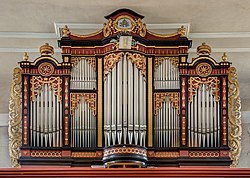
👁 Image The pipe organ is a musical instrument that produces sound by driving pressurised air (called wind) through the organ pipes selected from a keyboard. Because each pipe produces a single tone and pitch, the pipes are provided in sets called ranks, each of which has a common timbre, loudness (volume), and construction throughout the keyboard compass. In other words, a rank is a set of pipes all having the same tonal quality, but having a range of different pitches. Most organs have many ranks of pipes of differing pitch, timbre, and volume that the player can employ singly or in combination through the use of controls called stops.
A pipe organ has one or more keyboards (called manuals) played by the hands, and most have a pedalboard played by the feet; each keyboard controls its own division (group of stops). The keyboard(s), pedalboard, and stops are housed in the organ's console. The organ's continuous supply of wind allows it to sustain notes for as long as the corresponding keys are pressed, unlike the piano and harpsichord whose sound begins to dissipate immediately after a key is depressed. The smallest portable pipe organs may have only one or two dozen pipes and one manual; the largest pipe organs can have over 33,000 pipes and seven manuals. A list of some of the most notable and largest pipe organs in the world can be viewed at List of pipe organs. A ranking of the largest organs in the world—based on the criterion constructed by Michał Szostak, i.e. 'the number of ranks and additional equipment managed from a single console'—can be found in the quarterly magazine The Organ and in the online journal Vox Humana. (Full article...)
Image 4Portion of Du Fay's setting of Ave maris stella, in fauxbourdon. The top line is a paraphrase of the chant; the middle line, designated "fauxbourdon", (not written) follows the top line but exactly a perfect fourth below. The bottom line is often, but not always, a sixth below the top line; it is embellished, and reaches cadences on the octave.Play (from Renaissance music)
Image 8Musicians from 'Procession in honour of Our Lady of Sablon in Brussels.' Early 17th-century Flemish alta cappella. From left to right: bass dulcian, alto shawm, treble cornett, soprano shawm, alto shawm, tenor sackbut. (from Renaissance music)
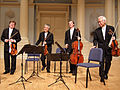
Image 16A modern string quartet. In the 2000s, string quartets from the Classical era are the core of the chamber music literature. From left to right: violin 1, violin 2, cello, viola (from Classical period (music))
And when they encounter works of art which show that using new media can lead to new experiences and to new consciousness, and expand our senses, our perception, our intelligence, our sensibility, then they will become interested in this music.
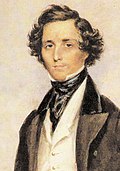
Mendelssohn's grandfather was the Jewish philosopher Moses Mendelssohn, but Felix was initially raised without religion until he was baptised aged seven into the Reformed Christian church. He was recognised early as a musical prodigy, but his parents were cautious and did not seek to capitalise on his talent. His sister Fanny received a similar musical education and was a talented composer and pianist in her own right; some of her early songs were published under her brother's name and her Easter Sonata was for a time mistakenly attributed to him after being lost and rediscovered in the 1970s. (Full article...)
👁 Middle-aged man, seated, facing towards the left but head turned towards the right. He has a high forehead, rimless glasses and is wearing a dark, crumpled suit Gustav Mahler, photographed in 1907 by Moritz Nähr at the end of his period as director of the Vienna Hofoper Gustav Mahler (German:[ˈɡʊstafˈmaːlɐ]ⓘ; 7 July 1860 – 18 May 1911) was an Austro-Bohemian Romantic composer, and one of the leading conductors of his generation. As a composer he acted as a bridge between the 19th-century tradition and the modernism of the early 20th century. While in his lifetime his status as a conductor was established beyond question, his own music gained wide popularity only after periods of relative neglect, which included a ban on its performance in much of Europe during the Nazi era. After 1945 his compositions were rediscovered by a new generation of listeners; Mahler then became one of the most frequently performed and recorded of all composers, a position he has sustained into the 21st century.
Born in Bohemia to Jewish parents of humble origins, the German-speaking Mahler displayed his musical gifts at an early age. After graduating from the Vienna Conservatory in 1878, he held a succession of conducting posts of rising importance in the opera houses of Europe, culminating in his appointment in 1897 as director of the Vienna Court Opera (Hofoper). During his ten years in Vienna, Mahler—who had converted to Catholicism to secure the post—experienced regular opposition and hostility from the anti-Semitic press. Nevertheless, his innovative productions and insistence on the highest performance standards ensured his reputation as one of the greatest of opera conductors, particularly as an interpreter of the stage works of Wagner, Mozart, and Tchaikovsky. Late in his life he was briefly director of New York's Metropolitan Opera and the New York Philharmonic. (Full article...)
Frederik Magle conducting on 20 September 2011, in the DRs Koncerthuset.
Frederik Reesen Magle (Danish pronunciation:[ˈfʁeðˀʁekˈmɑwlə,ˈfʁæðˀʁæk-]; born 17 April 1977) is a Danish composer, concert organist, and pianist. He writes contemporary classical music as well as fusion of classical music and other genres. His compositions include orchestral works, cantatas, chamber music, and solo works (mainly for organ), including several compositions commissioned by the Danish royal family. Magle has gained a reputation as an organ virtuoso, and as a composer and performing artist who does not refrain from venturing into more experimental projects – often with improvisation – bordering jazz, electronica, and other non-classical genres.
His best-known works include his concerto for organ and orchestra The Infinite Second, his brass quintet piece Lys på din vej (Light on your path), composed for the christening of Prince Nikolai, The Hope for brass band and choir, his symphonic suite Cantabile, a collection of improvisations for organ titled Like a Flame, and his fanfare for two trumpets and organ The Fairest of Roses. (Full article...)
The son of a military bandmaster, Sullivan composed his first anthem at the age of eight and was later a soloist in the boys' choir of the Chapel Royal. In 1856, at 14, he was awarded the first Mendelssohn Scholarship by the Royal Academy of Music, which allowed him to study at the academy and then at the Leipzig Conservatoire in Germany. His graduation piece, incidental music to Shakespeare's The Tempest (1861), was received with acclaim on its first performance in London. Among his early major works were a ballet, L'Île Enchantée (1864), a symphony, a cello concerto (both 1866), and his Overture di Ballo (1870). To supplement the income from his concert works he wrote hymns, parlour ballads and other light pieces, and worked as a church organist and music teacher. (Full article...)
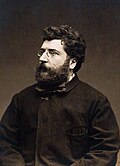
Georges Bizet (néAlexandre César Léopold Bizet; 25 October 1838 – 3 June 1875) was a French composer of the Romantic era. Best known for his operas in a career cut short by his early death, Bizet achieved few successes before his final work, Carmen, which has become one of the most popular and frequently performed works in the entire opera repertoire.
During a brilliant student career at the Conservatoire de Paris, Bizet won many prizes, including the prestigious Prix de Rome in 1857. He was recognised as an outstanding pianist, though he chose not to capitalise on this skill and rarely performed in public. Returning to Paris after almost three years in Italy, he found that the main Parisian opera theatres preferred the established classical repertoire to the works of newcomers. His keyboard and orchestral compositions were likewise largely ignored; as a result, his career stalled, and he earned his living mainly by arranging and transcribing the music of others. Restless for success, he began many theatrical projects during the 1860s, most of which were abandoned. Neither of his two operas that reached the stage in this time—Les pêcheurs de perles and La jolie fille de Perth—were immediately successful. (Full article...)
Guto Pryderi Puw (born 1971) is a Welsh composer, university lecturer and conductor. He is considered to be one of the most prominent Welsh composers of his generation and a key figure in current Welsh music. Puw's music has been broadcast on BBC Radio 3 and been featured on television programmes for the BBC and S4C. He has twice been awarded the Composer's Medal at the National Eisteddfod.
Puw's works include pieces for unusual combinations of instruments, such as a tuba quartet or a trio consisting of harp, cello and double-bass, as well as more traditional forces such as solo baritone and piano, choir or orchestra. He was associated with the BBC National Orchestra of Wales as its Resident Composer, the first holder of this title, from 2006 to 2010. Puw's own Welsh identity is a recurrent theme in his music: some of his pieces set Welsh-language poetry to music and one of his pieces, Reservoirs, is written about the flooding of Welsh valleys to provide water for England. (Full article...)
Jane Marian Joseph (31 May 1894 – 9 March 1929) was an English composer, arranger, and music teacher. She was a pupil and later associate of the composer Gustav Holst, and was instrumental in the organisation and management of various of the music festivals which Holst sponsored. Many of her works were composed for performance at these festivals and similar occasions. Her early death at age 34, which prevented the full realisation of her talents, was considered by her contemporaries as a considerable loss to English music.
Holst first observed Joseph's potential when he was teaching her composition at St Paul's Girls' School. She began to act as his amanuensis in 1914, when he was composing The Planets, her special responsibility being the preparation of the score for the "Neptune" movement. She continued to assist Holst with transcriptions, arrangements and translations, and was his librettist for the choral ballet The Golden Goose. (Full article...)
Born in the Himmelpfortgrund suburb of Vienna, Schubert showed uncommon gifts for music from an early age. His father gave him his first violin lessons and his elder brother gave him piano lessons, but Schubert soon surpassed their abilities. In 1808, at the age of eleven, he became a pupil at the Stadtkonvikt school, where he became acquainted with the orchestral music of Joseph Haydn, Wolfgang Amadeus Mozart, and Ludwig van Beethoven. He left the Stadtkonvikt at the end of 1813 and returned home to live with his father, where he began studying to become a schoolteacher. Despite this, he continued his studies in composition with Antonio Salieri and still composed prolifically. In 1821, Schubert was admitted to the Gesellschaft der Musikfreunde as a performing member, which helped establish his name among the Viennese citizenry. He gave a concert of his works to critical acclaim in March 1828, the only time he did so in his career. He died eight months later at the age of 31, the cause officially attributed to typhoid fever, but believed by some historians to be syphilis. (Full article...)
👁 Image Edward Benjamin Britten, Baron Britten (22 November 1913 – 4 December 1976) was an English composer, conductor, and pianist. He was a central figure of 20th-century British music, with a range of works including opera, other vocal music, orchestral and chamber pieces. His best-known works include the opera Peter Grimes (1945), the War Requiem (1962) and the orchestral showpiece The Young Person's Guide to the Orchestra (1945).
Britten was born in Lowestoft, Suffolk, the son of a dentist. He showed talent from an early age. He studied at the Royal College of Music in London and privately with the composer Frank Bridge. Britten first came to public attention with the a cappella choral work A Boy Was Born in 1934. With the premiere of Peter Grimes in 1945, he leapt to international fame. Over the next 28 years, he wrote 14 more operas, establishing himself as one of the leading 20th-century composers in the genre. In addition to large-scale operas for Sadler's Wells and Covent Garden, he wrote chamber operas for small forces; among the best known of these is The Turn of the Screw (1954). Recurring themes in his operas include the struggle of an outsider against a hostile society and the corruption of innocence. (Full article...)
Philip Arnold Heseltine (30 October 1894 – 17 December 1930), known by the pseudonymPeter Warlock, was a British composer and music critic. The Warlock name, which reflects Heseltine's interest in occult practices, was used for all his published musical works. He is best known as a composer of songs and other vocal music; he also achieved notoriety in his lifetime through his unconventional and often scandalous lifestyle.
As a schoolboy at Eton College, Heseltine met the British composer Frederick Delius, with whom he formed a close friendship. After a failed student career in Oxford and London, Heseltine turned to musical journalism, while developing interests in folk-song and Elizabethan music. His first serious compositions date from around 1915. Following a period of inactivity, a positive and lasting influence on his work arose from his meeting in 1916 with the Dutch composer Bernard van Dieren; he also gained creative impetus from a year spent in Ireland, studying Celtic culture and language. On his return to England in 1918, Heseltine began composing songs in a distinctive, original style, while building a reputation as a combative and controversial music critic. During 1920–21 he edited the music magazine The Sackbut. His most prolific period as a composer came in the 1920s, when he lived first in Wales and later at Eynsford in Kent. (Full article...)
Born in Montbrison, in the Loire department of France, the son of an engineer, Boulez studied at the Conservatoire de Paris with Olivier Messiaen, and privately with Andrée Vaurabourg and René Leibowitz. He began his professional career in the late 1940s as music director of the Renaud-Barrault theatre company in Paris. He was a leading figure in avant-garde music, playing an important role in the development of integral serialism in the 1950s, controlled chance music in the 1960s and the electronic transformation of instrumental music in real time from the 1970s onwards. His tendency to revise earlier compositions meant that his body of work was relatively small, but it included pieces considered landmarks of twentieth-century music, such as Le Marteau sans maître, Pli selon pli and Répons. His uncompromising commitment to modernism and the trenchant, polemical tone in which he expressed his views on music led some to criticise him as a dogmatist. (Full article...)
Philibert Rabezoza (1923 – 29 September 2001), better known by the name Rakoto Frah, was a flautist and composer of traditional music of the central highlands of Madagascar. Born in 1923 near the capital city of Antananarivo to a poor rural family, Rakoto Frah surmounted the challenges posed by his underprivileged origins to become the most acclaimed 20th century performer of the sodina flute, one of the oldest traditional instruments on the island. Through frequent international concerts and music festival performances, he promoted the music of the highlands of Madagascar and became one of the most famous Malagasy artists, both within Madagascar and on the world music scene.
After gaining regional recognition for his sodina skills as a youth, Rakoto Frah rose to national fame in 1958 when he was selected by Malagasy President Philibert Tsiranana to perform on the sodina for the visiting French president Charles de Gaulle. This event launched his career as a professional musician. He first played at traditional ceremonies around the country, then expanded his performances from 1967 to include participation in international music competitions and festivals. His popularity declined in the 1970s but underwent a revival that began in the mid-1980s and continued until his death in 2001. During this period Rakoto Frah recorded ten albums, toured extensively in Madagascar and overseas, was featured in two French documentaries, and collaborated with a variety of international and Malagasy artists. Over the course of his career he recorded over 800 original compositions. Rakoto Frah and his sodina were depicted on the 200 ariary Malagasy banknote in honor of his key role in revitalizing and internationally popularizing the sodina. Despite the artist's worldwide acclaim, he lived simply and died having earned little from his lifetime of musicianship. His death was widely mourned and marked by a state funeral, and in 2011 a famadihana (the Malagasy highland "turning of the bones" funerary tradition) was organized to celebrate the artist's life. (Full article...)
Garry Schyman is an American film, television, and video game music composer. He graduated from the University of Southern California with a degree in music composition in 1978, and began work in the television industry, writing music for television series such as Magnum, P.I. and The A-Team. By 1986, he was composing for movies such as Judgement and Hit List. At the request of a friend in 1993, he composed the music for the video game Voyeur, but after creating the music for two more games he left the industry, citing the low budgets and poor quality of video game music at the time. He continued to compose for film and television, only to return to video games for 2005's Destroy All Humans!. Finding that in his absence the quality and perceived importance of video game music had risen substantially, he has since composed for several games, writing the scores to BioShock and Dante's Inferno among others. He still composes for film however, his latest being Brush with Danger directed by young Indonesian director Livi Zheng. He has won numerous awards for his video game scores, including several "soundtrack of the year" awards. During his career, he has worked on over 25 television shows, 10 films, and 13 video games. (Full article...)
... that opera singer Charles Holland spent much of his career in Europe as opportunities in classical music for African Americans were limited?
... that WFMT classical music radio host Don Tait owned such a large collection of recordings that he had to buy a house and have its floor reinforced to accommodate the weight?
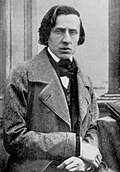
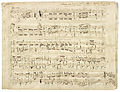
Sheet music for the Polonaise in A-flat major, Op. 53, a solo piano piece written by Frédéric Chopin in 1842. This work is one of Chopin's most admired compositions and has long been a favorite of the classical piano repertoire. The piece, which is very difficult, requires exceptional pianistic skills and great virtuosity to be interpreted. A typical performance of the polonaise lasts seven minutes.
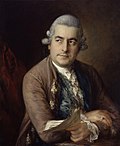
Johann Christian Bach (5 September 1735 – 1 January 1782) was a composer of the Classical era, the eighteenth child of Johann Sebastian Bach, and the youngest of his eleven sons. Bach was taught by his father and then, after the latter's death, by his half-brother C. P. E. Bach. Bach moved to Italy in 1754, and then to London in 1762, where he became known as the "London Bach". Bach's compositions include eleven operas, as well as chamber music, orchestral music and compositions for keyboard music. In 1764 Bach met Wolfgang Amadeus Mozart, who was eight at the time, and spent five months teaching him composition. He had considerable influence on Mozart, and was later described by scholars as his "only, true teacher".
The anatomy of a Périnet piston valve, this one taken from a B♭trumpet. When depressed, the valve diverts the air stream through additional tubing, thus lengthening the instrument and lowering the harmonic series on which the instrument is vibrating (i.e., it lowers the pitch). Trumpets generally use three valves, with some variations, such as a piccolo trumpet, having four. When used singly or in combination, the valves make the instrument fully chromatic, or capable of playing all twelve pitches of classical music. Trumpets may also use rotary valves instead.
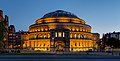
The Royal Albert Hall is a concert hall, seating a maximum of 5,272, on the northern edge of South Kensington, London. Constructed beginning in 1867, the hall was inaugurated on 29 March 1871. Since 1941 it has held The Proms, an eight-week summer season of daily orchestral classical music concerts and other events.
Jules Massenet (12 May 1842 – 13 August 1912) was a French composer of the Romantic era, best known for his operas. Between 1867 and his death, he wrote more than forty stage works in a wide variety of styles, from opéra comique to grand depictions of classical myths, romantic comedies and lyric dramas, as well as oratorios, cantatas and ballets. Massenet had a good sense of the theatre and of what would succeed with the Parisian public. Despite some miscalculations, he produced a series of successes that made him the leading opera composer in France in the late 19th and early 20th centuries. By the time of his death, he was regarded as old-fashioned; his works, however, began to be favourably reassessed during the mid-20th century, and many have since been staged and recorded. This photograph of Massenet was taken by French photographer Eugène Pirou in 1875.
Stradivarius is one of the violins, violas, cellos and other string instruments built by members of the Italian Stradivari family, particularly Antonio Stradivari.
Billy Strayhorn (November 29, 1915 – May 31, 1967) was an American jazz composer, pianist, lyricist, and arranger, best remembered for his long-time collaboration with bandleader and composer Duke Ellington that lasted nearly three decades. Though classical music was Strayhorn's first love, his ambition to become a classical composer went unrealized because of the harsh reality of a black man trying to make his way in the world of classical music, which at that time was almost completely white. He was introduced to the music of pianists like Art Tatum and Teddy Wilson at age 19, and the artistic influence of these musicians guided him into the realm of jazz, where he remained for the rest of his life. This photograph of Strayhorn was taken by William P. Gottlieb in the 1940s.





![👁 Image 1 1748 portrait of Bach holding a copy of the canon BWV 1076 Johann Sebastian Bach (31 March [O.S. 21 March] 1685 – 28 July 1750) was a German composer and musician of the late Baroque period. He is known for his prolific output across a variety of instruments and forms, including the orchestral Brandenburg Concertos; solo instrumental works such as the Cello Suites and Sonatas and Partitas for Solo Violin; keyboard works such as the Goldberg Variations and The Well-Tempered Clavier; organ works such as the Schübler Chorales and the Toccata and Fugue in D minor; and choral works such as the St. Matthew Passion and the Mass in B minor. He is known for his mastery of counterpoint, as heard in The Musical Offering and The Art of Fugue. Felix Mendelssohn precipitated the Bach Revival with a performance of the St. Matthew Passion in 1829. Ever since, Bach has been acclaimed as one of the greatest composers in the history of Western music. The Bach family had already produced several composers when Johann Sebastian was born in Eisenach, the youngest child of the city musician Johann Ambrosius Bach. After being orphaned at age 10, he lived for five years with his eldest brother, Johann Christoph, then continued his musical education in Lüneburg. In 1703 he returned to Thuringia, working as a musician for Protestant churches in Arnstadt and Mühlhausen. Around that time he also paid extended visits to the courts in Weimar, where he expanded his organ repertory, and the reformed court at Köthen, where he was mostly engaged with chamber music. By 1723 he was hired as Thomaskantor, church music director of the city of Leipzig and thus responsible for music in four Lutheran city churches and for the St. Thomas School. He decided to compose annual cycles of church cantatas, and also wrote music for Leipzig University's student ensemble, Collegium Musicum. In 1726 he began publishing his organ and other keyboard music. In Leipzig, he had difficult relations with his employer, as he had during some of his earlier positions. This situation was somewhat remedied when his sovereign, Augustus III of Poland, granted him the title of court composer of the Elector of Saxony in 1736. In the last decades of his life, Bach reworked and extended many of his earlier compositions. He died due to complications following eye surgery in 1750 at the age of 65. Four of his twenty children, Wilhelm Friedemann, Carl Philipp Emanuel, Johann Christoph Friedrich, and Johann Christian, became composers. (Full article...)](https://upload.wikimedia.org/wikipedia/en/d/d2/Blank.png)









.jpg)




.jpg)







_Google_Art_Project.jpg)

















.jpg)


.jpg)


.jpg)


.jpg)

.jpg)








.jpg)


