As jazz spread around the world, it drew on national, regional, and local musical cultures, which gave rise to different styles. New Orleans jazz began in the early 1910s, combining earlier brass band marches, French quadrilles, biguine, ragtime and blues with collective polyphonicimprovisation. However, jazz did not begin as a single musical tradition in New Orleans or elsewhere. In the 1930s, arranged dance-oriented swingbig bands, Kansas City jazz (a hard-swinging, bluesy, improvisational style), and gypsy jazz (a style that emphasized musette waltzes) were the prominent styles. Bebop emerged in the 1940s, shifting jazz from danceable popular music toward a more challenging "musician's music" which was played at faster tempos and used more chord-based improvisation. Cool jazz developed near the end of the 1940s, introducing calmer, smoother sounds and long, linear melodic lines.
The mid-1950s saw the emergence of hard bop, which introduced influences from rhythm and blues, gospel, and blues to small groups and particularly to saxophone and piano. Modal jazz developed in the late 1950s, using the mode, or musical scale, as the basis of musical structure and improvisation, as did free jazz, which explored playing without regular meter, beat and formal structures. Jazz fusion appeared in the late 1960s and early 1970s, combining jazz improvisation with rock music's rhythms, electric instruments, and highly amplified stage sound. In the early 1980s, a commercial form of jazz fusion called smooth jazz became successful, garnering significant radio airplay. Other styles and genres abound in the 21st century, such as Latin and Afro-Cuban jazz. (Full article...)
Industrial Zen is a studio album recorded by English jazz musician John McLaughlin in 2006. It was released on 22 May 2006 by Verve Records as a compact disc. Following the release of Thieves and Poets (2003), he began creating an album that was more ambitious and one that he could consider unique to him. He collaborated with various musicians for the project, such as vocalist Shankar Mahadevan, saxophonist Bill Evans, and tabla player Zakir Hussain. A jazz fusion and electric jazz album, Industrial Zen features the use of several instruments, including drums, keyboards, the electric bass, and the tabla. Additionally, McLaughlin wrote and produced all eight songs that appear on the record.
The album was generally well received by music critics for being musically diverse. One critic also pointed out that it resembled some of McLaughlin's work that he released in the 1970s. Commercially, the album fared well on two jazz music Billboard charts, peaking at numbers 9 and 14 on the Top Jazz Albums and Jazz Albums charts, respectively. (Full article...)
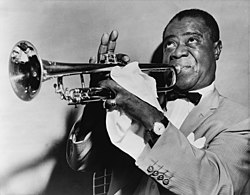
👁 Image The Jazz Age was a period from 1920 to the early 1930s in which jazz music and dance styles gained worldwide popularity. The Jazz Age's cultural repercussions were primarily felt in the United States, the birthplace of jazz. Originating in New Orleans as mainly sourced from the culture of African Americans, jazz played a significant part in wider cultural changes in this period, and its influence on popular culture continued long afterwards.
The Jazz Age is often referred to in conjunction with the Roaring Twenties, and overlapped in significant cross-cultural ways with the Prohibition era. The movement was largely affected by the introduction of radios nationwide. During this time, the Jazz Age was intertwined with the developing youth culture. The movement would also help in introducing jazz culture to Europe. The Jazz Age ends before the Swing era. (Full article...)
Holiday's version reached No. 5 on the R&B chart and No. 16 on pop in 1945. In July 1946, Charlie Parker recorded a rendition of "Lover Man" while he was intoxicated. Dial Records producer Ross Russell had to hold him up to the microphone during the recording. Sonny Stitt played the song many times on alto saxophone in a virtuoso way, in the original key of D flat. Most jazz musicians, nevertheless, play the song in the key of F. Barbra Streisand recorded a version for her album Simply Streisand in 1967, and her version peaked at No. 29 on the Billboard Adult Contemporary chart. (Full article...)
Misterioso is a 1958 live album by American jazz ensemble the Thelonious Monk Quartet. By the time of its recording, the pianist and bandleader Thelonious Monk had overcome an extended period of career difficulties and achieved stardom with his residency at New York's Five Spot Café, beginning in 1957. He returned there the following year for a second stint with his quartet, featuring drummer Roy Haynes, bassist Ahmed Abdul-Malik, and tenor saxophonist Johnny Griffin. Along with Thelonious in Action (1958), Misterioso captures portions of the ensemble's August 7 show at the venue.
One of the first successful live recordings of Monk's music, Misterioso was produced by Orrin Keepnews of Riverside Records. According to Keepnews, the pianist played more distinctly here than on his studio albums in response to the audience's enthusiasm during the performance. Misterioso's title was meant to evoke Monk's reputation as an enigmatic, challenging performer, while its cover art was part of Riverside's attempt to capitalize on his popularity with intellectual and bohemian audiences; it appropriated Giorgio de Chirico's 1915 painting The Seer. (Full article...)
"Amar pelos dois" (Portuguese pronunciation:[ɐˈmaɾp(e)luʒˈðojʃ]; English: "To Love for the Both of Us") is a song recorded by Portuguese singer Salvador Sobral. The song was written and produced by his sister Luísa Sobral and released for digital download as a single on 10 March 2017 by Sons em Trânsito. It premiered earlier that year, on 19 February, when it was performed during the first semi-final of Festival da Canção 2017.
"Amar pelos dois" is a jazz waltz with the lyrical theme of heartbreak after a breakup. The track received praise from music critics. The song earned the Sobral siblings various awards, including two Marcel Bezençon Awards. The track achieved commercial success, particularly in Europe, reaching the top ten in several countries. It was certified platinum by the Associação Fonográfica Portuguesa (AFP). Sobral has performed "Amar pelos dois" at his international tours. It is included in the European Union Songbook as the all-time top Portugueselove song, and it is listed in the Guinness World Records. The song has been covered by several artists. (Full article...)
Jazz saxophonists are musicians who play various types of saxophones (alto saxophone, tenor saxophone, baritone saxophone etc.) in jazz and its associated subgenres. The techniques and instrumentation of this type of performance have evolved over the 20th century, influenced by both movements of musicians that became the subgenres and by particularly influential sax players who helped reshape the music.
In recent decades, jazz saxophonists have embraced elements of fusion, avant-garde, and electronic music, further expanding the boundaries of the instrument's role in jazz. This has allowed the saxophone to remain a versatile and vital voice in contemporary music, blending traditional techniques with cutting-edge innovations. (Full article...)
Musical improvisation (also known as musical extemporization) is the creative activity of immediate ("in the moment") musical composition, which combines performance with communication of emotions and instrumental technique as well as spontaneous response to other musicians. Sometimes musical ideas in improvisation are spontaneous, but may be based on chord changes in classical music and many other kinds of music. One definition is a "performance given extempore without planning or preparation". Another definition is to "play or sing (music) extemporaneously, by inventing variations on a melody or creating new melodies, rhythms and harmonies". Encyclopædia Britannica defines it as "the extemporaneous composition or free performance of a musical passage, usually in a manner conforming to certain stylistic norms but unfettered by the prescriptive features of a specific musical text." Improvisation is often done within (or based on) a pre-existing harmonic framework or chord progression. Improvisation is a major part of some types of 20th-century music, such as blues, rock music, jazz, and jazz fusion, in which instrumental performers improvise solos, melody lines and accompaniment parts.
Throughout the eras of the Western art music tradition, including the Medieval, Renaissance, Baroque, Classical, and Romantic periods, improvisation was a valued skill. J. S. Bach, Handel, Mozart, Beethoven, Chopin, Liszt, and many other famous composers and musicians were known especially for their improvisational skills. Improvisation might have played an important role in the monophonic period. The earliest treatises on polyphony, such as the Musica enchiriadis (ninth century), indicate that added parts were improvised for centuries before the first notated examples. However, it was only in the fifteenth century that theorists began making a hard distinction between improvised and written music. (Full article...)
Jazz Dance is a performance dance and style that arose in the United States in the early 20th century. Jazz Dance may allude to vernacular Jazz, Broadway or dramatic Jazz. The two types expand on African American vernacular styles of dance that arose with Jazz Music. Vernacular dance refers to dance forms that emerge from everyday life and cultural practices of a specific community, often reflecting the social, cultural, and historical contexts of that community. In the context of African American culture, vernacular dance encompasses styles that developed organically within African American communities, influenced by African traditions, European dance forms, and the unique experiences of African Americans in the United States.
Bossa nova (Portuguese pronunciation:[ˈbɔsɐˈnɔvɐ]ⓘ) is a relaxed style of samba developed in the late 1950s and early 1960s in Rio de Janeiro, Brazil. It is mainly characterized by a calm syncopated rhythm with chords and fingerstyle mimicking the beat of a samba groove, as if it was a simplification and stylization on the guitar of the rhythm produced by a samba school band. Another defining characteristic of the style is the use of unconventional chords in some cases with complex progressions and "ambiguous" harmonies. A common misconception is that these complex chords and harmonies were derived from jazz, but samba guitar players have been using similar arrangement structures since the early 1920s, indicating a case of parallel evolution of styles rather than a simple transference from jazz to bossa nova. Nevertheless, bossa nova was influenced by jazz, both in the harmonies used and also by the instrumentation of songs, and today many bossa nova songs are considered jazz standards. The popularity of bossa nova has helped to renew samba and contributed to the modernization of Brazilian music in general.
One of the major innovations of bossa nova was the way to synthesize the rhythm of samba on the classical guitar. According to musicologist Gilberto Mendes, the bossa nova was one of the "three rhythmic phases of samba", in which the "bossa beat" had been extracted by João Gilberto from the traditional samba. The synthesis performed by Gilberto's guitar was a reduction of the "batucada" of samba, a stylization produced from one of the percussion instruments: the thumb stylized a surdo; the index, middle and ring fingers phrased like a tamborim. In line with this thesis, musicians such as Baden Powell, Roberto Menescal, and Ronaldo Bôscoli also understand the bossa nova beat as being extracted from the tamborim play in the bateria. (Full article...)
👁 Image The Louis Moholo Quintet performing at a jazz club.
This is a list of notable venues where jazz music is played. It includes jazz clubs, clubs, dancehalls and historic venues such as theatres. A jazz club is a venue where the primary entertainment is the performance of live jazz music. Jazz clubs are usually a type of nightclub or bar, which is licensed to sell alcoholic beverages. Jazz clubs were in large rooms in the eras of Orchestral jazz and big band jazz, when bands were large and often augmented by a string section. Large rooms were also more common in the Swing era, because at that time, jazz was popular as a dance music, so the dancers needed space to move. With the transition to 1940s-era styles like Bebop and later styles such as soul jazz, small combos of musicians such as quartets and trios were mostly used, and the music became more of a music to listen to, rather than a form of dance music. As a result, smaller clubs with small stages became practical.
In the 2000s, jazz clubs may be found in the basements of larger residential buildings, in storefront locations or in the upper floors of retail businesses. They can be rather small compared to other music venues, such as rock music clubs, reflecting the intimate atmosphere of jazz shows and long-term decline in popular interest in jazz. Despite being called "clubs", these venues are usually not exclusive. Some clubs, however, have a cover charge if a live band is playing. Some jazz clubs host "jam sessions" after hours or on early evenings of the week. At jam sessions, both professional musicians and advanced amateurs will typically share the stage. (Full article...)
👁 Image Funk music, as performed by groups such as Parliament-Funkadelic, uses catchy electric basslines and drum patterns to create a propulsive, emphatic rhythmic "feel" that is often referred to as a "groove".
In music, groove is the sense of an effect ("feel") of changing pattern in a propulsive rhythm or sense of "swing". In jazz, it can be felt as a quality of persistently repeated rhythmic units, created by the interaction of the music played by a band's rhythm section (e.g. drums, electric bass or double bass, guitar, and keyboards). Groove is a significant feature of popular music, and can be found in many genres, including salsa, rock, soul, funk, and fusion.
From a broader ethnomusicological perspective, groove has been described as "an unspecifiable but ordered sense of something that is sustained in a distinctive, regular and attractive way, working to draw the listener in." Musicologists and other scholars have analyzed the concept of "groove" since around the 1990s. They have argued that a "groove" is an "understanding of rhythmic patterning" or "feel" and "an intuitive sense" of "a cycle in motion" that emerges from "carefully aligned concurrent rhythmic patterns" that stimulates dancing or foot-tapping on the part of listeners. The concept can be linked to the sorts of ostinatos that generally accompany fusions and dance musics of African derivation (e.g. African-American, Afro-Cuban, Afro-Brazilian, etc.). (Full article...)
The band's music is a fusion of Delta blues, gypsy jazz, 1930s–era swing, klezmer, and other styles. They found commercial success during the swing revival of the late 1990s with their 1996 single "Hell", written by Tom Maxwell. After a hiatus of several years, the original band members reunited and performed in 2007, playing in the U.S. and Canada. (Full article...)
The New Orleans Jazz & Heritage Festival (commonly called Jazz Fest or Jazzfest) is an annual celebration of local music and culture held at the Fair Grounds Race Course in New Orleans, Louisiana. Jazz Fest attracts thousands of visitors to New Orleans each year. The New Orleans Jazz & Heritage Festival and Foundation Inc., as it is officially named, was established in 1970 as a 501(c)(3) nonprofit organization (NPO). The Foundation is the original organizer of the New Orleans Jazz & Heritage Festival presented by Shell Oil Company, a corporate financial sponsor. The Foundation was established primarily to redistribute the funds generated by Jazz Fest into the local community. As an NPO, its mission further states that the Foundation "promotes, preserves, perpetuates and encourages the music, culture and heritage of communities in Louisiana through festivals, programs and other cultural, educational, civic and economic activities". The founders of the organization included pianist and promoter George Wein, producer Quint Davis and the late Allison Miner.
In addition to the Festival, the organization's other assets include radio station WWOZ 90.7 FM, the Jazz & Heritage Foundation Archive and The George & Joyce Wein Jazz & Heritage Center. The Foundation also raises funds by holding the Jazz & Heritage Gala every year and provides several educational programs and a variety of more targeted festivals. (Full article...)
Swing was also dance music. It was broadcast on the radio 'live' nightly across America for many years especially by Hines and his Grand Terrace Cafe Orchestra broadcasting coast-to-coast from Chicago, well placed for 'live' time-zones. Although it was a collective sound, swing also offered individual musicians a chance to 'solo' and improvise melodic, thematic solos which could at times be very complex and 'important' music. Over time, social structures regarding racial segregation began to relax in America: white bandleaders began to recruit black musicians and black bandleaders. In the mid-1930s, Benny Goodman hired pianist Teddy Wilson, vibraphonist Lionel Hampton, and guitarist Charlie Christian to join small groups. Kansas City Jazz in the 1930s as exemplified by tenor saxophonist Lester Young marked the transition from big bands to the bebop influence of the 1940s. (Full article...)
Thomas Lee Flanagan (March 16, 1930 – November 16, 2001) was an American jazz pianist and composer. He grew up in Detroit, initially influenced by such pianists as Art Tatum, Teddy Wilson, and Nat King Cole, and then by bebop musicians. Within months of moving to New York in 1956, he had recorded with Miles Davis and on Sonny Rollins' album Saxophone Colossus. Recordings under various leaders, including Giant Steps of John Coltrane, continued well into 1962, when he became the full-time accompanist to Ella Fitzgerald. He worked with Fitzgerald for three years until 1965, and then in 1968 returned to be her pianist and musical director, this time for a decade.
After leaving Fitzgerald in 1978, Flanagan attracted praise for the elegance of his playing, which was principally in trio settings when under his own leadership. In his 45-year recording career, he recorded more than three dozen albums under his own name and more than 200 as a sideman. By the time of his death, he was one of the most widely admired jazz pianists and had influenced both his contemporaries and later generations of players. (Full article...)
Sheldon "Shelly" Manne (June 11, 1920 – September 26, 1984) was an American jazz drummer. Most frequently associated with West Coast jazz, he was known for his versatility and also played in a number of other styles, including Dixieland, swing, bebop, avant-garde jazz, and later fusion. He also contributed to the musical background of hundreds of Hollywood films and television programs. (Full article...)
Frank Vincent Zappa (December 21, 1940 – December 4, 1993) was an American composer, songwriter, guitarist, conductor, actor, satirist, filmmaker, and activist. In a career spanning more than 30 years, Zappa composed rock, pop, jazz, jazz fusion, orchestral and musique concrète works; he additionally produced nearly all the 60-plus albums he released with his band the Mothers of Invention and as a solo artist. His discography is characterized by nonconformity, improvisation, sonic experimentation, musical virtuosity and satire of American culture. Zappa also directed feature-length films and music videos, and designed album covers. He is considered one of the most innovative and stylistically diverse musicians of his generation.
As a mostly self-taught composer and performer, Zappa had diverse musical influences that led him to create music that was sometimes difficult to categorize. While in his teens, he acquired a taste for 20th-century classical modernism, African-American rhythm and blues, and doo-wop music. He began writing classical music in high school, while simultaneously playing drums in rhythm-and-blues bands, later switching to electric guitar. His debut studio album with the Mothers of Invention, Freak Out! (1966), combined satirical but seemingly conventional rock-and-roll songs with extended sound collages. He continued this eclectic and experimental approach throughout his career. (Full article...)
Edward Kennedy "Duke" Ellington (April 29, 1899 – May 24, 1974) was an American jazz pianist, composer, and leader of his eponymous jazz orchestra from 1924 through the rest of his life. Ralph J. Gleason called him "America's most important composer."
Born and raised in Washington, D.C., Ellington was based in New York City from the mid-1920s and gained a national profile through his orchestra's appearances at the Cotton Club in Harlem. A master at writing miniatures for the three-minute 78 rpm recording format, Ellington wrote or collaborated on more than one thousand compositions; his extensive body of work is the largest recorded personal jazz legacy, and many of his pieces have become standards. He also recorded songs written by his bandsmen, such as Juan Tizol's "Caravan", which brought a Spanish tinge to big band jazz. (Full article...)
David Roy Eldridge (January 30, 1911 – February 26, 1989), nicknamed "Little Jazz", was an American jazz trumpeter. His sophisticated use of harmony, including the use of tritone substitutions, his virtuosic solos exhibiting a departure from the dominant style of jazz trumpet innovator Louis Armstrong, and his strong impact on Dizzy Gillespie mark him as one of the most influential musicians of the swing era and a precursor of bebop. (Full article...)
Mingus's compositions continue to be played by contemporary musicians ranging from the repertory bands Mingus Big Band, Mingus Dynasty, and Mingus Orchestra to high school students who play the charts and compete in the Charles Mingus High School Competition. In 1993, the Library of Congress acquired Mingus's collected papers—including scores, sound recordings, correspondence and photos—in what it called "the most important acquisition of a manuscript collection relating to jazz in the Library's history". (Full article...)
Hasaan Ibn Ali (born William Henry Langford, Jr.; May 6, 1931 – 1980) was an American jazz pianist and composer.
Ibn Ali was strongly influenced by Elmo Hope, and his playing was rapid and intense, retaining a sense of rhythm even when his style became increasingly unconventional. Only one recording of his playing – The Max Roach Trio Featuring the Legendary Hasaan – was released in his lifetime. Ibn Ali built a reputation in Philadelphia, where he influenced musicians including John Coltrane, but he remained little known elsewhere. (Full article...)
Mulgrew Miller (August 13, 1955 – May 29, 2013) was an American jazz pianist, composer, and educator. As a child he played in churches and was influenced on piano by Ramsey Lewis and then Oscar Peterson. Aspects of their styles remained in his playing, but he added the greater harmonic freedom of McCoy Tyner and others in developing as a hard bop player and then in creating his own style, which influenced others from the 1980s on.
After leaving university he was pianist with the Duke Ellington Orchestra for three years, then accompanied vocalist Betty Carter. Three-year stints with trumpeter Woody Shaw and with drummer Art Blakey's high-profile Jazz Messengers followed, by the end of which Miller had formed his own bands and begun recording under his own name. He was then part of drummer Tony Williams' quintet from its foundation, while continuing to play and record with numerous other leaders, mostly in small groups. (Full article...)
Wynton Charles Kelly (December 2, 1931 – April 12, 1971) was an American jazz pianist and composer. He is known for his lively, blues-based playing and as one of the finest accompanists in jazz. He began playing professionally at the age of 12 and was pianist on a No. 1 R&B hit at the age of 16. His recording debut as a leader occurred three years later, around the time he started to become better known as an accompanist to singer Dinah Washington, and as a member of trumpeter Dizzy Gillespie's band. This progress was interrupted by two years in the United States Army, after which Kelly worked again with Washington and Gillespie, and played with other leaders. Over the next few years, these included instrumentalists Cannonball Adderley, John Coltrane, Hank Mobley, Wes Montgomery, and Sonny Rollins, and vocalists Betty Carter, Billie Holiday, and Abbey Lincoln.
Kelly attracted the most attention as part of Miles Davis' band from 1959, including an appearance on the trumpeter's Kind of Blue, often mentioned as the best-selling jazz album ever. After leaving Davis in 1963, Kelly played with his own trio, which recorded for several labels and toured the United States and internationally. His career did not develop much further, and he had difficulty finding enough work late in his career. Kelly, who was known to have epilepsy, died in a hotel room in Canada following a seizure, aged 39. (Full article...)
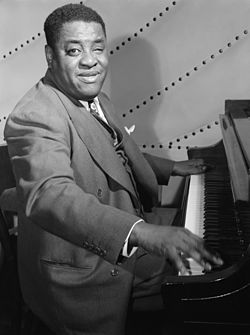
Arthur Tatum Jr. (/ˈteɪtəm/, October 13, 1909 – November 5, 1956) was an American jazz pianist who is widely regarded as one of the greatest ever. From early in his career, fellow musicians acclaimed Tatum's technical ability as extraordinary. Tatum also extended jazz piano's vocabulary and boundaries far beyond his initial stride influences, and established new ground through innovative use of reharmonization, voicing, and bitonality.
Tatum grew up in Toledo, Ohio, where he began playing piano professionally and had his own radio program, rebroadcast nationwide, while still in his teens. He left Toledo in 1932 and had residencies as a solo pianist at clubs in major urban centers including New York, Chicago, and Los Angeles. In that decade, he settled into a pattern he followed for most of his career – paid performances followed by long after-hours playing, all accompanied by prodigious alcohol consumption. He was said to be more spontaneous and creative in such venues, and although the drinking did not hinder his playing, it did damage his health. (Full article...)
After her marriage to trumpeter Jimmy McPartland in February 1945, she resided in the United States when not travelling throughout the world to perform. In 1969, she founded Halcyon Records, a recording company that issued albums for 10 years. In 2000, she was named a National Endowment for the Arts Jazz Master. In 2004, she was given a Grammy Award for lifetime achievement. In 2007, she was inducted into the National Radio Hall of Fame. Although known mostly for jazz, she composed other types of music as well, performing her own symphonic work A Portrait of Rachel Carson with the University of South Carolina Symphony Orchestra in 2007. In 2010, she was named a member of the Order of the British Empire. (Full article...)
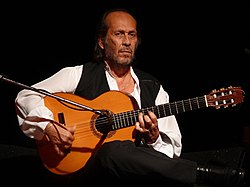
Francisco Gustavo Sánchez Gómez (Spanish:[fɾanˈθiskoɡusˈt̪a.β̞oˈsantʃeθˈɣomeθ]; 21 December 1947 – 25 February 2014), known as Paco de Lucía (Spanish:[ˈpakoðeluˈθi.a]), was a Spanish virtuosoflamenco guitarist, composer, and record producer. A leading proponent of the new flamenco style, he was one of the first flamenco guitarists to branch into classical and jazz. Richard Chapman and Eric Clapton, authors of Guitar: Music, History, Players, describe de Lucía as a "titanic figure in the world of flamenco guitar", and Dennis Koster, author of Guitar Atlas, Flamenco, has referred to de Lucía as "one of history's greatest guitarists".
De Lucía was noted for his fast and fluent picados (fingerstyle runs). A master of contrast, he often juxtaposed picados and rasgueados (flamenco strumming) with more sensitive playing and was known for adding abstract chords and scale tones to his compositions with jazz influences. These innovations played a key role in the development of traditional flamenco and the evolution of new flamenco and Latin jazz fusion from the 1970s. He received acclaim for his recordings with flamenco singer Camarón de la Isla in the 1970s, recording ten albums which are considered some of the most important and influential in flamenco history. (Full article...)
John William Coltrane (September 23, 1926 – July 17, 1967) was an American jazz saxophonist, bandleader, and composer. He is among the most influential and acclaimed figures in the history of jazz and 20th-century music.
Born and raised in North Carolina, Coltrane moved to Philadelphia after high school, where he immersed himself in the local jazz scene, studied music, and served in the Navy toward the end of World War II before making his professional debut in 1945. Working in the bebop and hard bop idioms early in his career, Coltrane helped pioneer the use of modes and was one of the players at the forefront of free jazz. He led at least fifty recording sessions and appeared on many albums by other musicians, including trumpeter Miles Davis and pianist Thelonious Monk. Over the course of his career, Coltrane's music took on an increasingly spiritual dimension, as exemplified on his most acclaimed album A Love Supreme (1965) and others. Decades after his death, Coltrane remains influential, and he has received numerous posthumous awards, including a special Pulitzer Prize, and was canonized by the African Orthodox Church. (Full article...)
Jean Reinhardt (23 January 1910 – 16 May 1953), known by his Romani nickname Django (French:[dʒãŋɡoʁɛjnaʁt] or [dʒɑ̃ɡoʁenɑʁt]), was a Belgian-born Romani jazz guitarist and composer who lived most of his life in France. He was one of the first major jazz talents to emerge in Europe and has been hailed as one of its most significant exponents.
With violinist Stéphane Grappelli, Reinhardt formed the Paris-based Quintette du Hot Club de France in 1934. The group was among the first to play jazz that featured the guitar as a lead instrument. Reinhardt recorded in France with many visiting American musicians, including Coleman Hawkins and Benny Carter, and briefly toured the United States with Duke Ellington's orchestra in 1946. He died suddenly of a brain hemorrhage in 1953 at the age of 43. (Full article...)
... that Albert Gumble and Owen Murphy's music score for the Broadway musical Red Pepper was dismissed by one critic as not "real music" because of its embrace of jazz?
This is a list of recognized content, updated weekly by JL-Bot (talk·contribs) (typically on Saturdays). There is no need to edit the list yourself. If an article is missing from the list, make sure it is tagged or categorized (e.g. Category:WikiProject Jazz articles) correctly and wait for the next update. See WP:RECOG for configuration options.




.jpg)


,_New_York,_ca._Nov._1946_(William_P._Gottlieb_02271).jpg)


.jpg)

.jpg)




.jpg)


.jpg)


