A monarchy is a hereditary form of government in which political power is legally passed on to the family members of the monarch, a head of state who rules for life. While monarchs gain their power depending on specific succession laws, they can also gain their authority via election.
Monarchies have historically been a common form of government. Nearly half of all independent states at the start of the 19th century were monarchies. After reaching a peak in the middle of the 19th century, the proportion of monarchies in the world has steadily declined. Republics replaced many monarchies, notably at the end of World War I and World War II.
There are conventionally two types of monarchy: absolute monarchy and constitutional monarchy. Absolute monarchies, of which there are approximately twelve, are governed as autocracies. Most of the modern monarchies are constitutional monarchies, retaining under a constitution unique legal and ceremonial roles for monarchs exercising limited or no political power, similar to heads of state in a parliamentary republic.
RichardIII, the final ruler of the Plantagenet dynasty, was killed on 22 August 1485 in the Battle of Bosworth Field, the last significant battle of the Wars of the Roses. His body was taken to Greyfriars, where it was buried in a crude grave in the friary church. Following the friary's dissolution in 1538 and subsequent demolition, Richard's tomb was lost. An erroneous account arose that Richard's bones had been thrown into the River Soar at the nearby Bow Bridge. (Full article...)
Æthelwulf in the early fourteenth-century Genealogical Roll of the Kings of England
Æthelwulf (Old English:[ˈæðelwuɫf]; Old English for "Noble Wolf"; died 13 January 858) was King of Wessex from 839 to 858. In 825, his father, King Ecgberht, defeated King Beornwulf of Mercia, ending a long Mercian dominance over Anglo-Saxon England south of the Humber. Ecgberht sent Æthelwulf with an army to Kent, where he expelled the Mercian sub-king and was himself appointed sub-king. After 830, Ecgberht maintained good relations with Mercia, and this was continued by Æthelwulf when he became king in 839, the first son to succeed his father as West Saxon king since 641.
The Vikings were not a major threat to Wessex during Æthelwulf's reign. In 843, he was defeated in a battle against the Vikings at Carhampton in Somerset, but he achieved a major victory at the Battle of Aclea in 851. In 853, he joined a successful Mercian expedition to Wales to restore the traditional Mercian hegemony, and in the same year, his daughter Æthelswith married King Burgred of Mercia. In 855, Æthelwulf went on a pilgrimage to Rome. In preparation he gave a "decimation", donating a tenth of his personal property to his subjects; he appointed his eldest surviving son Æthelbald to act as King of Wessex in his absence, and his next son Æthelberht to rule Kent and the south-east. Æthelwulf spent a year in Rome, and on his way back he married Judith, the daughter of the West Frankish king Charles the Bald. (Full article...)
Marble head found at Pergamon dated to the 3rd century BC, currently at the Pergamon Museum in Berlin; hypothesized to be depicting Attalus I.
Attalus I (Ancient Greek: Ἄτταλος'Attalos'), surnamed Soter (Greek: Σωτήρ, 'Savior'; 269–197 BC), was the ruler of the Greek polis of Pergamon (modern-day Bergama, Turkey) and the larger Pergamene Kingdom from 241 BC to 197 BC. He was the adopted son of King Eumenes I, whom he succeeded, and the first of the Attalid dynasty to assume the title of king, sometime around 240 to 235 BC. He was the son of Attalus and his wife Antiochis.
Attalus won an important victory, the Battle of the Caecus River, over the Galatians, a group of migratory Celtic tribes from Thrace, who had been plundering and exacting tribute throughout most of Asia Minor for more than a generation. The victory was celebrated with a triumphal monument at Pergamon (The Dying Gaul) and Attalus taking the surname "Soter" and the title of king. He participated in the first and second Macedonian Wars against Philip V of Macedon as a loyal ally of the Roman Republic, although Pergamene participation was ultimately rather minor in these wars. He conducted numerous naval operations throughout the Aegean, gained the island of Aegina for Pergamon during the first war and Andros during the second, twice narrowly escaping capture at the hands of Philip V. During his reign, Pergamon also repeatedly struggled with the neighboring Seleucid Empire to the east, resulting in both successes and setbacks. (Full article...)
Æthelflæd was born around 870 at the height of the Viking invasions of England. By 878, most of England was under Danish Viking rule – East Anglia and Northumbria having been conquered, and Mercia partitioned between the English and the Vikings – but in that year Alfred won a crucial victory at the Battle of Edington. Soon afterwards the English-controlled western half of Mercia came under the rule of Æthelred, Lord of the Mercians, who accepted Alfred's overlordship. Alfred adopted the title King of the Anglo-Saxons (previously he was titled King of the West Saxons like his predecessors) claiming to rule all Anglo-Saxon people not living in areas under Viking control. In the mid-880s, Alfred sealed the strategic alliance between the surviving English kingdoms by marrying Æthelflæd to Æthelred. (Full article...)
Solidus of Basiliscus, marked: d·n· Basiliscus p·p· aug·
Basiliscus (Ancient Greek: Βασιλίσκος, romanized: Basilískos; died 476/477) was Eastern Roman emperor from 9 January 475 to August 476. He became magister militum per Thracias in 464, under his brother-in-law, Emperor Leo I (r. 457–474). Basiliscus commanded the army for an invasion of the Vandal Kingdom in 468, which was defeated at the Battle of Cape Bon. There were accusations at the time that Basiliscus was bribed by Aspar, the magister militum; many historians dismiss this, instead concluding that Basiliscus was either incompetent or foolish for accepting Vandal King Gaiseric's offer of a truce, which the latter used to construct fireships. Basiliscus's defeat cost the Eastern Empire 130,000 pounds (59,000 kg) of gold, causing the empire to hover above bankruptcy for 30 years. When Basiliscus returned to Constantinople, he sought refuge in the Hagia Sophia. His sister, Empress Verina, secured a pardon for him and he left the church to retire in Neapolis.
When Emperor Leo died in 474, his grandson Leo II (r. 474) took power, but soon died; his father, Zeno (r. 474–475, 476–491) ascended the throne in the same year, in a politically precarious position. Verina conspired to install the magister officiorum Patricius, her lover, as emperor. This plot was supported by Basiliscus, who succeeded in recruiting Isaurian brothers Illus and Trocundes, as well as Verina's nephew Armatus. Zeno fled on 9 January 475, either after learning of the plot or after Verina warned him that his life was in danger. Although Patricius was Verina's intended successor, Basiliscus convinced the Eastern Roman Senate to acclaim him instead. (Full article...)
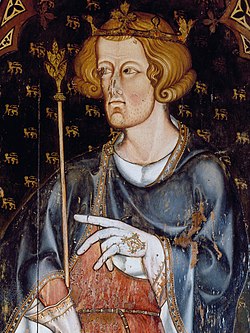
Portrait in Westminster Abbey probably depicting Edward I, installed during his reign
Edward I (17/18 June 1239 – 7 July 1307), also known as Edward Longshanks and the Hammer of the Scots (Latin: Malleus Scotorum), was King of England from 1272 to 1307. Concurrently, he was Lord of Ireland, and from 1254 to 1306 ruled Gascony as Duke of Aquitaine in his capacity as a vassal of the French king. Before his accession to the throne, he was commonly referred to as the Lord Edward.
The eldest son of Henry III, Edward was involved from an early age in the political intrigues of his father's reign. In 1259, he briefly sided with a baronial reform movement, supporting the Provisions of Oxford. After reconciling with his father, he remained loyal throughout the subsequent armed conflict, known as the Second Barons' War. After the Battle of Lewes, Edward was held hostage by the rebellious barons, but escaped after a few months and defeated the baronial leader Simon de Montfort at the Battle of Evesham in 1265. Within two years, the rebellion was extinguished and, with England pacified, Edward left to join the Ninth Crusade to the Holy Land in 1270. He was on his way home in 1272 when he was informed of his father's death. Making a slow return, he reached England in 1274 and was crowned at Westminster Abbey. (Full article...)
Theodore was the scion of a distinguished Byzantine aristocratic family related to the imperial Komnenos, Doukas, and Angelos dynasties. Nevertheless, nothing is known about Theodore's life before the conquest of Constantinople and dissolution of the Byzantine Empire by the Fourth Crusade in 1204. Following the fall of Constantinople, he served Theodore I Laskaris, founder of the Empire of Nicaea, for a few years before being called to Epirus, where his half-brother Michael I Komnenos Doukas had founded an independent principality. When Michael died in 1215, Theodore sidelined his brother's underage and illegitimate son Michael II and assumed the governance of the Epirote state. Theodore continued his brother's policy of territorial expansion. Allied with Serbia, he expanded into Macedonia, threatening the Latin Kingdom of Thessalonica. The capture of the Latin EmperorPeter II of Courtenay in 1217 opened the way to the gradual envelopment of Thessalonica, culminating in the city's fall in 1224. (Full article...)
Solidus of Glycerius marked: d·n· glycerius p·f· aug·
Glycerius (died after 474) was Roman emperor of the West from 473 to 474. He served as comes domesticorum (commander of the palace guard) during the reign of Olybrius (r. 472), until Olybrius died in November 472. After a four-month interregnum, Glycerius was proclaimed as emperor in March 473 by Gundobad, the magister militum (master of soldiers) and power behind the throne. Very few of the events of his reign are known other than that an attempted invasion of Italy by the Visigoths was repelled by local commanders, diverting them to Gaul. Glycerius also prevented an invasion by the Ostrogoths through diplomacy, including a gift of 2,000 solidi.
Glycerius was not recognized by the Eastern Roman emperor Leo I (r. 457–474), who instead nominated Julius Nepos (r. 474–475/480) as Western Emperor and sent him with an army to invade the Western Empire. Glycerius was without allies because Gundobad had abandoned him, and therefore was forced to abdicate on 24 June 474, and was succeeded by Nepos. He was appointed Bishop of Salona, which position he held until his death. He died, possibly in 480, and a nearly contemporaneous source blames him for the assassination of Nepos, but the records for this event are muddled. (Full article...)
Neferefre Isi (fl. 25th century BC; also known as Raneferef, Ranefer and in Greek as Χέρης, Cherês) was an ancient Egyptian pharaoh of the Fifth Dynasty during the Old Kingdom period. He was most likely the eldest son of pharaoh Neferirkare Kakai and queen Khentkaus II. He was known as prince Ranefer before he ascended to the throne.
Neferefre started a pyramid for himself in the royal necropolis of Abusir called Netjeribau Raneferef, which means "The bas of Neferefre are divine". The pyramid was never finished, with a mason's inscription showing that works on the stone structure were abandoned during or shortly after the king's second year of reign. Together with the sparsity of attestations contemporaneous with his reign, this is taken by Egyptologists as evidence that Neferefre died unexpectedly after two to three years on the throne. Neferefre was nonetheless buried in his pyramid, hastily completed in the form of a mastaba by his second successor and presumably younger brother, pharaoh Nyuserre Ini. Fragments of his mummy were uncovered there, showing that he died in his early twenties. (Full article...)
Empress Matilda (c. 7 February 1102 – 10 September 1167), also known as Empress Maud, was Holy Roman Empress as the consort of Emperor Henry V from 1110 until his death in 1125, and was subsequently a claimant to the English throne during the civil war known as the Anarchy. Following the death of her father, King Henry I of England, she asserted her right to the English throne as his only surviving legitimate child and styled herself Lady of the English. However, her cousin Stephen of Blois was crowned king in her place.
Matilda was the only daughter and eldest child of Henry I, king of England and ruler of Normandy, by his first wife Matilda of Scotland, to survive to adulthood. As a child, she went to Germany where she was married to the future Henry V. She travelled with the emperor to Italy in 1116, was controversially crowned empress in St Peter's Basilica, and acted as the imperial regent in Italy. Matilda and Henry V had no children, and when he died in 1125, the imperial crown was claimed by his rival Lothair of Supplinburg. (Full article...)
Hurra-yi Khuttali (Persian: حره ختلی; fl.1006 c. 1006 – c. 1040) was a princess from the Ghaznavid dynasty and the daughter of Sabuktigin, the ruler of Ghazna (now in Afghanistan). She was married to two Maʽmunid rulers of the Khwarazm region, Abu al-Hasan Ali and, after his death, his brother Maʽmun II. It is not known if she had any children with either of her husbands. Her marriages were a direct cause of the annexation of Khwarazm by her brother, Mahmud of Ghazni. In 1030, following Mahmud's death, she wrote a letter to her favourite nephew, Masʽud, urging him to claim the throne from his brother, Muhammad. After receiving her missive, Masʽud quickly marched to Ghazna and usurped the throne. Hurra's letter is considered the most prominent political act of a woman during the Ghaznavid era. She is last mentioned in 1040, leaving Ghazna for India; her ultimate fate is unknown. (Full article...)
👁 Map of south-east Wales Map of medieval south-east Wales, fifth to thirteenth centuries. The number "9" west of Gwent is listed in the map legend as Morgannwg, which superseded Glywysing as the name for the kingdom at the end of the tenth century. Meurig ab Arthfael (or Mouric, ruled c. 848 – c. 874) was a king in south-east Wales. In the seventh century, Gwent was a single kingdom covering south-east Wales, but in the ninth century it was divided between Glywysing (now called Glamorgan), which had a higher status, and a smaller Gwent, covering the area which is now Monmouthshire. Historians disagree whether Meurig was king of Glywysing, with authority across south-east Wales, or only of Gwent. His sons Brochfael ap Meurig and Ffernfael ap Meurig were only kings of Gwent, and they were subject to their cousin Hywel ap Rhys, king of Glywysing.
The twelfth-century Book of Llandaff records charters in which Meurig granted land to bishops or guaranteed grants by others. Two charters state that he freed all churches from obligations to laymen, and in the view of the historian Wendy Davies, he was one of the few kings recorded in the charters who attempted to guarantee ecclesiastical immunity from widespread lawlessness and arbitrary use of power. Historians disagree when he died. Deaths of kings called Meurig are recorded in 849 and 874, and some historians date Meurig ab Arthfael's death definitely to 874, but others think that it is possible that he was the Meurig who died in 849. (Full article...)
Cædwalla (/ˈkædˌwɔːlə/; c. 659 – 20 April 689) was the King of Wessex from approximately 685 until he abdicated in 688. His name is derived from the Welsh Cadwallon. He was exiled from Wessex as a youth and during this period gathered forces and attacked the South Saxons, killing their king, Æthelwealh, in what is now Sussex. Cædwalla was unable to hold the South Saxon territory, however, and was driven out by Æthelwealh's ealdormen. In either 685 or 686, he became King of Wessex. He may have been involved in suppressing rival dynasties at this time, as an early source records that Wessex was ruled by underkings until Cædwalla.
After his accession, Cædwalla returned to Sussex and won the territory again. He also conquered the Isle of Wight, gained control of Surrey and the kingdom of Kent, and in 686 he installed his brother Mul as king of Kent. Mul was burned in a Kentish revolt a year later, and Cædwalla returned, possibly ruling Kent directly for a period. (Full article...)
The crowns of Silla are a series of gold crowns made in the Korean kingdom of Silla between the 5th and 7th centuries CE. These crowns were excavated in Gyeongju, the former capital of Silla. All are designated national treasures of South Korea. Shown here is the gold crown from Seobongchong Tumulus (Treasure No. 339), an ornamented crown with five branches standing on the broad crown frame. It is held by the Gyeongju National Museum.
... that King Owodo, the last Ogiso of Igodomigodo, was deposed after killing a pregnant widow, an act punishable by deposition under the kingdom's law?
... that Britain's King George IV specifically requested George Haden(pictured) to design and install the new heating system for Windsor Castle in 1826?
Kalākaua was the last reigning king of the Kingdom of Hawaii. He was elected king after Kamehameha V died without leaving an heir, and began his reign on February 12, 1874. During his nearly 17-year rule, Kalākaua believed in the hereditary right of the aliʻi to rule, putting him in contention with the Hawaiian League, composed mostly of Americans who favored annexation of the Hawaiian Islands by the United States. In 1887, he was forced to sign the Bayonet Constitution, which stripped the monarchy of much of its power. He died in 1891, and the throne passed to his sister, Liliuokalani.
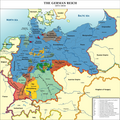
Image 11The constituent states of the German Empire (a federal monarchy). Various states were formally suzerain to the emperor, whose government retained authority over some policy areas throughout the federation, and was concurrently King of Prussia, the empire's largest state. (from Non-sovereign monarchy)
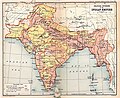
Image 12British India and the princely states within the Indian Empire. The princely states (in yellow) were sovereign territories of Indian princes who were practically suzerain to the Emperor of India, who was concurrently the British monarch, whose territories were called British India (in pink) and occupied a vast portion of the empire. (from Non-sovereign monarchy)
This is a list of recognized content, updated weekly by JL-Bot (talk·contribs) (typically on Saturdays). There is no need to edit the list yourself. If an article is missing from the list, make sure it is tagged or categorized (e.g. Category:Royalty and nobility articles) correctly and wait for the next update. See WP:RECOG for configuration options.


.svg)


._Berlin,_Pergamon_Museum._(5256233048).jpg)




.jpg)




.jpg)


.jpg)


.jpg)


-en.png)

.jpg)


.jpg)


,_rev%C3%AAtu_du_grand_costume_royal_en_1779_-_Google_Art_Project.jpg)
.jpg)

_-_Google_Art_Project.jpg)


.jpg)
_(restoration).jpg)


_-_Prado.jpg)

_R%C3%A1k%C3%B3czi_(1593-1648)_-_Rembrandt_van_Rijn_%26_Jan_Gillisz._van_Vliet.jpg)


.jpg)


,_dit_le_Grand_Dauphin_-_Google_Art_Project.jpg)


.jpg)


.jpg)
_(restoration).jpg)
.jpg)


_-_Bildnis_einer_vornehmen_s%C3%A4chsischen_Dame_(1534),_Mus%C3%A9e_des_Beaux-Arts_de_Lyon.jpg)

_MET_DP320094.jpg)

_-_Google_Cultural_Institute.jpg)

,_Queen_of_Hungary.jpg)


_Cho_Seok-jin_(%E8%B6%99%E9%8C%AB%E6%99%89_1853-1920)_et_(cropped).jpg)
.jpg)
.jpg)


_Amir_of_Afghanistan,_photographed_in_1869_by_John_Burke.jpg)
_-_Google_Art_Project.jpg)
.jpg)


