


| Geography | Projects |
.svg)


Nepal, officially the Federal Democratic Republic of Nepal, is a landlocked country in South Asia. It is mainly situated in the Himalayas, but also includes parts of the Indo-Gangetic Plain. It borders the Tibet Autonomous Region of China to the north, and India to the south, east, and west, while it is narrowly separated from Bangladesh by the Siliguri Corridor, and from Bhutan by the Indian state of Sikkim. Nepal has a diverse geography, including fertile plains, subalpine forested hills, and eight of the world's ten highest mountains, including Mount Everest, the highest point above mean sea level on Earth. Kathmandu is the nation's capital and its largest city. Nepal is a multi-ethnic, multi-lingual, multi-religious, and multi-cultural sovereign state, with Nepali as the official language. (Full article...)

Selected article - show another


Madhesh Province (Nepali: मधेश प्रदेश, romanized: Madhēś pradēś) is a province of Nepal in the Terai region with an area of 9,661 km2 (3,730 sq mi) covering about 6.5% of the country's total area. It has a population of 6,114,600 as per the 2021 Nepal census, making it Nepal's most densely populated province and the smallest province by area. It borders Koshi Pradesh to the east and the north, Bagmati Province to the north, and India’s Bihar state to the south and the west. The border between Chitwan National Park and Parsa National Park acts as the provincial boundary in the west, and the Kosi River forms the provincial border in the east. The province includes eight districts, from Parsa in the west to Saptari in the east. It is a centre for religious and cultural tourism. (Full article...)
👁 Image
Good article - show another


Nepal sent a delegation to compete at the 2016 Summer Paralympics in Rio de Janeiro, Brazil, from 7–18 September 2016. This was the fourth time the nation had taken part in a Paralympic Games following its first appearance at the 2004 Summer Paralympics. Nepal was represented by two athletes in Rio de Janeiro: sprinter Bikram Rana and short-distance swimmer Laxmi Kunwar, who both qualified for the Paralympics by using wild card spots for their respective sports. Neither athlete advanced beyond the first round of their respective events as they both finished 17th overall in their competitions. (Full article...)
Selected picture - show another


The Ganges, is a trans-boundary river of Asia which flows through India and Bangladesh. The 2,525 km (1,569 mi) river rises in the western Himalayas in the Indian state of Uttarakhand, and flows south and east through the Gangetic Plain of North India into Bangladesh, where it empties into the Bay of Bengal. It is the third largest river by discharge.
Selected biography - show another
.png)
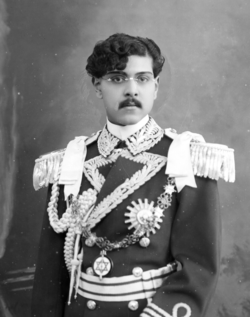
Tribhuvan Bir Bikram Shah Dev (30 June 1906 – 13 March 1955) was King of Nepal from 1911 until his death in 1955, excluding a brief period of exile between November 1950 and January 1951.
Born in Kathmandu, the capital city of Nepal, he ascended to the throne at the age of five, upon the death of his father, Prithvi Bir Bikram Shah, and was crowned on 20 February 1913 at the Nasal Chowk, Hanuman Dhoka Palace in Kathmandu, with his mother acting as regent. At the time of his coronation, the position of monarch was largely ceremonial, with the Rana dynasty exercising de facto power. (Full article...)
Selected fare or cuisine - show another
Newa cuisine/नेवा: नसा (also referred to as Newari cuisine) is a subset of Nepalese cuisine that has developed over centuries among the Newars of the Nepal Mandala region in Nepal. Newa cuisine is more elaborate than most Nepalese cuisines because the Kathmandu Valley has exceptionally fertile alluvial soil and enough wealthy households to make growing produce more profitable than cultivating rice and other staples.
Food is an integral part of the Newar culture. Dishes served during feasts and festivals have symbolic significance. (Full article...)
List of fare/cuisine articles
|
|---|
Did you know - show another
- ... that according to legend, Swayambhunath, one of the oldest stupas in Nepal, came out of a sacred lotus at the centre of Kathmandu when the city was a lake?
- ... that construction of the 195 m (640 ft) Gorkha Bridge in Nepal reconnected seven remote villages and reestablished a portion of a popular hiking trail?
Wiki Loves Nepal


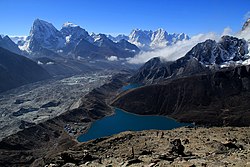


Wiki Loves Earth is an international photographic competition to promote natural heritage sites around the World through Wikimedia projects (mainly Wikipedia and Wikimedia Commons).
- 2018 • 2017 • 2016 • 2015 • 2014 • More information • Main category page

Wiki Loves Monuments is an international photographic competition to promote cultural monuments around the World through Wikimedia projects (mainly Wikipedia and Wikimedia Commons.
- 2017 • 2016 • 2015 • 2014 • 2013 • More information • Main category page
General images - show another
The following are images from various Nepal-related articles on Wikipedia.
-
The old king's palace on a hill in Gorkha (from History of Nepal)
-
Procession of Nepali Pahadi Hindu Wedding (from Culture of Nepal)
-
Procession of Nepali Hindu Wedding (from Culture of Nepal)
-
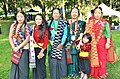
👁 Image 5Women in cultural costume at Ubhauli Kirati festival 2017 at Gough Whitlam Park, Earlwood (from Culture of Nepal)Women in cultural costume at Ubhauli Kirati festival 2017 at Gough Whitlam Park, Earlwood (from Culture of Nepal)
-
A 1905 painting of Nepalese woman (from Culture of Nepal)
-
Nepali Pahadi groom (from Culture of Nepal)
-
A Buddhist monastery in southern Nepal. (from Culture of Nepal)
-
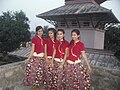
Costumed Hindu girls of Kathmandu during festival time in Nepal (from Culture of Nepal)
-
Nepali Pahadi Hindu marriage at Narayangadh, Chitawan (from Culture of Nepal)
-
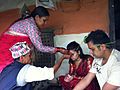
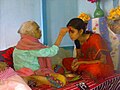
👁 Image 11Senior offering Dashain Tika on great Nepali Hindu festival at a traditional home. (from Culture of Nepal)Senior offering Dashain Tika on great Nepali Hindu festival at a traditional home. (from Culture of Nepal)
-
Senior offering Dashain Tika to junior (from Culture of Nepal)
-
👁 Image 13"Nēpāla" in the late Brahmi script, in the Allahabad Pillar inscription of Samudragupta (350-375 CE). (from History of Nepal)"Nēpāla" in the late Brahmi script, in the Allahabad Pillar inscription of Samudragupta (350-375 CE). (from History of Nepal)
-
A family in a Maoist-controlled valley, 2005 (from History of Nepal)
-
Ascension of King Gyanendra, 2001 (from History of Nepal)
-
Mohar of king Prithvi Narayan Shah dated Saka Era 1685 (CE 1763) (from History of Nepal)
-
👁 Image 17Procession of Nepali Hindu Wedding; Groom being carried by a bride brother or relatives (from Culture of Nepal)Procession of Nepali Hindu Wedding; Groom being carried by a bride brother or relatives (from Culture of Nepal)
-
Nepali traditional Pahadi dress used for dance (from Culture of Nepal)
-
👁 Image 19Statue of the Bodhisattva Avalokiteshvara, gilded bronze, Nepal, 16th century CE (from Culture of Nepal)Statue of the Bodhisattva Avalokiteshvara, gilded bronze, Nepal, 16th century CE (from Culture of Nepal)


.jpg)

.jpg)







.jpg)




Nepal Topics
Categories


Related Portals


.svg)

Religions in Nepal

.svg)

Indian Subcontinent


Other countries


Wikipedias in Nepali languages
Recognized content

.jpg)


_(restoration).jpg)




_4.jpg)

_(restoration).jpg)


,_male,_Gokarna.jpg)


.jpg)

.jpg)


Associated Wikimedia
The following Wikimedia Foundation sister projects provide more on this subject:
-
Commons
Free media repository -
Wikibooks
Free textbooks and manuals -
Wikidata
Free knowledge base -
Wikinews
Free-content news -
Wikiquote
Collection of quotations -
Wikisource
Free-content library -
Wikiversity
Free learning tools -
Wikivoyage
Free travel guide -
Wiktionary
Dictionary and thesaurus


- Portals with triaged subpages from February 2026
- All portals with triaged subpages
- Portals with no named maintainer
- Random portal component with more available subpages than specified max
- Random portal component with 6–10 available image subpages
- Random portal component with 11–15 available subpages
- Portals needing placement of incoming links