


|
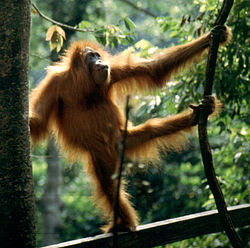
A primate is a member of the biological order Primates, the group that contains lemurs, the aye-aye, lorisids, galagos, tarsiers, monkeys, and apes, with the last category including great apes. With the exception of humans, who inhabit every continent on Earth, most primates live in tropical or subtropical regions of the Americas, Africa and Asia. Primates range in size from the 30-gram (1 oz) pygmy mouse lemur to the 200-kilogram (440 lb) mountain gorilla. According to fossil evidence, the primitive ancestors of primates may have existed in the late Cretaceous period around 65 mya (million years ago), and the oldest known primate is the Late Paleocene Plesiadapis, c. 55–58 mya. Molecular clock studies suggest that the primate branch may be even older, originating in the mid-Cretaceous period around 85 mya. Primates exhibit a wide range of characteristics. Some primates do not live primarily in trees, but all species possess adaptations for climbing trees. Locomotion techniques used include leaping from tree to tree, walking on two or four limbs, knuckle-walking, and swinging between branches of trees (known as brachiation). Primates are characterized by their large brains relative to other mammals. These features are most significant in monkeys and apes, and noticeably less so in lorises and lemurs. Many species are sexually dimorphic, which means males and females have different physical traits, including body mass, canine tooth size, and coloration.
Selected article
Archaeoindris fontoynontii is an extinct, giant lemur and the largest primate known to have evolved on Madagascar, comparable in size to a male gorilla. It belonged to a family of extinct lemurs known as "sloth lemurs" (Palaeopropithecidae), and because of its extremely large size, it has been compared to the extinct ground sloths of North and South America. It was most closely related to Palaeopropithecus, the second largest type of sloth lemur. Along with the other extinct sloth lemurs, Archaeoindris was related to the living indri, sifakas, and woolly lemurs, as well as the recently extinct monkey lemurs (Archaeolemuridae). It probably became extinct recently, around 350 BCE.
Its remains have been found at only one location: Ampasambazimba, a subfossil site in central Madagascar. The skeleton of Archaeoindris was massive and robust, and shared many traits with that of Palaeopropithecus. The arms were longer than the legs, but no hand or foot bones have been found for comparison with the other sloth lemurs. Size estimates based on the limited remains have varied widely, ranging as high as 244.1 kg (538 lb), but the most thorough statistical investigation estimates a mass of 160 kg (350 lb). There are varying opinions about the way Archaeoindris moved in its environment, ranging from tree-dwelling to ground-dwelling. Its skeleton suggests it was a deliberate climber that visited the ground to travel. The diet of Archaeoindris was mostly leaves, and its habitat—prior to human arrival—was a mix of woodlands, bushlands, and savanna, rich in lemur diversity. Although it was a rare lemur, it was still extant when humans first arrived on Madagascar, and it would have been vulnerable to hunting and habitat loss. Selected picture
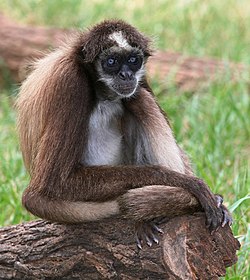
The brown spider monkey, Ateles hybridus, is a species of spider monkey, a type of New World monkey, from South America. It is found in Colombia and Venezuela. Like all spider monkeys, it has very long, spindly limbs and a lengthy prehensile tail which can almost be called a fifth limb. The tail is made up of highly flexible, hairless tips with skin grooves which improves grip on tree branches and is adapted to its strictly arboreal lifestyle. It is currently critically endangered, with few examples of them remaining in the wild. CategoriesSelect [►] to view subcategories
Selected species
👁 Image
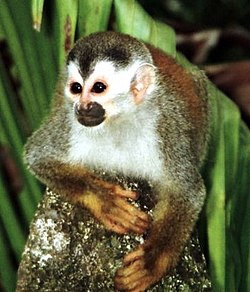
Vulnerable (IUCN 3.1)|Vulnerable The Central American squirrel monkey (Saimiri oerstedii) is a squirrel monkey species from the Pacific coast of Costa Rica and Panama. It is a small monkey with an orange back and a distinctive white and black facial mask. It has an omnivorous diet, eating fruits, other plant materials, invertebrates and some small vertebrates. In turn, it has a number of predators, including raptors, cats and snakes. It lives in large groups that typically contain between 20 and 75 monkeys. It has one of the most egalitarian social structures of all monkeys. Females do not form dominance hierarchies, and males only do so at breeding season. Females become sexually mature at 2½ years, and males at 4 to 5 years. Sexually mature females leave the natal group, but males can remain with their natal group their entire life. The Central American squirrel monkey can live for more than 15 years. Did you know?
Primate lists
WikiProjectsThings to do
Associated Wikimedia
Discover Wikipedia using portals |



.jpg)







- Portals with triaged subpages from February 2020
- All portals with triaged subpages
- Portals with no named maintainer
- Random portal component with 31–40 available subpages
- Random portal component with 6–10 available image subpages
- Random portal component with 26–30 available subpages
- Random portal component with 2–5 available subpages