


.jpg)


The Porto Metro (Portuguese: Metro do Porto) is a light rail network in Porto, Portugal and a key part of the city's public transport system.[4] It runs underground in central Porto and above ground into the city's suburbs while using low-floor tram vehicles.[5][6] The first parts of the system have been in operation since 2002.[7]
The network has 6 lines and reaches seven municipalities within the metropolitan Porto area: Porto, Gondomar, Maia, Matosinhos, Póvoa de Varzim, Vila do Conde and Vila Nova de Gaia. It currently has a total of 85 operational stations across 70 kilometres (43 mi) of double track commercial line. Most of the system is at ground level or elevated, but 8.3 kilometres (5.2 mi) of the network is underground. The system is run by ViaPORTO.[2][8]
The Porto Metro has received the Veronica Rudge Green Prize in Urban Design from Harvard University's Graduate School of Design in 2013.[9]
History
[edit]During the 1990s, political leaders started advocating for a partially underground electrified railway transport system to service the city of Porto and the surrounding municipalities. This culminated in the founding of Metro do Porto S.A. in 1993 and the start of planning and construction of the first expansion phase of the Porto Metro. This first phase was deemed completed in 2006 and saw the creation of lines A, B, C, D and E.[10][11]
The project included the conversion of sections of the narrow gauge railway lines of Linha do Porto à Póvoa e Famalicão and Linha de Guimarães, including the section between Senhora da Hora and Trindade nowadays shared by 5 different lines. In 2001, train services came to an end as construction started.[12]
Line A (blue line) was the first line to open on 7 December 2002, running between Senhor de Matosinhos and Trindade in central Porto. On 5 June 2004, the line was extended to Estádio do Dragão, Porto's largest football stadium, in time for the Euro 2004 Football championship.[10]
On 3 March, 2005, Line B (red line) opened between Estádio do Dragão and Pedras Rubras [pt]. The remaining section between Pedras Rubras and Póvoa de Varzim was opened a year later in March 2006. This line replaced the Linha do Porto à Póvoa e Famalicão, a narrow gauge railway between Porto and Póvoa de Varzim.[10] The section between Póvoa de Varzim and Famalicão had already been closed in 1995 and was not included in the project. Instead, it got decommissioned and converted into a bicycle trail.[12][13] In July 2017, an infill station called VC Fashion Outlet - Modivas [pt] was added.[10][14]
.jpg)

Line C (green line) opened on July 30, 2005, until Fórum da Maia [pt] in the centre of Maia and was extended until ISMAI in March 2006.[10] Line C was built using part of the Guimarães line between Senhora da Hora and ISMAI. A section of this railway line between ISMAI and Lousado was decommissioned and expected to be serviced by the Porto Metro until Trofa, but as of 2024 it was only serviced by busses.[15] The Guimarães line continued to have train services from Lousado via Linha do Minho.[12]
Line D (yellow line) proved the most problematic to excavate[citation needed] and opened on 17 September 2005 between Câmara de Gaia in Vila Nova de Gaia and Pólo Universitário in the north. In the northern end, the São João Hospital and IPO stations, were not brought into service until March 2006 due to safety concerns[citation needed]. In the southern end, the line was expanded until D. João II [pt] in May 2008 and then to Santo Ovídio in October 2011.[10] In June 2024, the line was extended southwards by 3.15km with three new stations added, Manuel Leão, Hospital Santos Silva and Vila d'Este.[16]
Line E (violet line) opened on May 27, 2006, connecting the Airport Francisco Sá Carneiro and Campanhã.[10] Several weeks later, the line was extended to Estádio do Dragão.[citation needed]
Line F (orange line) opened on January 2, 2011, connecting the Porto city centre to the Gondomar region in the east, this line runs between Senhora da Hora and Fânzeres.[10][17]
The Metro do Porto company managed and operated the Funicular of Guindais between 2004 and 2019. Management was transferred to Porto municipality in 2019 and to a municipal company called STCP Serviços in 2022.[10][18][19]
Corporate affairs
[edit]Key figures
[edit]Between 2016 and 2023, the number of yearly passengers using the Porto Metro system has gradually increased, with the exception of the years affected by the COVID-19 pandemic. On the supply side, the number of yearly train trips has varied, and as of 2023 it had not recovered to the peak of 370,000 in 2019. Porto Metro's punctuality is high, bottoming out at 93% in 2019.[20] Investment increased from 2021 onward, when construction started on Line G and on the expansion of Line D.[20][21][22]
| 2016 | 2017 | 2018 | 2019 | 2020 | 2021 | 2022 | 2023 | |
|---|---|---|---|---|---|---|---|---|
| Passengers (M) | 58 | 61 | 63 | 71 | 39 | 42 | 65 | 79 |
| Passenger km (M) | 297 | 312 | 321 | 376 | 204 | 217 | 348 | 425 |
| Train trips (k) | 353 | 352 | 341 | 370 | 307 | 310 | 342 | 355 |
| Train km (M) | 5.2 | 5.3 | 5.1 | 5.4 | 4.6 | 4.5 | 5 | 5.2 |
| Punctuality (%)[a] | 100% | 100% | 97% | 93% | 95% | 98% | 99% | 97% |
| Investment (€M)[b] | 0 | 0 | 1.8 | 3 | 2.5 | 43 | 98.5 | 83.2 |
| Source: Autoridade da Mobilidade e dos Transportes[20] | ||||||||
Costs and financial results
[edit]This section needs to be updated. Please help update this article to reflect recent events or newly available information. (February 2025) |

As of 2007, the total cost of the Porto Metro public transport system stands at 3.5 billion euros - over 1% of Portugal's GDP. The first phase of the project alone, which was led by the mayors of several Grande Porto (Greater Porto) municipalities including Valentim Loureiro as a chairman of the state-owned company, was 140% more expensive than initially planned – a slippage of over 1,5 billion euros. The Porto Metro state-owned company has reported losses every year, reaching a record loss of 122 million euros in 2006.[23][24]
Rolling stock
[edit]

The Metro uses 72 modern Eurotram low-floor, articulated trams. Flexity Swift LRVs are used on line B, Bx and line C since 2008, and can reach 100 km/h (62.1 mph). They also have more seats, and can, in common with most modern light rail systems, recover 30% of the total of consumed energy during braking.[citation needed] The LRVs from CRRC Tangshan, dubbed CRRC Tram or CT,[25] are the latest to be introduced on the network, running since 2023 on line C and E.[26]
The majority of services run with two LRVs coupled together. The Eurotram consists of four main compartments, two in each carriage linked by short corridors, and also features an articulation between the two carriages. They have a capacity of 80 seated and 134 standing passengers. The Flexity Swift consists of three components linked by articulations, with a capacity of 100 seated and 148 standing passengers. The CT consists of four articulated components, having a capacity of 244 passengers, 64 of which are seated.[27]
Tickets
[edit]

The system uses the "Andante" ticketing system, used for public transport in the Porto Metropolitan Area. Under this system, a ticket holder can use multiple modes of transportation by various providers within a certain time period. Ticket prices and single ticket duration can vary depending on the number of zones that the ticket includes. The Andante system divides the Porto metropolitan area into fare zones, each representing a geographic area. The number of zones required is determined by the traveler's starting zone. A Z2 ticket allows the traveler go to all adjacent zones. A Z3 ticket lets the traveler go to all adjacent zones and to all zones adjacent to those.[28][29][30]
Various ticketing options exist to use the Porto Metro. Paper tickets called Blue Andante (Andante azul) can be bought and recharged in machines in stations. These can be charged with single trips or 24 hour tickets. Monthly passes called Silver Andante (Andante prateado) can be purchased in Lojas Andante (Andante Shops) and topped up at Multibanco ATM terminals. They are personalized PVC cards with the name and picture of the holder. They are free for students between the ages of 4 and 18 and discounts exist for families, seniors, veterans and lower income households. Other ticketing options under the Andante system include Andante Tour, a 24 or 78 hour ticket for tourists, the Anda App, an app available for Android and contactless card payments on some readers. Children under 4 years old do not require a ticket if they are accompanied by an adult.[28][29]
The Porto Metro operates on a proof-of-payment system. Tickets must be validated before travel by scanning them in front of the yellow machines located in stations. Instead, groups of fare inspectors randomly check tickets with hand-held scanners. As of October 2024, the penalty for travelling without a validated ticket is €95.[31]
Network
[edit]| 👁 Porto Metro Metro do Porto | |||||
|---|---|---|---|---|---|
| Line | Length | Stations | Opened | Equipment | |
| 👁 Porto Metro |
Estádio do Dragão – Senhor de Matosinhos | 15.6 km (9.7 mi) |
23 | 7 December 2002 | Bombardier Flexity Outlook (Eurotram) |
| 👁 Porto Metro |
Estádio do Dragão – Póvoa de Varzim | 33.6 km (20.9 mi) |
36 | 13 March 2005 | Bombardier Flexity Swift |
| 👁 Porto Metro |
Campanhã – ISMAI | 19.6 km (12.2 mi) |
24 | 30 July 2005 | |
| 👁 Porto Metro |
Hospital São João – Vila d'Este | 9.2 km (5.7 mi) |
19 | 18 September 2005 | Bombardier Flexity Outlook (Eurotram) |
| 👁 Porto Metro |
Trindade – Aeroporto | 13.1 km (8.1 mi) |
21 | 27 May 2006 | |
| 👁 Porto Metro |
Fânzeres – Senhora da Hora | 17.4 km (10.8 mi) |
24 | 2 January 2011 | |
| 👁 Porto Metro |
Casa da Música – São Bento | 2.7 km (1.7 mi) |
4 | To open by early 2027[32] | Bombardier Flexity Outlook (Eurotram) |
| 👁 Porto Metro |
Casa da Música – Santo Ovídio | 6.3 km (3.9 mi) |
8 | To open by late 2026 | |
| Metrobus 👁 Image | |||||
| 👁 Image |
Casa da Música – Império | 3.7 km (2.3 mi) |
7 | 28 February 2026[33] | Hydrogen cell bus |
| 👁 Image |
Casa da Música – Anémona | 6.0 km (3.7 mi) |
9 | August 2026[34] | Hydrogen cell bus |


Line A – Senhor de Matosinhos – Estádio do Dragão
[edit]Line A | ||||||||||||||||||||||||||||||||||||||||||||||||||||||||||||||||||||||||||||||||||||||
|---|---|---|---|---|---|---|---|---|---|---|---|---|---|---|---|---|---|---|---|---|---|---|---|---|---|---|---|---|---|---|---|---|---|---|---|---|---|---|---|---|---|---|---|---|---|---|---|---|---|---|---|---|---|---|---|---|---|---|---|---|---|---|---|---|---|---|---|---|---|---|---|---|---|---|---|---|---|---|---|---|---|---|---|---|---|---|
| ||||||||||||||||||||||||||||||||||||||||||||||||||||||||||||||||||||||||||||||||||||||


_(5760545159).jpg)

Line A or the Blue Line is the earliest of the five Porto Metro lines and the second busiest line as of 2023, transporting 12 million passengers.[10][20] It runs between Senhor de Matosinhos and Estádio do Dragão stations, with 21 intermediate stations. Services run every 12 to 15 minutes with an end to end travel time of approximately 40 minutes.[10][35][36]
Between Trindade and Senhora da Hora stations, the line uses the inner part of the route of the old Porto to Póvoa de Varzim railway line. Between Trindade and Estádio do Dragão stations it uses a new tunneled alignment, whilst between Senhora da Hora and Senhor de Matosinhos stations it mostly uses a new surface alignment, albeit with short sections coinciding with the route of the Matosinhos branch railway. Flexity Outlook Eurotrams number 001–072 service the line.[citation needed]
Line B/Bx – Póvoa de Varzim – Estádio do Dragão
[edit]Line B/Bx | |||||||||||||||||||||||||||||||||||||||||||||||||||||||||||||||||||||||||||||||||||||||||||||||||||||||||||||||||||||||||||||||||||||||||||||||
|---|---|---|---|---|---|---|---|---|---|---|---|---|---|---|---|---|---|---|---|---|---|---|---|---|---|---|---|---|---|---|---|---|---|---|---|---|---|---|---|---|---|---|---|---|---|---|---|---|---|---|---|---|---|---|---|---|---|---|---|---|---|---|---|---|---|---|---|---|---|---|---|---|---|---|---|---|---|---|---|---|---|---|---|---|---|---|---|---|---|---|---|---|---|---|---|---|---|---|---|---|---|---|---|---|---|---|---|---|---|---|---|---|---|---|---|---|---|---|---|---|---|---|---|---|---|---|---|---|---|---|---|---|---|---|---|---|---|---|---|---|---|---|---|
| |||||||||||||||||||||||||||||||||||||||||||||||||||||||||||||||||||||||||||||||||||||||||||||||||||||||||||||||||||||||||||||||||||||||||||||||


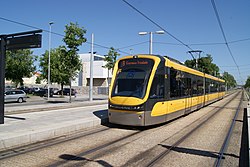
Line B or the Red Line runs between Póvoa de Varzim and Estádio do Dragão stations, has 34 intermediate stations and is the longest line of the system. Because of its length, the line provides two types of services: B and Bx.[35] The line reuses, for almost its entire length, the route of the old Porto to Póvoa de Varzim railway line.[10]
The regular B service stops at all stations, whilst the express Bx service stops only at principal stations between Póvoa de Varzim and Senhora da Hora and at all station between Senhora da Hora and Estádio do Dragão. On weekdays during the day, each service provide two trams per hour in each directions. During weekends and in the evenings only the B service runs twice or thrice per hour in each directions. The regular service takes just over an hour between Póvoa de Varzim and Estádio do Dragão, while the express service saves approximate 10 minutes.[35][37]
Although no extensions are planned, consideration was given to use the abandoned Famalicão branch of the old Póvoa Line, converted to a cycle path after closure, to reach Mourões and Barreiros, near Avenida 25 de Abril.[citation needed]
Line C – ISMAI – Campanhã
[edit]Line C | |||||||||||||||||||||||||||||||||||||||||||||||||||||||||||||||||||||||||||||||||||||||||||||||||
|---|---|---|---|---|---|---|---|---|---|---|---|---|---|---|---|---|---|---|---|---|---|---|---|---|---|---|---|---|---|---|---|---|---|---|---|---|---|---|---|---|---|---|---|---|---|---|---|---|---|---|---|---|---|---|---|---|---|---|---|---|---|---|---|---|---|---|---|---|---|---|---|---|---|---|---|---|---|---|---|---|---|---|---|---|---|---|---|---|---|---|---|---|---|---|---|---|---|
| |||||||||||||||||||||||||||||||||||||||||||||||||||||||||||||||||||||||||||||||||||||||||||||||||
.jpg)
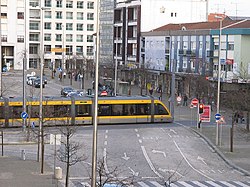
Line C or the Green Line runs between ISMAI and Campanhã stations, with 22 intermediate stations. The line has a basic frequency of four trams per hour, but some trams on the line terminate at Fórum da Maia [pt]. Travel time between ISMAI and Campanhã stations is just over 40 minutes.[35][38]
The line reuses part of the route of the old Porto to Guimarães railway line, albeit with a significant section of new alignment through the city of Maia.[10] Line C was originally projected to service the city of Trofa, previously served by this railway line. While, this project was never pursued, the Porto Metro provides a bus link between the ISMAI and Trofa.[15][35][39][40]
Line D – Vila d'Este – Hospital São João
[edit]Line D | |||||||||||||||||||||||||||||||||||||||||||||||||||||||||||||||||||
|---|---|---|---|---|---|---|---|---|---|---|---|---|---|---|---|---|---|---|---|---|---|---|---|---|---|---|---|---|---|---|---|---|---|---|---|---|---|---|---|---|---|---|---|---|---|---|---|---|---|---|---|---|---|---|---|---|---|---|---|---|---|---|---|---|---|---|---|
| |||||||||||||||||||||||||||||||||||||||||||||||||||||||||||||||||||


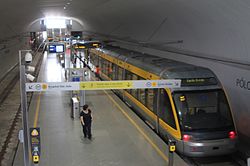
Line D or the Yellow Line runs between Vila d'Este and Hospital São João stations, with 17 intermediate stations and a very visible crossing of the River Douro on the upper level of the iconic Dom Luís I bridge.[35] As of 2023, it was the busiest line of the Porto Metro, transporting a total of 30 million passengers across 106,500 train trips throughout the year.[20]
Line D runs on an entirely new alignment, partly on the surface and partly underground, separate from all the other lines of the Porto Metro. It connects with lines A, B, C, E and F at Trindade station. Between Hospital São João and Santo Ovídio stations the service runs every 5 to 6 minutes during workdays, or every 10 minutes on weekends and evenings. Half of the trams have a southern terminus at Santo Ovídio, thus frequency is halves in the rest of the line until Vila d'Este. The travel time for the whole line is just over 30 minutes.[35][41]
Line E – Aeroporto – Trindade (– Estádio do Dragão)
[edit]Line E | |||||||||||||||||||||||||||||||||||||||||||||||||||||||||||||||||||||||||
|---|---|---|---|---|---|---|---|---|---|---|---|---|---|---|---|---|---|---|---|---|---|---|---|---|---|---|---|---|---|---|---|---|---|---|---|---|---|---|---|---|---|---|---|---|---|---|---|---|---|---|---|---|---|---|---|---|---|---|---|---|---|---|---|---|---|---|---|---|---|---|---|---|---|
| |||||||||||||||||||||||||||||||||||||||||||||||||||||||||||||||||||||||||

.jpg)

Line E or the Violet Line runs between Aeroporto and Trindade stations, with 13 intermediate stations. Trams run as far as Trindade every 15 minutes, with a journey time of around 30 minutes. Depending on day and time, between one and three trams an hour continue beyond Trindade to Estádio do Dragão, serving a further four intermediate stations and taking about 10 more minutes.[35][42]
Line E was specifically built to serve Porto Airport, and Aeroporto station is directly accessible from the terminal building. The station is at the end of a short branch off line B of the Metro, which it joins at Verdes station [pt], sharing tracks variously with lines A, B, C and F for the rest of its route.[10][35]
Line F – Fânzeres – Senhora da Hora (– Senhor de Matosinhos)
[edit]Line F | ||||||||||||||||||||||||||||||||||||||||||||||||||||||||||||||||||||||||||||||||||||||||||||||||
|---|---|---|---|---|---|---|---|---|---|---|---|---|---|---|---|---|---|---|---|---|---|---|---|---|---|---|---|---|---|---|---|---|---|---|---|---|---|---|---|---|---|---|---|---|---|---|---|---|---|---|---|---|---|---|---|---|---|---|---|---|---|---|---|---|---|---|---|---|---|---|---|---|---|---|---|---|---|---|---|---|---|---|---|---|---|---|---|---|---|---|---|---|---|---|---|---|
| ||||||||||||||||||||||||||||||||||||||||||||||||||||||||||||||||||||||||||||||||||||||||||||||||


Line F or the Orange Line runs between Fânzeres and Senhora da Hora stations, stopping at 22 additional stations and taking approximately 40 minutes. Trams depart as frequently as every 12 minutes during weekdays, and as little as every 30 minutes during the evenings.[41][43]
It is expected that the line will be extended from Senhora da Hora to Senhor de Matosinhos, which is the current teminus of Line A. This extension is shown on new official network maps of the Porto Metro, but as of February 2025 it has not been incorporated into the official timetable.[43][44]
Besides the shared segment between Senhora da Hora and Estádio do Dragão, Line F runs mainly above ground. It is the only service operating in the municipality of Gondomar, and it transported 9 million people in 2024.[20]
Line 1 MetroBus – Casa da Música – Império
[edit]MetroBus Line 1 | |||||||||||||||||||||
|---|---|---|---|---|---|---|---|---|---|---|---|---|---|---|---|---|---|---|---|---|---|
| |||||||||||||||||||||


Line 1 is a Bus rapid transit, called MetroBus, which opened for service on 28 February 2026, between Casa da Música and Império Square, run by hydrogen cell buses, that is managed by Porto Metro.[33] It stops at seven stations, with MetroBus departures with a frequency of 10 minutes during weekdays and rush hours, and 15 minutes during the weekend.[45]
Future expansion
[edit]MetroBus Line 2 | |||||||||||||||||||||||||||
|---|---|---|---|---|---|---|---|---|---|---|---|---|---|---|---|---|---|---|---|---|---|---|---|---|---|---|---|
| |||||||||||||||||||||||||||
Line G | ||||||||||||
|---|---|---|---|---|---|---|---|---|---|---|---|---|
| ||||||||||||


Line H | ||||||||||||||||||||||||
|---|---|---|---|---|---|---|---|---|---|---|---|---|---|---|---|---|---|---|---|---|---|---|---|---|
| ||||||||||||||||||||||||

- Metrobus line 2: A Bus rapid transit line is expected to open for service by August 2026, between Casa da Música and Anémona, in Matosinhos, also run by hydrogen cell buses.[34]
- Line G (Pink line): A new 2.7km, 4 station fully underground line which connects Casa da Música to São Bento through Cordoaria.[46] The construction started in 2020 and Porto Metro expects it to be concluded by early 2027.[21][47][48][32]
- Line H (Ruby line): A new 6.74km, 8 station line that will connect Casa da Música station in Porto with Santo Ovídio station in Vila Nova de Gaia. Construction started in May 2024 with the line planned to enter service, partially, by late 2026.[49][50][51]
See also
[edit]


- Trams in Porto
- Sociedade de Transportes Colectivos do Porto (STCP)
- Lisbon Metro
- List of tram and light rail transit systems
References
[edit]- ^ a b "Metro do Porto supera as 94 milhões de validações em 2025" [Porto Metro surpasses 94 million validations in 2025]. Observador (in European Portuguese). 2026. Retrieved 29 March 2026.
- ^ a b "Relatório E Contas" [Report and Accounts] (PDF) (in Portuguese). Metro do Porto. 2023. Archived (PDF) from the original on 18 August 2024. Retrieved 18 August 2024.
- ^ Schwandl, Robert. "UrbanRail.Net > Europe > Porto > Porto Metro". Archived from the original on 4 December 2024. Retrieved 4 December 2024.
- ^ Ashton, J.H. (10 August 2018). "An Ergonomic Study and Analysis for the Porto Metro Driver Cabin Area". Proceedings of the 20th Congress of the International Ergonomics Association (IEA 2018). VII (Ergonomics in Design, Design for All, Activity Theories for Work Analysis and Design, Affective Design). Springer: 193. ISBN 978-3-319-96071-5. Retrieved 9 August 2024.
- ^ Trikkestrategi (in Norwegian) (4 ed.). Oslo: Ruter As. 2011. p. 46.
- ^ "Sistema de Metro Ligeiro do Porto" [Porto's Light Rail System] (in European Portuguese). Archived from the original on 6 January 2025. Retrieved 21 March 2024.
- ^ Webb, Mary (ed.) (2009). Jane's Urban Transport Systems 2009–2010, p. 277. Coulsdon, Surrey (UK): Jane's Information Group. ISBN 978-0-7106-2903-6.
- ^ "Metro em números" [Metro in numbers]. Metro do Porto (in European Portuguese). Archived from the original on 24 September 2024. Retrieved 18 August 2024.
- ^ "Veronica Rudge Green Prize in Urban Design". gsd.harvard.edu. Archived from the original on 23 June 2024. Retrieved 16 October 2024.
- ^ a b c d e f g h i j k l m n "História" [History] (in European Portuguese). Metro do Porto, SA. Archived from the original on 4 December 2024. Retrieved 4 December 2024.
- ^ Avaliação do impacto global da 1ª fase do projecto do Metro do Porto [Evaluation of the global impact of the first phase of the Porto Metro project] (PDF) (in European Portuguese). Vol. 2. March 2008. p. 3.
- ^ a b c Trofa, O. Notícias da (31 December 2023). "A linha de Guimarães "nasceu" na Trofa há 140 anos" [The Guimarães line was "born" in Trofa 140 years ago]. O Notícias da Trofa (in European Portuguese). Retrieved 18 August 2024.
- ^ "Ecopista de Famalicão" [Famalicão Eco-Track]. IP Património. Retrieved 18 August 2024.
- ^ "Metro do Porto vai ter nova Estação em Modivas Norte" [Porto Metro will have a new station in Modivas Norte]. Metro do Porto (in European Portuguese). 1 July 2016. Retrieved 18 August 2024.
- ^ a b "Horários ISMAI-Trofa" (PDF).
- ^ Amorim, Miguel (28 June 2024). "É oficial: o metro chegou a Vila d'Este" [It's official: the metro arrived in Vila d'Este]. Jornal de Noticias (in European Portuguese). Retrieved 11 February 2025.
- ^ "Metro do Porto celebra 20 anos. Ainda se lembra como tudo começou?" [Porto Metro celebrates 20 years. Do you still remember how it all started?]. SAPO Viagens (in European Portuguese). Lusa. 6 December 2022. Retrieved 11 February 2025.
- ^ "Câmara aprova delegação de competências na STCP Serviços" [Municipality approves delegation of powers to STCP Serviços]. www.porto.pt (in European Portuguese). 7 February 2022. Retrieved 25 October 2024.
- ^ "Funicular dos Guindais no Porto encerrado por tempo indeterminado" [Guindais Funicular in Porto closed indefinitely]. Correio da Manhã Canadá (in European Portuguese). 1 April 2022. Retrieved 28 October 2024.
- ^ a b c d e f "Metro do Porto". observatorio.amt-autoridade.pt (in Portuguese). Archived from the original on 11 December 2024. Retrieved 5 February 2025.
- ^ a b Silva, Ana Fernandes; Quesado, João Pedro (4 February 2025). "Linha Rosa pronta em julho? Metro do Porto não comenta previsão de Rui Moreira" [Pink Line ready in July? Porto Metro does not comment on Rui Moreira's forecast]. Rádio Renascença (in European Portuguese). Retrieved 5 February 2025.
- ^ Jesus, João (1 July 2024). "Novo troço da Linha Amarela inaugurado. Linha Rosa prometida para daqui a um ano" [New section of the Yellow Line opened. Pink Line promised for a year from now]. JPN (in European Portuguese). Retrieved 5 February 2025.
- ^ "Gestores do Metro do Porto recebem €650 mil de prémios". Expresso newspaper (in Portuguese). 18 February 2006. Retrieved 1 March 2007.[permanent dead link]
- ^ Pereira, Sónia Santos; Oliveira, Sílvia de; Freire, Tiago (7 March 2007). "Metro do Porto fechou exercício com resultado negativo de 122 milhões de euros" [Porto Metro closed the financial year with a negative result of 122 million euros]. Diário Económico (in European Portuguese). Archived from the original on 29 September 2011. Retrieved 7 March 2007.
- ^ "Já chegou o novo Metro" [The new metro has already arrived]. Metro do Porto (in European Portuguese). 23 December 2022. Retrieved 31 March 2024.
- ^ Cruz, Hermana (12 December 2023). "Passageiros rendidos ao "luxo" dos novos assentos do metro do Porto" [Passengers surrendered to the "luxury" of the new seats on the Porto metro]. Jornal de Notícias. Retrieved 31 March 2024.
- ^ Larguesa, António (6 December 2023). "Novo metro chinês do Porto faz viagem inaugural com Costa a bordo" [Porto's new Chinese metro takes maiden voyage with Costa on board]. ECO (in European Portuguese). Lusa. Retrieved 31 March 2024.
- ^ a b "Fares". Metro do Porto. Retrieved 25 October 2024.
- ^ a b "Purchase". Andante. Retrieved 25 October 2024.
- ^ "Zones". Andante. Retrieved 25 October 2024.
- ^ "Faq's". Metro do Porto. Retrieved 25 October 2024.
- ^ a b "Linha Rosa do Metro do Porto estará operacional até março de 2027" (in European Portuguese). Observador. 20 January 2026. Retrieved 2 February 2026.
- ^ a b ""A haver uma avaliação de zero a dez, dou ao metrobus do Porto nota dez"". Jornal de Notícias. 28 February 2026. Retrieved 2 March 2026.
- ^ a b "Metrobus arranca hoje no Porto com fase de adaptação (e grátis) antes da operação regular" (in European Portuguese). Executive Digest. 28 February 2026. Retrieved 2 March 2026.
- ^ a b c d e f g h i Schwandl, Robert. "UrbanRail.Net > Europe > Porto > Porto Metro". Archived from the original on 4 December 2024. Retrieved 4 December 2024.
- ^ "Timetable" (PDF). Metro do Porto, SA. pp. 2–7. Archived (PDF) from the original on 9 December 2024. Retrieved 21 December 2024.
- ^ "Timetable" (PDF). Metro do Porto, SA. pp. 8–13. Archived (PDF) from the original on 9 December 2024. Retrieved 21 December 2024.
- ^ "Timetable" (PDF). Metro do Porto, SA. pp. 14–19. Archived (PDF) from the original on 9 December 2024. Retrieved 21 December 2024.
- ^ "Autarquia aguarda marcação de julgamento sobre extensão do metro à Trofa" [Local authority awaits ruling on metro extension to Trofa]. Diário de Notícias (in Portuguese). 6 December 2018. Retrieved 27 March 2019.
- ^ "Decreto-Lei n.º 394-A/98" [Decree-Law No. 394-A/98]. Diário da República — I série-A (in Portuguese). 15 December 1998. Retrieved 27 March 2019.
- ^ a b "Frequencies" (PDF). Metro do Porto, SA. Archived (PDF) from the original on 26 December 2024. Retrieved 26 December 2024.
- ^ "Timetable" (PDF). Metro do Porto, SA. pp. 20–25. Archived (PDF) from the original on 9 December 2024. Retrieved 9 December 2024.
- ^ a b "Timetable" (PDF). Metro do Porto, SA. pp. 26–31. Archived (PDF) from the original on 9 December 2024. Retrieved 9 February 2025.
- ^ "Network Map" (PDF). Metro do Porto, SA. Retrieved 9 February 2025.
- ^ "Frequência do metrobus do Porto será menor que a anunciada no arranque do projeto" (in European Portuguese). RTP. 26 February 2026. Retrieved 2 March 2026.
- ^ "Mais 6 quilómetros. 7 novas estações. Metro do Porto vai crescer" [Another 6 kilometers. 7 new stations. Porto Metro will grow] (in European Portuguese). Diário de Notícias. 7 February 2017. Retrieved 12 February 2017.
- ^ Vidal, Daniel (7 February 2017). "A nova linha do Metro do Porto vai ligar a Casa da Música a S. Bento" [The new Porto Metro line will connect Casa da Música to S. Bento] (in European Portuguese). NIT. Retrieved 12 February 2017.
- ^ "Nova Linha Rosa pronta a arrancar" [New Pink Line ready to take off] (in European Portuguese). Archived from the original on 30 November 2024. Retrieved 11 February 2025.
- ^ "Desenho da linha Casa da Música/Santo Ovídio já está a concurso" [Tender for designing the line Música/Santo Ovídio is already open]. Metro do Porto (in European Portuguese). 27 April 2021. Archived from the original on 4 December 2023. Retrieved 11 February 2025.
- ^ "A bridge to the future (soon)". Metro do Porto. 16 March 2021. Retrieved 11 February 2025.
- ^ "Linha Rubi deverá começar a funcionar ainda em 2026, mas de forma parcial" (in European Portuguese). JornalismoPortoNet. 18 April 2025. Retrieved 21 June 2025.
External links
[edit]

- Porto Metro Official Homepage
- Official website for the ticketing system
- Map of the Porto Metro network (.pdf file)
- Metro do Porto news archive
- Photos of Metro do Porto's station architecture
- Flickr's Metro do Porto group
- Expansion - 2nd and 3rd phases (Portuguese)
- Porto database / photo gallery and Porto tram list at Urban Electric Transit – in various languages, including English.


- CS1 European Portuguese-language sources (pt-pt)
- CS1 Portuguese-language sources (pt)
- CS1 Norwegian-language sources (no)
- All articles with dead external links
- Articles with dead external links from December 2024
- Articles with permanently dead external links
- Articles with short description
- Short description matches Wikidata
- Use dmy dates from January 2025
- Articles containing Portuguese-language text
- All articles with unsourced statements
- Articles with unsourced statements from August 2024
- Wikipedia articles in need of updating from February 2025
- All Wikipedia articles in need of updating
- Articles with unsourced statements from November 2023
- Articles with unsourced statements from January 2025
- Commons category link is on Wikidata